Showing posts with label vernon. Show all posts

Sunday, October 18, 2015

No KCAL9, that's not what the results mean. Part 4

Okay Bowman, you are confusing me.  How can 101 mg/kg of lead in the soil possibly make it a hazardous waste, but 400 mg/kg in the soil make it acceptable for children to live at?

That don't make no sense!

What makes a physical solid material a hazardous waste for lead is based on the idea that if the lead leaches out at or above 5 mg/L it could get into the groundwater and be consumed above the maximum contaminate level (MCL).
The STLCs and TTLCs, originally proposed in 1978, were intended to identify those wastes that “pose a substantial threat to human health and the environment if not disposed in a controlled and systematic manner.  ...the STLC for lead focused on ingestion of drinking water as the route of exposure, considering the exposure pathway of drinking water derived from groundwater or surface water. The STLC was developed by applying a 100-fold attenuation factor to the maximum contaminant level (MCL) for lead, which was 50 µg of lead/L of drinking water at the time the threshold was developed. (Page 4-4)
What makes soil containing less than 400 mg/kg of lead "not hazardous" is based on a risk assessment related to children and the concentration of lead in the blood.

The idea that 5 mg/L of lead leaching from soil is hazardous is archaic. But it is how the regulations require a determination of "hazardous waste" be met.  Would soil that leaches out 5 mg/L of lead create a hazard for the public - children in particular - ??  I don't know.  My guess is that based on what we know now, probably not.

But you are more interested in why up to 400 mg/kg of lead in the soil is okay for a backyard where children play.

That value of 400 mg/kg is based on a complex risk assessment, which is based on how much lead would increase the blood-lead level in a child:
Briefly, within the context of the §403 risk analysis, individual risks refer to the risks associated with a young child’s exposure to specified levels of environmental-lead. Once environmental-lead levels were specified for each medium, the model-predicted blood-lead concentration at these levels, along with the assumption that blood-lead concentrations have a lognormal distribution with a specified variability, were used to estimate the percentage of children exposed to the specified set of environmental-lead levels that would have elevated blood-lead concentrations (i.e., at or above 10 µg/dL). 
Then, those sets of environmental-lead levels associated with estimated elevated blood-lead percentages of 1%, 5%, and 10%... The IEUBK model was used to identify soil-lead concentrations associated with these elevated blood-lead percentages (at specified dust-lead loadings), while the Rochester multimedia model was used to identify (wipe) dust-lead loadings associated with these elevated blood-lead percentages (at specified soil-lead concentrations).  (source)
Told you it was complex!

California looks at lead a bit differently than the EPA, which offers even more confusion when trying to understand why.
One of California’s hazardous waste standards is the total threshold limit concentration (TTLC). The TTLC for lead is intended to protect receptors from direct exposure, primarily through ingestion, which is the type of exposure of greatest concern with lead and certain sensitive receptors. The TTLC in use today assumes that 1,000 mg/kg is protective of children likely to ingest soil containing lead. However, as shown by the recently developed health-based screening values for soils at school sites and near residential lead-paint sites, soil-lead concentrations that protect children who are exposed to lead in soil range from 255 mg/kg to 400 ppm, depending upon the model and assumptions used. The models and assumptions used to develop these values consider the most recent information regarding the health effects of lead and the exposure likely to occur.
California lowers that threshold to 80 mg/kg for children:
The Department of Toxic Substances Control’s Leadspread model (DTSC, 2007) was used to estimate blood lead concentrations in children. The Leadspread model considers exposure to lead in soil by three pathways: ingestion, re-suspension and inhalation, and dermal contact. The Leadspread model was queried for the soil lead concentrations that would give rise to a 90th percentile estimate of increase in blood lead of 1 µg/dL using the “goal seek” function in Excel
The point of all this is this.  The lead concentrations Randy Paige found using the XL2 XRF are above 400 ppm.  This is concerning, especially if the California model is correct.

What needs to happen now is to look at the blood-lead levels in these children.  That would indicate the potential for health concerns.

No need to scare people with "hazardous waste."  That's a whole different wacky world that does not apply to these folks living in Vernon near the Exide facility.

tl;dr: Stop saying "hazardous waste"!!


Thanks for reading.

Jeff


No KCAL9, that's not what the results mean. Part 3

Is soil that contains 1000 ppm of lead - as detected by a Niton XL2 XRF - a hazardous waste?

Probably not.  But I cannot say for sure without running a TCLP on the soil.

But it contains 100 ppm of lead!  The regulatory limit for lead as a hazardous waste is 5 ppm!  That's 200 times more lead in that soil than a hazardous waste!

Whales are aquatic.  Fish are aquatic.  Whales are not fish.

XL2 XRF reports a ppm for lead.  TCLP reports a ppm for lead.  These ppm results mean two different things.  You cannot use the XL2's ppm to state "hazardous waste."

And here is where it gets really wacky!

The XL2 is telling us a ppm based on surface area and depth.  I do not know how this correlates to a ppm we use in environmental determination of regulatory compliance or cleanup levels.  I am going to assume that the ppm reported aligns with mg/kg - the standard way we discuss ppm when looking at lead in soil.

So let's just accept that a reading of 1000 ppm determined by Randy Paige when using the XL2 in the yard near the bike detected 1000 mg of lead per kg of soil.

1000 mg is 200 times more than 5 mg (the hazardous waste threshold).

Yeah...but..1000 mg per kilogram of soil versus 5 mg per liter of liquid (the leachate).

They do not correlate.  With one exception...

If we were to run a totals constituent analysis on that soil, and we obtained 1000 mg/kg of lead, this would cause us to consider the soil as possibly being a hazardous waste.  This is due to a concept we call "the rule of 20."
If a waste is 100% solid, as defined by the TCLP method, then the results of the total constituent analysis may be divided by twenty to convert the total results into the maximum leachable concentration. This factor is derived from the 20:1 liquid-to-solid ratio employed in the TCLP.
So now we have ourselves a dilemma.

If the ppm reported by the XL2 correlates to a totals analysis result in mg/kg.  1000 ppm detected by the XL2 is way above "the maximum theoretical concentration in the leachate could have" which is 20 times the TC regulatory value of 5 mg/L - or 100 ppm.

If the soil contains less than 100 ppm of lead from a totals analysis, then theoretically, because of the 20 to 1 dilution - it could not leach more than 5 mg of lead per liter of leachate.

Too many numbers Bowman!  Boring!

Okay...so work with me here.  We are told 1000 ppm in the backyard by the bike. Let's assume that 1000 ppm reported by the XL2 meter is the same result we would get if we took a soil sample to a laboratory.  1000 ppm is greater than 100 so we cannot rule out this soil - in this backyard - by this bike - does not meet the definition of a hazardous waste.

Here we get wacky!

The EPA threshold for lead in the soil of residential property is 400 ppm.

But...400 is four times higher than 100 - the theoretical value!  How can the EPA say that up to 400 ppm is a safe level for children?

Because what makes something a hazardous waste relates to risk of a particular health impact and not the health impact that is present.

Confused?


No KCAL9, that's not what the results mean.  Part 4

No KCAL9, that's not what the results mean. Part 2

Using the term "hazardous waste" in this report was done - and I am being qualitative here - to illicit a much more visceral response from readers and that community.

Or, Randy Paige - the reporter - was misinformed about what makes lead in soil a hazardous waste

Or, Randy Paige just completely does not understand what a hazardous waste is and uses the term because he thinks it is appropriate.

The reason I started this blog - and the reason it is called the Wacky World of Waste - is because hazardous waste is, well, wacky.

If you think that calling something a "hazardous waste" somehow elevates it to a new level of concern you would be wrong.

Here are a four examples of hazardous waste:

D001 Ignitable Hazardous Waste -  fire through friction 40 CFR 261.21(a)(2)

and this...

U129 Toxic Waste  - 40 CFR 261.33(f)

and this one...
D001 Ignitable Hazardous Waste - 40 CFR 261.21(a)(3)

and this too...

D003 - Reactive (Flame-less Ration Heater [FRH]) - 40 CFR 261.23(a)(3)

 My mom takes Coumadin as a blood thinner.  Coumadin contains warfarin which is an acutely hazardous waste - P001.

So calling something a hazardous waste means what?

Wacky right?

But let's get back to the soil with lead as a hazardous waste, shall we.


Next post: No KCAL9, that's not what the results mean.  Part 3

No KCAL9, that's not what the results mean. Part 1

Argggggg.

CBS2/KCAL9 rented a device certified by the EPA to provide instant readings of the amount of lead in soil or dust.
If you read any of my posts, you know I get all long-winded about methodology and technique.  I don't want to go that route with this post.  So I will ignore this screenshot from the video:


Now I don't know much about XRF analyzers, but I stayed at a Holiday Inn Express once, so that taught me how to Google.

Google brought me to the Thermo Fisher Scientific Niton Analyzer website - the guys who make the instrument shown in the screenshot.

That looks to be a Niton™ XL2 XRF Analyzer, which, when I click on the link "Which XRF analyzer is right from me?" I am shown this:

Source

The reason I need to ignore that table that shows which instrument is used for what matrix, is because of this statement:
We found levels more than 10 times that amount with so much lead in the soil, it was defined as hazardous waste.
I don't want to split hairs on if the XL2's results are accurate and they should have used an XL2 GOLD for sampling soil.  I don't want to discuss if this reporter - the guy shown using the instrument - was trained to use it.  I will ignore the requirement from Thermo - as detailed by USA Today in a report they did on lead in the soil near smelters - that "to be considered a valid test result...a full 80-second scan had to be completed" because the results shown were under 80 seconds.

I am going to ignore all of that and accept the values the reporter tells us the instrument determined are accurate.

Instead I want to focus on these statements:
...it was defined as hazardous waste.
and this statement:
... contained hazardous-waste levels of lead...
and this:
...we found levels of hazardous waste...
and this:
...was exposed to this hazardous waste.
and this:
...it, too, is defined as hazardous waste.
and this too:
...such high levels of hazardous waste...
What makes soil containing lead a hazardous waste is dependent on the amount of lead that leaches from the soil.  The reporter is using the XL2 for an in situ soil sample that is qualitative, not quantitative.

The instrument reports ppm that is based on this:
The FPXRF instrument measures the metal content of the sample over a surface area of approximately one square centimeter (1 cm2) to a depth of approximately 2 millimeters (2 mm), displaying lead concentration in parts per million (ppm). (US EPA)
To be defined as a hazardous waste, soil containing lead must be tested using a procedure called the "Toxicity Concentration Leaching Procedure (TCLP) which reports the concentration of lead as mg/L.

The reading you get from the XL2 - reported in ppm - does not equate to the concentration you would get running a TCLP on that same soil sample.

You can state we found levels of lead in the soil measured at 1,000 ppm but you cannot state "we found levels of hazardous waste measured at 1,000 ppm."

A determination of hazardous waste is a different animal than reporting a screening level.

And here is where it gets wacky...

Next post: No KCAL9, that's not what the results mean.  Part 2

Saturday, January 4, 2014

If they only had a RCRA permit...Part 7

Does Exide pose an imminent or substantial risk to the community?

The DTSC ordered Exide to cease operation on April 24, 2013 claiming that:
16.1 In a letter dated March 1,2013, the SCAQMD advised Exide that the HRA submitted by Exide in January, 2013 indicates the Facility poses a maximum individual cancer risk (MICR) of 156 in one million for an offsite worker receptor about 300 meters northeast of the Facility (primarily arsenic).
In addition to compromised stormwater piping that Exide self-reported, the HRA values for cancer and non-cancer risk were also used by the DTSC to claim the need immediately shut down operations on the grounds that these two situations met the 25186.2 conditions for DTSC action "necessary to prevent or mitigate an imminent and substantial danger to the public health or safety or the environment."

Assuming that fixing the stormwater pipes corrects and mitigates that issue, does Exide pose a "maximum individual cancer risk" now or at the time of the DTSC notice to cease?

Looking at Exide's HRA:


You will notice that arsenic is the primary contributor to the risk number that was quantified.  In the RRP, Exide states:
Analysis of the HRA results and concurrent research determined that approximately 90 percent of the above-tabulated risks were due to emissions of arsenic from the Hard Lead Ventilation System stack and that the source of that arsenic was the “leakage” of blast furnace process exhaust from its primary ventilation system into hooding served by the Hard Lead Ventilation System.
So if both Exide and the DTSC conclude that arsenic is the chemical of concern for the risk, eliminating or reducing the amount of arsenic put into the air would reduce that risk.  Exide made some modifications to their equipment and went back into the original numbers and recalculated the theoretical risk:
Promptly after AQMD approval of the HRA on March 1, 2013, Exide designed an isolation door on the charge chute to the facility’s blast furnace to minimize the potential for blast furnace process exhaust gases to be drawn into the hooding served by the Hard Lead Ventilation System. This door system was permitted on March 28, 2013, and became operational on April 4, 2013. This door remains closed except to open briefly when charge material is actually being added to the furnace, only a small percentage of the time. (1)
What if instead of calculating a theoretical risk we could agree on something a little bit more quantitative and easier to understand.  Let's makes some assumptions and hold them as true.
  1. Exide should only be held accountable for the risk they pose over background.  That is, if you take Exide out of the equation and there is no difference in the amount of arsenic in the air, then the same risk is still present.  Exide is responsible for what they put in over that baseline.
  2. We will assume that the cancer potency the SCAQMD used for arsenic calculates a risk of 16 in one million for one nanogram per cubic meter of air.
  3. We will assume that the data collected by SCAQMD and reported in this document accurately reflects the actual amount of arsenic in the air near the Exide Vernon facility.
  4. We will assume that April 4, 2013 the facility was in operation with the new controls put in place and on April 24, 2013 operations ceased.
  5. We will assume that "the last week of June" is the 24th of June to indicate when Exide resumed operations.
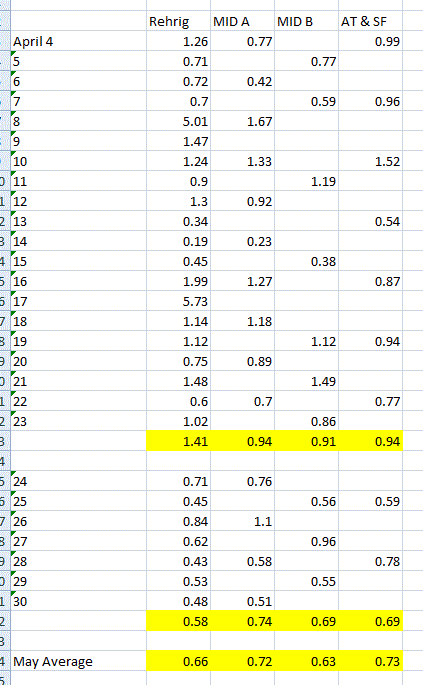
What I am going to do is calculate the average arsenic concentrations for each of the monitors based on the data presented in the SCAQMD document.  I am going to do this for the following periods:
  • April 4 to April 23 (new controls in place)
  • April 24 to June 23 (Exide not in operation - background)
  • June 24 to September 30th (Exide in operation last date for data provided)
I'll attach at the bottom of this post a gif of the spreadsheet I used to show the numbers that went into calculating these three time frames.  Here is what I came up with:


Based on where these monitors are placed...:

SCAQMD

According to SCAQMD's graph:

Source
The SCAQMD states that an average concentration of 1 nanogram per cubic meter equates to a lifetime cancer risk of 16.6 additional cancers.  I am not sure how they calculated that risk because it does not seem to jive with their written methodology for calculating cancer risk.

Based on California's 2003 "Air Toxics Hot Spots Program Risk Assessment Guidelines" the formula for calculating excess cancer risk look like this:

Appendix I - 4
The Inhalation Dose is based on this formula:

Appendix I - 2
Using their arsenic example for calculating the dose...:

Appendix I - 3

...I replaced 0,0015 micrograms with 0.0001 micrograms (1 nanogram).  The inhalation dose, based on 1 ng/m3 equals 3.8 x 10⁻⁸ mg/kg-day

To calculate the cancer risk per million, I replaced the Inhalation dose in the following example with the one calculated based on 1 ng/m3:

Appendix I-4
Based on an exposure of 1 ng/m3 the inhalation cancer risk is 0.45 chances per million.  That number is consistent with the cancer risk calculated by the WHO (0.66). [Cancer Potency checked 2011 most current]

So what does all this mean?

The DTSC gave an immediate cease operation order to Exide based on "imminent and substantial" harm to the public, claiming that:
Based on the Health Risk Assessment submitted to the SCAOMD, DTSC has determined that the Facility is operating its furnaces and its air pollution devices in a manner that is not sufficiently protective of human health and the environment, impacting as many as 110,000 residents in a large geographical area...
The HRA is a theoretical exposure calculated by Exide.  The graph SCAQMD put together represents actual concentrations of arsenic in the air. Before the order to cease operations was given by DTSC the SCAQMD had been collecting arsenic concentrations in the air in and around the Exide facility.

The SCAQMD calculated the highest monthly average of 3.33 ng/m3 from the off-site ATSF in May of 2012.  Assuming that all of that arsenic came from Exide - less the background I calculated (0.75) - this would give us a concentration of 2.58 ng/m3.

2.58 ng/m3 exposure equals a dose of 9.7 x 10⁻⁷.  With that dose, using the California HotSpot calculations, the excess cancer risk would be 11.67 in one million.

Would the highest amount calculated - before the modifications were made - be considered "imminent and substantial"?  That depends on how those two terms are defined.  Here is what the SCAQMD defines as "significant" in their Rule 1402:


Under the rule for air emissions, a cancer risk of 11.67 per one million would equal a risk of 0.11 per one hundred million and would not be considered "significant."

All of this information was available to the DTSC.  Heck if I can find it just using Google and a team of me, myself, and I, so could the DTSC.


Next Post: If they only had a RCRA permit...Part 8


__________________________


Thursday, January 2, 2014

If they only had a RCRA permit...Part 6

April 24, 2013:
A separate report submitted to the South Coast Air Quality Management District by Exide demonstrates that emissions from the facility operations pose a significant risk to the surrounding community.
That's the reason DTSC gave for telling Exide to "CEASE OPERATIONS EFFECTIVE APRIL 24, 2013."

That report, called a "Health Risk Assessment" was required by the SCAQMD and approved by them on March 1, 2013.  The next step was for Exide to make a public notice and develop a Risk Reduction Plan (RRP) which they did on August 28, 2013.

The DTSC, with the data from the HRA - along with the stormwater pipe issues - struck Exide with a cease operations mandate, which Exide challenged and won, starting operations back up on the last week of June, 2013.

That's a nice little history lesson you might be thinking, but what does it have to do with anything?

My question, at this point in time, regards harm or risk to the community around the Exide facility in Vernon.  The public wants it shut down and they are concerned for their health, as the Los Angeles Times wrote October 8, 2013:
Joe Gonzalez of Boyle Heights demanded of regulators: "How dare you come back here and ask us what we want. You're killing us...at what point does this become blatant racism?"
De León, who called the meeting, noted that "there are no Exides in Brentwood ... in Malibu."
"Are our children worth as much as any other child?"
 Does Exide present a "significant risk to the surrounding community."?

Well, I guess that would depend on how one defines the term "significant."

Here is how the SCAQMD defines it:

Rule 1402
What's a MICR?

Rule 1402
What did the DTSC find in the HRA that indicated a "significant risk level?"

Source

Based on the data from the HRA, Exide presents a "significant risk level" for workers but not for the folks who live in the area.

The problem with those numbers; 156 in one million and 22 in one million, is that they are theoretical and based on a model.  Here is what the formula looks like:

Rule 1402


The MICR that is calculated is an estimate based on the premise that the receptor will be exposed to the maximum emission rate every day for a particular length of time (70 years for a residence).  All of this predicated on a calculated annual average concentration for all the chemicals emitted.  Those numbers are then multiplied by this thing they call in California the "Cancer Potency."

Cancer Potency, or the Slope Factor is how we determine that one in a million risk.  I written about it a lot in previous posts.  It assumes a straight line dose-response where no exposure = no cancer and any exposure = risk of cancer.  Remember that SCAQMD graph on arsenic in and around the Exide facility?

Source
Look at the sentence at the bottom.  The cancer potency derived from the slope of the line calculates 16.6 additional lung cancers per million for one nanogram of arsenic in one cubic meter of air inhaled everyday for 70 years.

Let me remind you how small a nanogram is.
  • 1 milligram = 0.001 grams
  • 1 microgram = 0.000001 grams
  • 1 nonogram = 0.000000001 grams
I was curious to how that number was derived.  So I went to the Google and found a document from the World Health Organization (WHO) Regional Office for Europe, Copenhagen, Denmark.
Neutron activation analysis (NAA) has a detection limit of 0.1 ng for total arsenic
Okay, I was wondering how they can detect with any degree of confidence to the nanogram level.

Then I read this in the WHO document:


WHO

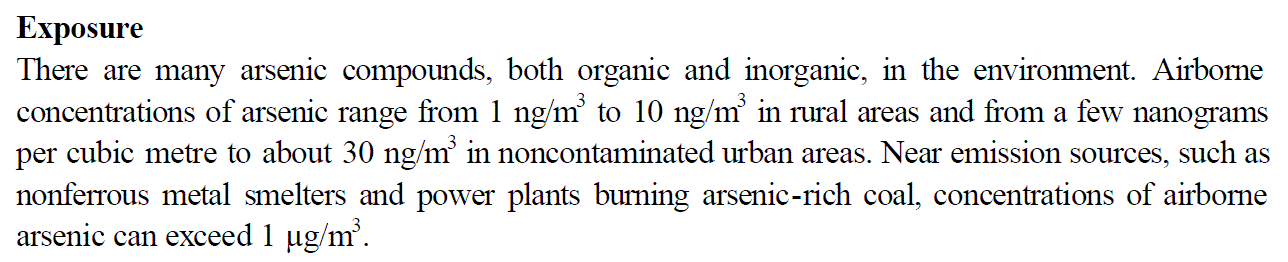
Wait...if the breathing rate is 20 cubic meters a day, and the estimated lower end is 20 ng, that would mean in a rural area the average amount of arsenic in air is about 1 nanogram per cubic meter.  The SCAQMD graph shows the average arsenic in the SCAQMD area to be just above 0.5 nanograms.  I thought that seemed low when I first saw the graph, but now it does not jive with what the WHO states should be found in industrial areas.

But I digress.  Back to slope factors:

WHO
Okay, that's a bunch of words.  What does it all mean?

WHO

The WHO estimates about 2 additional cancers per nanogram while the SCAQMD estimates 16 per nanogram.  That's how this process of looking at cancer risk works.  It's kind-of-sort-of quantitative but how accurate it is in actually determining the real risk is anyone's guess.  So what ever model they use, or data they depend on, once accepted becomes the way it is calculated.  They hope it reflects reality, but really what they want is the most protective model they can "scientifically" support.  The WHO supports 0.66 ng/m3 for a one in one million risk while California supports about 0.06 ng/m3 for the same risk.  Which one is correct?

As I have said before, this is how we do it, this is all we got, so...if you can support your slope factor then I will need to accept your estimated cancer risk.

The problem I have with this as it relates to Exide is that the DTSC used this calculated risk to meet the definition of "significant" which they then used as the reason to tell Exide to cease operation.

That's not what the estimate of risk calculated in the HRA was to be used for, and somebody at the DTSC should have known that.

Those values calculated by Exide and reported in the HRA are used to determine where effort needs to be placed in terms of controls.  This is done through the submission of a Risk Reduction Plan (RRP)

DTSC used those numbers claiming that they required the operation cease to "prevent or mitigate the substantial danger pursuant to Health and Safety Code Section 25186.2."
25186.2.  The department may temporarily suspend any permit, registration or certificate issued pursuant to this chapter prior to any hearing if the department determines that the action is necessary to prevent or mitigate an imminent and substantial danger to the public health or safety or the environment.
I went looking for California's definition of "imminent" in the Health & Safety Code
113810.  "Imminent health hazard" means a significant threat or danger to health that is considered to exist when there is evidence sufficient to show that a product, practice, circumstance, or event creates a situation that can cause food infection, food intoxication, disease transmission, vermin infestation, or hazardous condition that requires immediate correction or cessation of operation to prevent injury, illness, or death.
I went looking for the definition of "substantial" in California and this is what I found:
A substantial factor in causing harm is a factor that a reasonable person would consider to have contributed to the harm. It must be more than a remote or trivial factor. It does not have to be the only cause of the harm.
Okay, so you get the picture.  I think DTSC misused the information in the HRA - theoretical risk - to claim actual risk.  Apparently so did a Judge and Exide was up and running the last week of June 2013.

Remember that graph from the SCAQMD?  They included the data along with the graph.

Back to my question.  Does Exide pose a significant or substantial risk to the community?  Or, looking at it another way, would the community see their health positively impacted if Exide were closed?

Next Post:  If they only had a RCRA permit...Part 7

.

Wednesday, January 1, 2014

If they only had a RCRA permit...Part 5

So the DTSC tells us in Exhibit 2 that they accept "a cumulative risk that does not exceed a one in one million (10-6) for cancer risk."

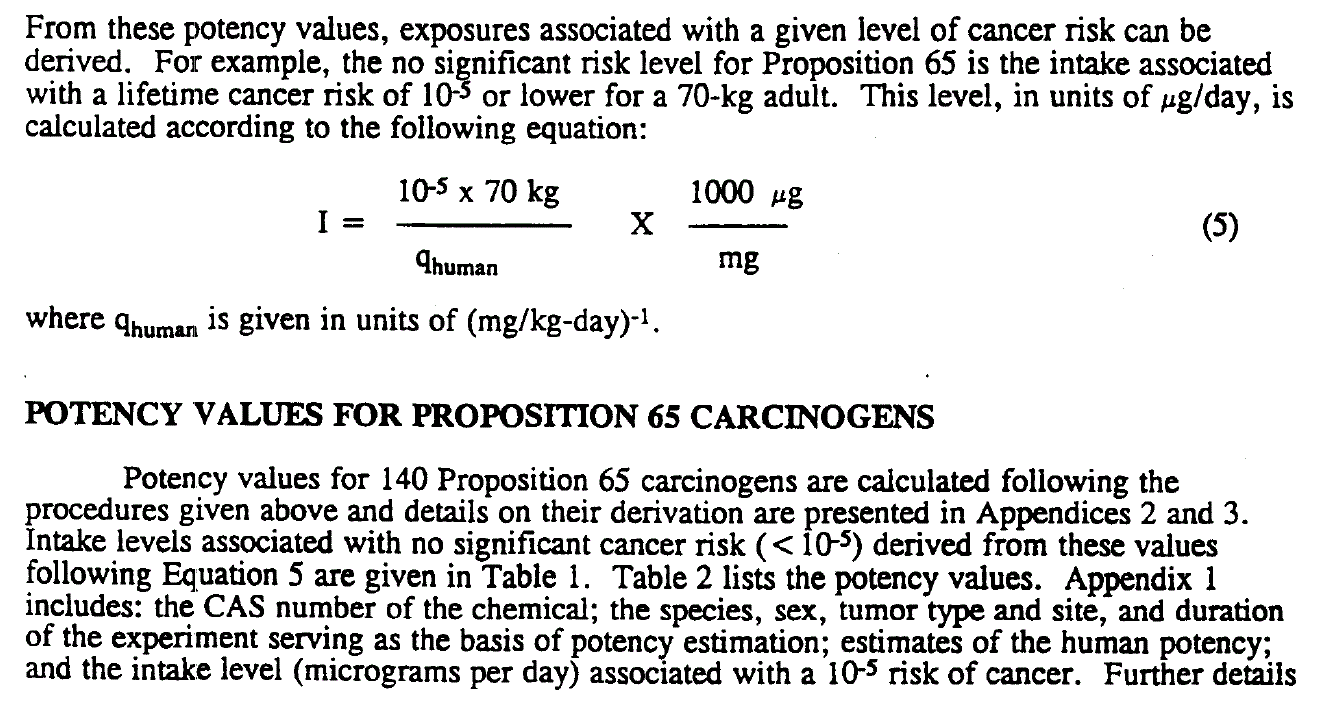
That did not sit right with me.  I wrote about California and how it calculates the slope factor for carcinogens and how it applies to the Proposition 65 notification requirements.  So I went about looking for that document.  And I found it:

Page 3
So DTSC accepts a 10-6 cumulative risk except when they accept a 10-5 cancer risk. This is one of the main problems in establishing risk.  Sometimes one in a million is okay, sometimes one in ten thousand is acceptable.

Okay, okay, I know what you are thinking.  The SCAQMD found a residential cancer risk of 22 in one million to the nearest residential receptor.  That's a 2.2 to the 10-5 risk and that's over one in 100,000.

Yeah, okay, that creates an increase risk - theoretical mind you - but a risk.  Not sure that 2.2 x 10⁻⁵ constitutes "an imminent and substantial danger to the public health or safety or the environment" though, even if you include the leaky stormwater pipes.

My question is, at this point in the discussion, does the arsenic emitted from Exide put the community at an imminent and substantial danger?  Remember our three intrepid reports at the Los Angeles Times?  Here is what they wrote about this risk:
In March, the South Coast Air Quality Management District reported that arsenic emissions from the plant created an elevated risk of cancer for as many as 110,000 people in an area stretching from Boyle Heights to Huntington Park.
I wonder where they got that number?  Oh, that's what the DTSC claims in Exhibit 2 of their justification to order Exide to halt operations:
18. Based on the Health Risk Assessment submitted to the SCAOMD, DTSC has determined that the Facility is operating its furnaces and its air pollution devices in a manner that is not sufficiently protective of human health and the environment, impacting as many as 110,000 residents in a large geographical area that includes portions of Vernon, Maywood, Huntington Park, Commerce, Boyle Heights and unincorporated areas of east Los Angeles. The predominant contributor to both chronic and acute cancer risk and non-cancer hazard is arsenic emissions from the Facility, with the primary human organs that are harmed are the cardiovascular system, central nervous system, developmental system, respiratory system and skin.
What this tells me is that the Exide facility in Vernon, California is pumping into the air enough arsenic to harm 110,000 people, causing cancer and affecting their cardiovascular system, central nervous system, developmental system, respiratory system and skin!

So...what did the SCAQMD find regarding arsenic and Exide?  Let's look at this graphic first:

Page 2 of the report
Before I get into the details of what is going on, I want you to look closely at this graphic paying particular attention to the "y" axis.  Do this while repeating "and non-cancer hazard is arsenic emissions from the Facility, with the primary human organs that are harmed are [sic] the cardiovascular system, central nervous system, developmental system, respiratory system and skin."

If you have read any of my other posts you will understand why this one bugs me.  Do you see how much arsenic was detected in the air around the facility?  Not milligrams (1,000th of a gram), not micrograms (1,000,000th of a gram) but nanograms - 1,000,000,000th of a gram.

Yeppers, that's what we now look at for arsenic in the air.  Nanograms per cubic meter.  So my next question will be, does less than 3.5 nanogram per cubic meter (the highest amount shown on the graph) present an "imminent and substantial danger?"

Remember those loud and angry folks yelling “Shut it down! Shut it down!”?  Those folks look to the DTSC for an answer.  They look to us scientists, toxicologists, experts for an answer to their number one concern "are we being harmed?"  And the DTSC gives them this:

Based on an average of about 2 nanograms of arsenic in each cubic meter of air, Exide is impacting "as many as 110,000 residents."  And "the predominant contributor to both chronic and acute cancer risk and non-cancer hazard is arsenic emissions from the Facility, with the primary human organs that are harmed are the cardiovascular system, central nervous system, developmental system, respiratory system and skin."

Is that an accurate representation of the risk these residence are encountering?


If they only had a RCRA permit...Part 6

.