Showing posts with label Wolf Eagle Environmental. Show all posts

Tuesday, March 22, 2011

Air in the Barnett Shale: Bibliography

Information on air quality in the Barnett Shale Area & Oil and Gas Production Environmental Issues in General.


TCEQ: Barnett Shale Air Sampling Map Viewer


TCEQ: Barnett Shale: Technical Questions Answered


RRC: Barnett Shale Information


RRC: Eagle Ford Information


RRC: Oil & Gas Permits


RRC: Oil and Gas Division - Texas Administrative Code-  Water Protection


RRC: Memorandum of Understanding between the Railroad Commission of Texas (RRC) and the Texas Commission on Environmental Quality (TCEQ)


Environmentally Friendly Drilling System (EFD)


Congressional Research Service:  Comparison of Selected Oil and Gas Regulations in Texas and Colorado


DISH: Alisa Rich & Wolf Eagle Environmental Reports for Town of Dish, Texas


FWLN: Feb 2011: Fort Worth League of Neighborhoods Report to ISD: RECOMMENDATIONS FOR POLICY CHANGES FOR GAS DRILLING NEAR SCHOOLS


Kleinfelder: January 2011: Town of Flower mound Limited Air Quality Evaluation


BSEEC: Ambient Air Quality study, Natural Gas Sites Cities of Fort Worth & Arlington, Texas, Barnett Shale Energy Education Council (BSEEC)


ERG: Natural Gas Air Quality Study Interim Report Executive Summary

.

Monday, February 21, 2011

Air Quality in the Barnett Shale - Part 19: Dr. Sattler's Deposition - Down with bad science!

Here is why I am critical of the work performed by Alisa Rich of Wolf Eagle Environmental and Dr. Sattler, of UTA.

From Fort Worth's NBC station:
"When you start actually looking at the levels of carbon disulfide, it's shocking," said Deborah Rogers, who has been involved in the league and monitoring natural gas drilling for the last several years. "People are going to be concerned."
Please read my post on TICs.  It is doubtful that carbon disulfide is present in the air.  Carbon disulfide is a TIC and is not positively identified nor is it quantified in the GC/MS test method used for the other contaminates.
The study makes the following recommendations for all Fort Worth ISD leases going forward:
1.Setbacks of approximately one mile from the school boundaries are needed to ensure that emissions of carbon disulfide (neurotoxin), benzene (carcinogen) and other drilling toxics do not exceed 8 hour limits for short term health benchmarks (See Dispersion Modeling Results).
Now whether setbacks are appropriate is not being questioned by me.  However, basing the one-mile setback on work performed by Rich and Sattler is.  Carbon disulfide is a TIC and its identity and quantification unverifiable.  Benzene concentrations from ambient air samples were backed in to the air dispersion model - generating an emission rate for that source.  Background benzene - that which is not from the source being modeled - was also included in this calculation generating a potential emission rate that would be higher than if the actual emission rate was known.  See my post on backed in data

Furthermore, Rich and Sattler compared these model contaminant levels to ESLs -which are for permitting and 70% lower than they need to be - and not to AMCVs - which are for ambient air.  See my post on ESLs & AMCVs.

Now I am in favor of a lot of the proposed requirements, such as green completions and substitution for toxic chemicals (depending on cost/benefit).  I think they are within reason, and if everyone is required to do them, that cost can be factored in as the cost of doing business.

So here is what really bothers me about bad science and those that should know better willingly feeding it as fact to the masses.

From the Star-Telegram Barnett Shale Blog
DISH Mayor Calvin Tillman, an outspoken critic of current drilling practices in the Barnett Shale, was the subject of a story in the Philadelphia Inquirer last week.  The story ends with a peek into Tillman's latest worry: 
Though Tillman's blood and urine came in below levels expected for the general population, he is still worried. "I'm not sure I'm going to be able to live here," he said earlier this week.
Tillman's water tested positive for traces of three contaminants, all below federal legal limits for public water: styrene was 3,700 times below the limit; ethylbenzene was 28,000 times below the limit, and xylenes were 47,393 times below the legal limit.
"The most disturbing is the toxins found in our water," Tillman said in an e-mail. "They should not be there at all. Not sure what to do about that."

Well I can tell you what you should not do about that.  Don't contact Alisa Rich, Wilma Subra, Dr. Sattler, or Wolf Eagle Environmental for advice.

You see, even when there is nothing there some people still worry.  So giving others this worry by telling them something is there does nothing more than bring in consulting dollars while causing more worry.

And from a public health point of view, worry causes stress, stress causes disease.  The worry over nothing is more likely to harm you than the air or water you are exposed to at your home.

Here's to good science in the future.


Next Post: Air Quality in the Barnett Shale - Part 20: Dr. Sattler's Deposition - The Gaussian Model

.

Sunday, February 20, 2011

Air Quality in the Barnett Shale - Part 18: Dr. Sattler's Deposition - 70% means what?

For the last four posts I've been looking at how Alisa Rich with Wolf Eagle Environmental and Dr. Sattler with UTA could have concluded that the results of air dispersion modeling performed on six ambient air samples collected over a 24-hour period indicated a problem with the air the good people of the Town of Dish, Texas, were having to breath now that a bunch of gas compressors were located in their town.

I've been critical of their work on many fronts, but it all seems to revolve around the use of ESLs to compare ambient air samples.  This is not what ESLs are to be used for, but Alisa Rich, with the assistance of Dr. Sattler, decided that it would be appropriate to use them in their reports.

The two of them have been unable to get their heads wrapped around why the ESL shouldn't be used, going so far as to accuse the TCEQ of not being technically competent when they tried to rectify this misuse with the issuance of the AMCV for ambient air samples, like the ones collected by Alisa Rich.

In their thinking, a value that is 70% lower than another must be, somehow, more safe.


So is the ESL that is 70% lower than this new AMCV value the TCEQ wants to use a better value to use?

No.


ESLs and AMCVs are based on an inhalation Reference Value (ReV) which is defined:
[a]s an estimate of an inhalation exposure concentration for a given duration to the human population (including susceptible subgroups) that is likely to be without an appreciable risk of adverse effects. ReVs are based on the most sensitive adverse health effect relevant for humans reported in the literature.

For non-cancer causing chemicals and chemicals that show a nonlinear effect, the formula:
  • (acute)ESL = 0.3 x (acute)ReV
  • (chronic)ESL = 0.3 x (chronic)ReV
  • (acute)AMCV = (acute)ReV
  • (chronic)AMCV = (chronic)ReV
For chemicals suspected to cause cancer the ESL and AMCV are the same.

The ESL is one third the ReV.  And the ReV is the value which is based on the most sensitive adverse health effects relevant for humans.

So if the AMCV = the ReV, and the ReV is the value which is based on the most sensitive adverse health effects relevant for humans, will lowering the value by 70% bring about any more protection?

No.

Another way to look at it is like this:  If the maximum temperature that a hot tub will go is 104F, is 104F the maximum temperature deemed safe for humans?

Yes.

If we lower the temperature to 90F, will we have made it any more safer?  How about to 65F?

No.

Now the thing about temperature is this.  If you add 90F water to 90F water, the water will be 90F.  But if you add 60 ppb of Benzene from one source with 60 ppb of Benzene from another source, you could get 120 ppb of Benzene in the ambient air.

If the ESL for Benzene is 54 ppb, the two sources would be putting more Benzene into the air than they should, but it would still be at a safe level.  Even when the two concentrations are added together (120 ppb) it is still safe because 120 is less than the ReV which is 180 ppb.

And you know what the AMCV for short term Benzene is?  180 ppb.

Since Benzene is also a suspected carcinogen, the long-term (chronic) level is set to 1.4 ppb for an average over a lifetime for both the ESL and the AMCV.

So there you have it.  You could be exposed to 180 ppb for up to one hour with no adverse health effects and as long as your average (for a lifetime) does not exceed 1.4 ppb, you should have no adverse health effects from Benzene.

That's how it works.

Now go check the TCEQ's ambient air monitoring web site to see what the one-hour levels for Benzene are. (make sure to check; measured in ppb-v, clear all checkboxes, check benzene, generate report)

I'll wait.

See?  Feel better now?

So just so we are clear on this.  The AMCV is the ReV.  The ReV is based on the most sensitive adverse health effect relevant for humans reported in the literature.  The ESL is 70% lower than the AMCV.


Next Post: Air Quality in the Barnett Shale - Part 19: Dr. Sattler's Deposition - Down with bad science!

.

Saturday, February 19, 2011

Air Quality in the Barnett Shale - Part 17: Dr. Sattler's Deposition - TCEQ Competency

For the last few posts I have been commenting on the Deposition of Dr. Melanie Sattler in the lawsuit of Law v. Range Resources.  My posts deal with the Town of Dish, Texas, which involve work done by Dr. Sattler and Alisa Rich of Wolf Eagle Environmental.

Now it may appear that, like the defendant's lawyer, I am trying to embarrass Dr. Sattler or ridicule Alisa Rich.  That's not the purpose of why I am writing this.  My goal is to show how and where their thinking is wrong, misguided, or has become biased.  I hold everyone accountable for supporting their beliefs and comments, but I especially hold someone with a MPH, as well as anyone who teaches, with a higher level of accountability.  Bad science leads to bad decisions.

What these two professionals have put forth as "based on reasonable scientific probability" is anything but.  And it all relates back to their complete lack of understanding of a risk based exposure level (AMCV) and a contaminant level designed to allow for future growth (ESL).  All of this - plus a hefty dose of mistrust in the TCEQ - has lead these two down a path of paralogism.

I find it intellectually dishonest to discuss something - especially teach it or use it as the basis of a report to the general public - without attempting to understand it fully.  I had no idea what an ESL or AMCV was before I read Alisa Rich's reports to the Town of Dish, Texas.  I have the same degree as Alisa Rich so we should have come up with the same understanding.  Dr. Sattler is a Ph.D dealing with ESLs.  She should understand them fully, or at the very least be able to see how it is illogical to even contemplate a health concern if the value was ".001 micrograms per metered cubed above that."

So lets look at how these two look at the ESL and the AMCV:
Q. What is your understanding of an Effects Screening Level [ESL]?
A. They are used for comparison of dispersion modeling concentrations to assess whether there could be a potential short-term or long-term health impact.
Q. And the [ESL] are used for permitting purposes; are they not?
A. That's correct.
Q, [T]hey are not ambient air concentration levels, or shouldn't be used to compare ambient air concentration levels should they?
A. They have been used that way in the past, until recently when TCEQ came out with the [AMCV], [b]ut they have come out with a new set of values that they say are appropriate to compare ambient measurements with, but the {ESL] are still the appropriate values for comparing dispersion modeling results with.
It was at this point that I started to realize that Dr. Satller did not understand the difference between using a dispersion model to predict health impacts to a receptor and using an ambient air sample to conclude possible health impacts.  What was happening here is comparing apples to oranges.  Even though an ESL looks at health impact to a receptor, when Alisa Rich placed the canister to collect the sample, she was collecting an ambient air sample.

ESLs have never been appropriate for looking at potential health impacts for an ambient air sample since they are designed for permitting purposes.  They are purposely made to be 70% more protective than what is actually required.  This is why the the TCEQ brought forward the Air Monitoring Comparison Value.  Dr. Satller was aware of this, but possibly did not understand what the 70% decrease actually means.
A. The TCEQ Guidance says that the [ESL] are appropriate values to use for dispersion modeling because when your doing dispersion modeling, typically you're looking at the impacts of one source.  And so the [ESL] are set lower in some cases than the [AMCV] to allow for, like, future additional sources that might move into the area that arn't accounted for in the dispersion modeling.
So you don't want one source taking up all of the air quality, [a]ll of the room in the atmosphere for emissions of that compound, because there may be future sources that move into the area that may also emit the compound.  So in some cases the ESLs are set lower than the [AMCVs].
Dr. Sattler sees it, articulates it, but does not understand it.  If the ESLs are set lower to accommodate growth, then exceeding them would not indicate a health concern, since they are designed to allow another facility into the area that would emit up to a similar amount. 

Simply put; if source A puts 2 ppb into the air, and a new source, B, puts 2 ppb into the air, than the total ppb in the ambient air would be 4 ppb.  If the ESL is 2, then it is OK for both A & B to put that amount into the air.  So if this is OK, then how should one look at the 4 ppb actually now in the air?  That's why they developed the AMCV, because the ESL is appropriate for only one source in an area and is used only for air permitting - to see what additional air pollution devices or setback may be necessary for that one source.  The dispersion modeling looks to make sure that a receptor in and around that source will not be exposed to more than the ESL form that source.

If an ambient air sample - like Alisa Rich took in the Town of Dish, Texas - has levels above the ESL, it does not indicate a health concern since the ESL is 70% lower than what is considered to be a safe level.

So, when Alisa Rich and Wilma Subra reported that the ambient levels exceeded the ESL, they were incorrect.  When Dr. Sattler produced modeling results that showed receptor concentrations above the ESL, she erred not only in how the source's emission rate was calculated but in her data's ability to now allow Alisa Rich the means whereby she could allude that there was a health issue in the Town of Dish, Texas.  Her report under "Results" states:
"The basis of an ESL is health impacts..." and "According to Table 2, short-term and long-term ESLs were exceeded for all pollutants, with the exception of long-term ESLs for styrene and toluene."
Now it is my belief that Alsia Rich knew full well how Table 2 would be interpreted by the people in the Town of DISH, Texas, as well as anyone who has a concern about oil & gas production.  All her reports are written in such a way as to not make a conclusion of yes or no, but instead are cleverly worded to be truthful without being honest.  She must - as an MPH - understand how the ESL is calculated, as should Dr. Sattler.  However, Dr. Sattler's lack of a toxicological background may preclude her understanding of Hazard Quotient (HQ) and Cancer Slope factor (see  1.6.1.1 Calculation of ESLs for Nonlinear Effects)  which might account for why she has continued down this path and, unfortunately, brought her students along with her.

To know what the model is designed to do, but completely lack an understanding of what the numbers produced mean, is just....well I don't know what to make of it.  I think the idea behind Alisa Rich's dissertation is sound - that the ratio of chemicals detected in the air might be used to determine the possible source - has potential merit.  But using the model to back in data without this fingerprinting knowledge - which was done in all three studies provided to Alisa Rich - is unsound, making all this modeling work performed by Dr. Sattler nothing more than guessing.  At the very least I will accuse her of being intellectually sloppy in her premise and her understanding of what the true health impact should be identified as.

They don't hand Ph.Ds out to just anyone, so when you have that, along with the title of "engineer" and "professor" at a "major university" by your name, it is assumed that you should have a pretty good understanding of what your are saying.  It assumes that you have spent the time necessary to thoroughly research your topic, to know it inside and out.  If her topic is air dispersion modeling, then one should reasonably expect that she fully understands what the number the model calculates means.  She doesn't, and how many people has she confused because of her failure to look at anything other than the number produced?

Numbers mean something.  The air dispersion model numbers mean something.  They are used to compare against an ESL.  She knows that.  So how in the world does she not understand what an ESL is all about?
Q. [Your 6/15/10 email states] "It seems like the TCEQ should have been using AMCVs all along as a basis of comparison for monitoring data." [S]o if someone was taking ambient air tests certainly after June of 2010, the intellectually honest thing to do would be to compare that data to AMCVs, not [ESLs] correct?
A. In my opinion.  There are people who suspect the motives of the TCEQ in issuing the AMCVs at this late date; why didn't they issue AMCVs 20 years ago?
Q. [t]he intellectually honest thing to do if you're taking air data from ambient air samples would be to compare it to that, not [ESLs] which are set 70 percent lower than the level at which health effects would be anticipated; correct?
A. I don't think the issue is that simple, because, as I said, if AMCVs were the proper thing to use, why didn't TCEQ come out with them 30 years ago.  So there are people that suspect the TCEQ's motives in issuing the AMCVs.  And if you're one of those people, you can argue that it's appropriate to go ahead and continue using the ESLs as we have - as they have been used in the past 20 years or whenever it was that they first came out with the ESLs
I'm going to interject here.  The reason they had to put the AMCVs in place is because of Alisa Rich and Dr. Sattler's misuse of them.  Prior to Alisa Rich's "reports," they were used for air permitting, not for ambient air determination of a potential problem or concern.  Alisa Rich and Wilma Subra took ambient air samples and compared those values to values that are 70% lower than what is consider to be health based.  Then, to top it off, Dr. Sattler "backs in" this ambient air data into her dispersion model and calculates potential concentrations that are, once again, compared to ESLs.  This causes the people in these communities and those around oil & gas production sites to believe that they are being harmed.  Their (TCEQ) motive was to stop this abuse/misuse.

Oh, but it gets better...so unbelievably better:
Q. Are you one of the people that suspects the TCEQ's motives?

A. I don't know.  I've worked with some people at TCEQ that are technically competent, and I've worked with some people that arn't as technically competent, so I hope that the technically competent people were involved in this decision, but I don't know for sure.

Q. When you said [i]ts reasoning seems OK," have you changed your mind about that since June 15, 2010, as you sit here today?

A: If I read the document and take it at face value, the document seems okay, but there have been some other - decisions that TCEQ has made that I think have not been technically sound since that time.

Q. Do you [h]ave any reason to think that Alisa Rich questions the motives of the TCEQ?

A. Yeah

Q. And what do you base that on?

A. Because she's been reluctant to start using the AMCVs as a basis of comparison.

Q. And why is she reluctant to use the AMCVs as a basis for comparison?

A. Because we've been using [ESLs] to compare monitoring data for the last 20, 30 years, however long the ESLs have been in existence, and so I think she questions why - why they're just now coming up with them; why didn't they come up with them 20, 30 years ago.
So maybe I was wrong to assume that Alisa Rich - who holds an MPH, like me; from a reputable University, like me; with a focus on environmental health, like me - should understand why the ESL was replaced by the AMCV for ambient air monitoring.  It's all about the HQ and the Cancer Slope Factor, the BASIC principle behind assigning risk.  The TCEQ ESL document explains it all very well.

Air dispersion modeling is all about looking at risk.  To not understand the difference between the ESL and the AMCV, is to not understand the very basis of how we look at potential adverse health effects from one source and all sources combined
Q. If you were doing an ambient air study [w]ould you use the AMCVs as the comparison value as opposed to the ESLs?
A. Yes
Q. And you would do that because you believe that would be the intellectually honest thing to do; correct?
A It would be because I would take the AMCV report at face value and - hope that the people who decided to come up with the AMCV standards were the people at TCEQ that were technically competent.
And the TCEQ, environmental professionals like me, and the general public at large, would hope that someone with a Ph.D, a job as a UTA professor, and an engineer in air dispersion modeling, would be technically competent to be able to determine this on her own and not just reluctantly accept it at "face value."


AMCVs are the correct level to use when looking at ambient air concentrations.  ESLs are used to look at what level a receptor would be exposed to if the emission rate from the source is known.  ESLs are 70% less than AMCVs because they are used for permitting.  Exceeding them does not indicate a health concern.


Next Post: Air Quality in the Barnett Shale - Part 18: Dr. Sattler's Deposition - 70% means what?


.

Thursday, February 17, 2011

Air Quality in the Barnett Shale - Part 16: Dr. Sattler's Deposition - Those Seven Chemicals

In the Wolf Eagle Environmental report for the Town of Dish, Texas, Alisa Rich used values produced from dispersion modeling performed by Dr. Sattler of UTA.  These values are listed in Table 2:


Dr. Sattler's dispersion modeling maximum concentrations were developed using sampling data - collected with six SUMMA canisters possitioned a distance away from the oil & gas production site - provided by Alisa Rich.  Of these seven chemicals, two (Benzene and Toulene) are part of BTEX which is a common air pollutant derved from burring fossel fuel and cigaretts.  According to the EPA:
The primary HAP associated with the oil and natural gas production and natural gas transmission and storage source categories include BTEX and n-hexane. In addition, available information indicates that 2,2,4-trimethylpentane (iso-octane), formaldehyde, acetaldehyde, naphthalene, and ethylene glycol may be present in certain process and emission streams. Carbon disulfide (CS2), carbonyl sulfide (COS), and BTEX may also be present in the tail gas streams from amine treating and sulfur recovery units.
The State of New York identifies 1,2,4-Trimethylbenzene as a "chemical constituent" of "chemical additives proposed to be used in New York for hydraulic fracturing operations at shale wells."

This leaves styrene and dimethyl disulfide without a recognized association with oil & gas production.  Since these two chemicals were detected Alisa Rich and Dr. Sattler assume they must have come from the oil & gas production site in question and build a dispersion model as if they did.  This is why you can't back in air sample contaminant levels taken some distance from the source without first understanding what the normal background level is for the chemicals in question. There is no reason why styrene or dimethyl disulfide would be coming from this site.  Since styrene is a HAP, it would have been identified as chemicals of concern for oil & gas production MACT/GACT compliance under NESHAPS.

So lets say those two chemicals are background contaminants that came from some other process unrelated to oil & gas.  That leaves five remaining.  Both carbon disulfide and carbonyl sulfide (as well as dimethyl disulfide) were identified in the final report and in the lab reports as Tentatively Identified Compound (TICs).

This creates a bit of a problem that was not addressed in the report.  Here is what the TCEQ has to say about TICs:
TICs are observed measurements in the sample for which the gas chromatograph-mass spectrometer (GC/MS) was not specifically calibrated; however, the tentative identification of a compound can be made by comparing the mass spectrum from the environmental sample to a computerized library of mass spectra. The comparison of the sample spectra and that of the library are scored for their similarity to the mass spectrum of a particular TIC and the tentative identification is made based on the most similar spectra. This is a commonly used technique; however, the absolute identity of a TIC is uncertain. Quantifying TICs is also less accurate than for target compounds because the true relative response factor is not known, since the instrument was not calibrated for the TIC. It is important to note these uncertainties when evaluating TICs.
Given the uncertainties in identification and quantification of these compounds and the method used to determine potential 1-hour maximum concentrations, it is not possible to accurately draw conclusions about the potential for adverse health effects.
I understood why, but not to the level needed to discuss it here.  So I asked my professor over at SRPH that happens to know a little bit about analysis and GC/MS.  "It's because of the response factor" he said.  I just nodded my head making a mental note to Google that when I got back to my office.  Here is what I found to be a pretty good explanation of a Response Factor:

The size of a spectral peak is proportional to the amount of the substance that reaches the detector in the GC instrument. No detector responds equally to different compounds. Results using one detector will probably differ from results obtained using another detector. Therefore, comparing analytical results to tabulated experimental data using a different detector does not provide a reliable identification of the specimen.
A “response factor” must be calculated for each substance with a particular detector. A response factor is obtained experimentally by analyzing a known quantity of the substance into the GC instrument and measuring the area of the relevant peak. The experimental conditions (temperature, pressure, carrier gas flow rate) must be identical to those used to analyze the specimen. The response factor equals the area of the spectral peak divided by the weight or volume of the substance injected. If the technician applies the proper technique, of running a standard sample before and after running the specimen, determining a response factor is not necessary.
"Basically," he said.  "Because you did not use a standard that included these TICs, the computer makes a guess as to what chemical the peaks could represent."  He then showed me how this works by letting the computer identify an unknown bunch of peaks on a spectra he had.  The computer spat out a name.  "The lab tech needs to look at the peaks and compare it to the peaks of the compound the computer picked out.  If it's a match, great, but a lot of the time, like this example, the computer gets it wrong."

So basically what he showed me was the analytical equivalent of Damn you Auto Correct.   But they quantified these chemicals I said.  He just stared at me and then shook imaginary dice in his hands and let them fall.  I got the message.  Even if you spent the time comparing the peaks to the chemicals in the library, the lack of a standard means the quantity reported is nothing more than a guess.  Which is why the TCEQ says:
Given the uncertainties in identification and quantification of these compounds and the method used to determine potential 1-hour maximum concentrations, it is not possible to accurately draw conclusions about the potential for adverse health effects.
Well I called the lab and asked them if they physically compared the peaks found to the chemical in the library that the computer picked up.  They said no.  Damn you auto correct!

Now, to be scientific about this - which Alisa Rich should be and Dr. Sattler must be - with this information, we really need to exclude styrene, dimethyl disulfide, carbon disulfide, and carbonyl sulfide from the model.

That leaves only Benzene, Toluene, and 1,2,4-Trimethylbenzene with any reasonable plausibility for being emitted from the oil & gas production site.  Lets look at this from both a comparison to the ESL and AMCV.


Note: Toluene AMCV is for health.  ug/m3 were converted to ppbv using the formula 24.45 x concentration (ug/m3) ÷ molecular weight.  

When compared to the AMCV - which is proper in this case, and any case where air pollution permitting is not the goal -only Benzene and 1,2,4 Trimethylbenzene exceed the Annual AMCV based on the premise that these two chemicals came solely from one source only - the oil & gas production site.

So looking at it under these conditions - straightforward, fair, scientific based - what is the conclusion for the air in the Town of Dish, Texas even if these values were backed in the model?  Remember, those values reported in Table 2 are worst case possibilities.


Next Post: Air Quality in the Barnett Shale - Part 17: Dr. Sattler's Deposition - TCEQ Competency


.

Wednesday, February 16, 2011

Air Quality in the Barnett Shale - Part 15: Dr. Sattler's Deposition - Critique of the Method

In my last post, I discussed a Deposition I received via email regarding Dr. Melanie Sattler's involvement with Alisa Rich of Wolf Eagle Environmental (Cause No. 236-236781-09, December 14, 2010).

I find myself in another sorry-but-I-gotta-call-you-out-on-this-one position.  You see Dr. Sattler is a professor over at UTA.  She's an Engineer.  She also taught and helped Alisa Rich - who then used this association and credentials - to prepare a number of reports that are misleading (see previous posts on this topic).

In the Deposition, Dr. Sattler states:
"I think my work stands up to anybody that has expertise in dispersion modeling. If anybody was criticizing it, they probably didn't have -- well, it wouldn't surprise me to see somebody without a scientific background criticize it, because they probably wouldn't understand it." (Page 158-159)
The use of dispersion modeling to determine an emission rate is fundamentally and categorically an incorrect use of the model - unless - the contaminants being "backed in" to the equation are solely from the source - or - background levels of the contaminants have been factored out.

Here is how Dr. Satller determined the emission rate for the oil & gas production site in the Town of Dish, Texas, that Alisa Rich used to model the potential one-hour and annual exposure for those living in and around that production location:


So Alisa Rich set up seven SUMMA canisters in and around the Oil & Gas production site.  This map is included in the ZIP file titled "Revised Air Study Documents" found here.


From this graphic you might not notice all the potential sources that could be contributing to the seven contaminants reported by Alisa Rich - and supported by Dr. Sattler's work - allowing for the following statement to be made:


See those numbers in columns 2 and 5?  Those are the maximum averaged concentrations the dispersion model calculated could come from the oil & gas production site there in Dish, Texas.  Those values reported in Table 2 are what a human or environmental receptor some distance from the production site could - according to Dr. Sattles' calculations - potentially be exposed to.

So when Dr. Sattler makes that statement:


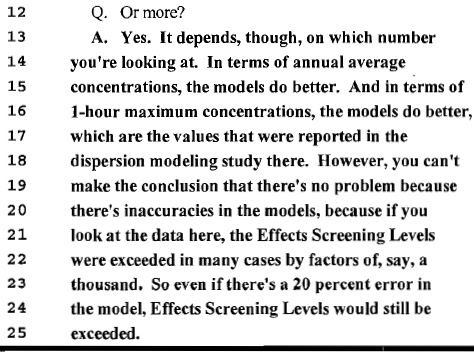
She is eluding to the fact that her modeled concentrations are so high that any error inherent in the model's ability to calculate levels of contaminants in and around the source would have no bearing on the model's conclusion that ESLs were exceeded.

This argument would be valid if you knew the actual emission rate of the source and the results obtained were high enough to overcome the percent error inherent in the model.  But in the case of Dish, Texas, her maximum contaminant levels are dependent on calculating an emission rate based on levels found in SUMMA canisters placed in and around the area where the source is located.


Because her basic premise is wrong - that you can back in the contaminant levels that were detected some distance from the source to determine the actual emission rate of the source - all the values presented in Table 2 that come from the model are wrong as well.  There is nothing wrong with the model, it's how she is using it that is wrong.  Why she can't see this, or any of her peers have not questioned her on this, is any one's guess.

There seems to be a clear lack of understanding of just what a dispersion model is capable of telling you.  Yes, she knows how they work and she knows how to report them, but she seems to lack a connection to the number obtained and how it was calculated.  Which is probably why she responded in the Deposition:
Q. When you read through [t]his report, doesn't it give you the impression that, boy, this is really bad, the air out here is just horrible?
A. I don't know.  I don't read it that way.  I look at the numbers. (page 147)
And if all you do is look at the numbers, then you are going to miss the connection to what the numbers must mean. So what do the numbers tell you?  Well based on the dispersion modelling, the air significantly exceeds the short-term and long-term ESL for six compounds.

So what Dr. Sattler accepts as good scientific methodology, is to take the sample results obtained at a distance from the source (the natural gas production area) to figure out what the emission rate coming from this source is.  Once she has this emission rate, the model can now be run like it normally is intended to be run, using all the meteorological data for a year.

Makes perfect sense, as long as you are willing to ignore all the other possible sources of these seven pollutants.  In other words, the assumption - or premise - must be that the levels of contaminants in the SUMMA canisters were solely from the natural gas production site and from no where else. 

For example, by shoving every single bit of Benzene and Toluene detected in the seven canisters back into the model's equation, an emission rate from that source was derived for Benzene and Toluene.  With that emission rate and a years worth of meteorological data, dispersion models could be run and maximum modeled concentrations (see Table 2) derived.

For these two chemicals - Benzene and Toluene - they are everywhere.  They are part of BTEX which is part of fuel, which when burned, enters the atmosphere.  Benzene also comes from smoking cigarettes.  So is it possible that not every bit of Benzene and Toluene detected in the SUMMA canisters was produced by that particular oil & gas production site?  Lets look at a map of the area:


The white rectangle is where the production site is located.  Now go back to the map showing where the sample points were located.  Isn't it possible that these contaminants could have come from other sources?

Dr. Sattler is aware of this as a potential problem:


But the Dish, Texas samples were not collected in the middle of an open field.  They were sampling air from an area where commercial activity took place, people lived, and a major thoroughfare and roads were also nearby.  Isn't it reasonable that some of that Benzene and Toluene may have come from vehicles driving on the nearby streets and FM156?  Or is that just too small of a probability to be considered?

Now if her premise is correct - that outside contaminant sources of contamination can be ignored - would this methodology - the placing of seven SUMMA canisters - work in downtown Houston?  Could you take the analytical results collected over a 24-hour period and back in to the model to derive the emission rate for one of the nearby refineries?  If not, then why is this modeling method acceptable for the Town of Dish, Texas?  You cannot reasonably make the argument for Dish that there is some small probability that maybe a little bit of the compounds came from another source.

To say that all of those seven contaminants came from one source does not even pass a grammar school understanding of how experimentation is supposed to account for bias, noise, and background.  Then, to use that emission rate to build your model whereby you can make bold sweeping statements that ESLs are exceeded by factors of, say, a thousand, is inexcusable.  You see, if the premise is wrong, then the numbers obtained are wrong - or at the very least, inconclusive.  

All models produce numbers.  All models produce numbers that - all things considered - are within a statistically acceptable level of possibility.  But not all the possible numbers produced by a model are plausible.  Intellectual integrity and the scientific method demands one know the difference. 

The numbers produced by Dr. Sattler's model are correct in terms of a calculation.  The premise, however, is wrong, making those dispersion model numbers worthless in looking at short term and long term health effects from this specific natural gas production area.


Next Post: Air Quality in the Barnett Shale - Part 16: Dr. Sattler's Deposition - Those Seven Chemicals


.

Friday, January 14, 2011

Air Quality in the Barnett Shale - Part 13: Why bother writing about this?

So here it is, one month and 13 posts later.  You know how many comments I've received for all this effort?  One, and that was from a lady who hopes no one believes what I wrote.  So the question I have to ask myself is why bother?

Does anyone really care about facts or data in pursuit of making a decision on something?  The answer to that is 'yes' but only, it appears, if that information is able to support an idea that they want supported.  So why share my thoughts with a public that has, for the most part, already chosen a side on this topic?  What do I hope to gain from all of this?

What I know to be true is this.  At one time I believed certain things to be true based on what I was told.  After a few decades on this planet and a lot of observation and research, I have found some beliefs to be false.  It was not fully my fault in what I thought to be true.  I have been taught these beliefs by ignorant folks, misguided folks, folks with an agenda, and downright liars.  All the while, though, what is true, remained that way, regardless of what I believed.

The field I have spent the last 25 years in, Environmental Management, is ripe with regulations and methods that are based on a poor knowledge of how to calculate risk.  And it is because of this, that the public - who initiates the do's and dont's we live under in the form of laws and regulations - is often confused on what is a proper course of action to take.

So with the Oil and Gas fracing, exploration, and pumping that is taking place, misinformation, mistrust, and agenda is drawing a line in the sand 180 degrees from where it needs to be drawn.  And if I were to look at this from a completely selfish point of view, I would conclude, so what?  I have no stake in oil and gas, no shares, job, financial gain or loss.  I don't live in an area affected nor do any of my family.  I have no dog in this hunt.  So why bother writing about this?

Because there is a chance that someone who has not made up their mind yet, may stumble across this blog when searching for information on health, oil & gas, or the Barnett Shale, and may come away with enough information to at least ask the question - Is what I am being told the truth, the whole truth, and nothing but the truth?

And why should that matter to me?  I don't know, it just does.  It's important to me that ignorance is not the norm, that those with a personal agenda don't dominate the thinking, that liars are exposed, and that laws, rules, and regulations be established based on good science and sound engineering practices.

If I can add fact, clarity, and insight into the discussion, then all of this is not for naught.  Even if only one person reads it and comes away better informed, then why bother is moot. The world is full of people who misuse science and data to further their own agenda.  In the course of doing this, people get hurt and resources are pulled away from issues that really are causing an impact.  If I can provide information that helps one person understand dose, exposure, risk, or impact, then they will be able to spot the people who - for their own personal agenda or beliefs - are trying to manipulate the system their way.

So when I read the reports on potential health concerns regarding oil and gas production for the Town of Dish, Texas, and I see that they were produced by someone who holds a Master in Public Health -  Alisa Rich - I have a reasonable expectation that the work should be, at the very least, sound in what it puts forth.

And when I determine that it is so fundamentally flawed as to make it worthless, I am left with having to not only defend the integrity of my profession, but my degree as well.  I am also left with the ugly truth that Ms. Rich is either woefully ignorant on the topic or is being purposely disingenuous.  In either case, she should apologize and ask the Town of DISH, Texas to remove her reports.

But even if that were to happen, the damage has already been done.  What Alisa Rich and Wilma Subra so carelessly have done is presented to the public what is referred to as a preinstructional theory.  That is, without informing the public on how dose, exposure, pharmacokentics, and risk play into the development of health issues, they lead people to a theory that because chemical A can cause harm, and operation X produces chemical A, operation X will cause harm. The danger here is that it now becomes very difficult to get the public to abandon what soon becomes a well-entrenched theory of what is happening to them. (1)

So even when presented with 12 individual posts of what Chinn and Brewer call Anomalous Data (evidence that contradicts their preinstructional theories) the unfortunate result will not be a change in the theory but a hunkering down in that belief (see comment in post 10). 

So what's the harm if people believe that oil and gas production is affecting their health?  Well if it leads to bans on drilling (NIMBY), pretty much nothing more than economical harm (although an argument could be made that burning gas for fuel is less damaging than coal or oil or the risk of transporting oil from oversees).

But what happens if the theory is brought forward by a professional that early childhood vaccinations can cause autism? (2).  In this case, "the British medical journal the Lancet retracted a study it had published in 1998 in which British researcher Andrew Wakefield suggested that the measles, mumps and rubella (MMR) vaccine triggered autism. Wakefield's science proved shoddy and his methods questionable." (3).

So what's the harm with that?  Because of shoddy and questionable work, along with his role as a researcher, and the publication in a very well respect journal, a lot of new parents failed to have their babies vaccinated for PREVENTABLE diseases.  They failed to do this because of a belief of a risk that was not there.  And in doing this - following this incorrect theory - they needlessly exposed their children to a REAL risk.

On 4/3/11 I read in our Sunday paper:  "Health officials struggling to contain a measles outbreak that's hit hard in Minneapolis' large Somali community are running into resistance from parents who fear the vaccine could give their children autism." (1)

This is similar to what Alisa Rich and Wilma Subra did when they produced these reports for the Town of DISH, Texas.  They focused the attention on a risk that is not there forcing agency and industry time and energy away from issues that are REAL.  As an MPH, Alisa Rich has an obligation to that credential to speak the truth, the whole truth, and nothing but the truth.  Misleading, biased, incorrect, poor, and shoddy information presented by public health professionals that should know better causes harm.  That's inexcusable for an environmental professional, especially an MPH from the University of  North Texas and a Ph.D candidate from the University of Texas at Arlington.

And that is why I bother writing this.


.

Thursday, December 16, 2010

Air Quality in the Barnett Shale - Part 11: Is there a real concern for DISH, Texas?

So what do we know so far regarding the real health concerns for the citizens of the Town of DISH, Texas?:
  • Benzene and other chemicals were found in the seven samples collected during one 24 hour sampling event conducted by Wolf Eagle Environmental.
  • The TCEQ has sampled the air in the Town of DISH, Texas and reports hourly values below the short-termAir Monitoring Comparison Values (AMCV)  
  • The TCEQ has sampled the air in the Town of DISH, Texas and reports hourly values below the short-termAir Monitoring Comparison Values (AMCV)  
Here is what I gathered from the TCEQ website for air monitoring at DISH, Texas:

Note: Report generated on Dec 16, 2010.  Monthly and Yearly data reported for BTEX.

As you can see, the amount of BTEX (Benzene, Toluene, Ethylbenzene, and Xylene) is under the AMCV for each chemical.  That's a good sign.  But lets make the assumption that the 24 hour results reported by Wolf Eagle Environmental are what the citizens of DISH, Texas are being exposed to on a regular basis.  Would there be a health concern?

That's a difficult one to make a call on.  In fact it is so uncertain that even Wolf Eagle Environmental and Wilma Subra in any of their reports do not make any claim what-so-ever as to these levels creating a undo health risk.  All that is said is that they exceed the ESL for some of the chemicals found.

The TCEQ, on the other hand, does state:
"24-hour air monitors in the Barnett Shale area are showing no levels of concern for any chemicals." and "there are no immediate health concerns from air quality in the area" and "that when they are properly managed and maintained, oil and gas operations do not cause harmful excess air emissions.”
Now I know better than to rest my case on one set of data.  However, I have at my disposal - and anyone clicking the links I cite does as well - a whole bunch of data or 'n'.  This gives me more confidence to agree with the statement TCEQ has issued above.

There is one more issue in play that leads me to conclude that the air is safe and that the folks in the Town of DISH, Texas are not going to experience " health concerns from air quality in the area."

Exposure is but one step of the K.C.Donnelly Risk Paradigm I discussed in Part 2.


What needs to happen after exposure to a chemical takes place is uptake.  That is, the chemical has to enter into the body where the dose, time, and pharmacokinetics now come into play.

The question becomes, OK, if they are exposed, how much are they actually getting into their system?  In order for a health effect to manifest, uptake must take place.  And if uptake has taken place, we can measure the actual concentration of the chemical in the blood stream or tissue.

And wouldn't you know it, that has been done.
Much of the concern about natural gas operations has been centered in DISH, so in early 2009, the Texas Department of State Health Services performed blood tests on 28 DISH residents (representing about 13 percent of the town’s population).
Test results showed that the exposure of DISH residents to VOCs was similar to that of the general U.S. population, and that exposure to certain contaminants was no higher than that of the general U.S. population.
The study further found that the only residents who had higher levels of benzene in their blood were smokers. Cigarette smoke contains benzene, so finding this in smokers’ blood is not unusual, the department noted. (1)

So now what do we know?
  • We know that we have detected chemicals contaminants in the 24 hour samples collected by Wolf Eagle Environmental
  • We can assume exposure has taken place.
  • We can show - through blood tests - that exposed citizens have levels of contaminants no higher than those of the general US population.

So what can we conclude from all this?  That excluding odor, noise, and catastrophic events, the TCEQ is correct in asserting "that when they are properly managed and maintained, oil and gas operations do not cause harmful excess air emissions.”


Next Post: Air Quality in the Barnett Shale - Part 12: Oil & Gas, it's better if you go green!

.

Tuesday, December 14, 2010

Air Quality in the Barnett Shale - Part 10: How not to describe Toluene

So here I am on my 10th rant...err, I mean post.  What started all of this was a simple Google search looking for information on air quality and oil & gas exploration/production involving frac'ing in Texas.  What I found mentioned over and over again mentioned sampling performed in the Town of DISH, Texas by Wolf Eagle Environmental.  Reading their report, written by an MPH named Alisa Rich, I come across a number of descriptions as to the hazards posed by the contaminants detected in the seven samples they took in the Town of DISH, Texas back in September of 2009.

The one on Toluene was what started these posts.  Nothing makes me madder than when someone who is in the know reports faulty, misleading or incorrect information to the general public.  As an MPH she knows better.  Although what she said was factually true, the context it was put in was misleading:

Lets look at a different chemical to illustrate how misleading a statement like this can be:

Phosphoric Acid - CAS Number 7664-38-2  
Corrosive. Causes skin and eye burns. Harmful if inhaled or swallowed. Irritating to respiratory system. Prolonged exposure may cause chronic effects.  This product is considered hazardous under 29 CFR 1910.1200 (Hazard Communication).  Risk of serious damage to eyes. Do not get this material in contact with eyes.  Causes skin burns. Harmful if inhaled. Inhalation of vapors or mists of the product may be irritating to the respiratory system. Prolonged inhalation may be harmful. Do not breathe dust/fume/gas/mist/vapors/spray.  Harmful if swallowed. Components of the product may be absorbed into the body by ingestion. Ingestion may produce burns to the lips, oral cavity, upper airway, esophagus and  possibly the digestive tract. Circulatory collapse. Unconsciousness, possibly death. Do not ingest. Components of this product are hazardous to aquatic life. May cause long-term adverse effects in the environment. (1)
Pay particular attention to the section in red.  Wow!  That phosphoric acid must be really bad stuff!  Now lets look at a can of Coke, or Pepsi, or Dr. Pepper, or any other carbonated drink.


So will drinking a can of Coke cause you to suffer "Circulatory collapse. Unconsciousness, possibly death?"  

No.

Is Coke, which contains phosphoric acid, "Harmful if swallowed?"

No.

Does ingestion of this product "produce burns to the lips, oral cavity, upper airway, esophagus and  possibly the digestive tract?"

No.

And the reason?  The dose!  In other words, there is a "safe amount" of phosphoric acid that a person can be exposed to.  Carbonated drinks contain that "safe amount."

So were the citizens of DISH, Texas exposed to an amount of Toluene that would/could present any of the hazards described in Wolf Eagle Environmental's report?

No. (2)(3)

And yet both Alisa Rich and Wilma Subra presented to the Town of DISH, Texas reports that imply that the amount of contaminants detected in the seven samples exposed the citizens to "a neurotoxin." (4)

If we go back to looking at chemical exposure in terms of exposure to a dog, in DISH, Texas a dog was indeed found to be present.  Even if we assume worst-case as the TCEQ did in their memo - increasing the amount of chemicals detected in a 24 hour sample to 24 times the levels detected - what was detected at the Town of DISH, Texas by Wolf Eagle Environmental, was a dog that looks like this:


But the way their report was worded, it describes a dog that looks like this:


So as Wilma Subra concludes in her report:
The data from the report should be used to educate community members living in the area with the highest concentrations of chemicals and chemicals in excess of TCEQ ESLs in the air they are being exposed to.
Well you now have the data and the correct context to help make a proper determination as to the risk posed by the oil & gas production that is taking place.


Next post: Air Quality in the Barnett Shale - Part 11:  Is there a real concern for DISH, Texas?


.

Saturday, December 11, 2010

Air Quality in the Barnett Shale - Part 9: Dose and Dogs

So now back to TCEQ and their statement:
“In response to these concerns, the TCEQ has committed a tremendous amount of time and resources to the issue of Barnett Shale air quality, and we will continue to do so.  After several months of operation, state-of-the-art, 24-hour air monitors in the Barnett Shale area are showing no levels of concern for any chemicals. This reinforces our conclusion that there are no immediate health concerns from air quality in the area, and that when they are properly managed and maintained, oil and gas operations do not cause harmful excess air emissions.”
How can this statement be made when contradictory statements from Wolf Eagle Environmental and Wilma Subra contend:
  • Laboratory results confirmed the presence of multiple Recognized and Suspected Human Carcinogens in fugitive air emissions present on several locations tested in the Town of DISH. (1)
  • Xylenes (m & p), a neorotoxin, was present in the highest concentration of all stations sampled and exceeded the Long-term ESL by 2 times. (2)
  • Benzene, a know human cancer causing agent, was present in the highest concentration of all stations sampled. (2)
It all comes back to the dose.

Lets say that you wanted to know the possible health effects of human contact with different types of mammals.  The first thing you would do is group them.
  1. Cats
  2. Dogs
  3. Hamsters
  4. Pigs
  5. Goats
Then you would look at each one to see what health effects occur.  For the sake of simpleness, lets pretend the only health hazards we are concerned with are bites, bone breaks, rabies, and death.

Now through research - some good and some poor - we find that not all bites are the same, so we break them down into small bites, medium bites, and large bites.

So our concern with human exposure to mammals has to do with the following health effects:
  1. Small bites
  2. Medium bites
  3. Large bites
  4. Bone breaks
  5. Rabies
  6. Death
The next thing one would do is look to see what type of exposure to one of the five mammal groups causes any of these health effects.  Through research we find that these health effects are dependent on the size of mammal (dose) and the amount of time in contact with the mammal (duration).

As a rule, we find that the bigger the mammal the larger the bite; the more time spent with the mammal the higher the chance of rabies; and in cases where a large number of mammals is encountered at one time, death may occur.

We also find that in most cases nothing happens.  Also, some large mammals can just nip and some small mammals can bite, although the size of the mammal does impact the size of the bite.  Additionally, any one single contact may have the ability to transmit rabies.

So looking at dogs, for example:
Now we need to determine what a safe level of dog exposure is.  For other than rabies, we look to see if there is a non-linear dose-response relationship, which means it has an effects threshold - an amount of dog for which human exposure is not expected to result in any adverse health effects.

We also find that within a human population, some people are much more prone to have negative health effects when exposed to dogs.  So when determining this safe level, it will need to be based on the most sensitive population (children, elderly) and adjusted for uncertainty and variability.

In toxicological assessments, this safe value is usually based on a determination of no-observed-adverse-effect-level - or - NOAEL.  The NOAEL is than divided by an uncertainty factor.  

For example, benzene - which is not a dog but a chemical - has a BMDL (which is similar in scope to the NOAEL) of 1.2 mg/kg/day is divided by an uncertainty factor of 300 for a reference dose (RfD) of 0.004 mg/kg/day.  The reference dose is the safe level one can be exposed to without any adverse health effects.

This uncertainty makes the safe level of benzene 300 times lower than the amount determined to be at the no-observed-adverse-effect-level (NOAEL).  In other words, at 1.2 mg/kg/day we don't expect anything, so at 0.004 mg/kg/day we are pretty dang sure nothing will happen.  Aint science fun!

It is because of this uncertainty that TCEQ can say:
"If predicted airborne levels of a constituent do not exceed the screening level, adverse health or welfare effects are not expected.  If predicted ambient levels of constituents in air exceed the screening levels, it does not necessarily indicate a problem but rather triggers a review in more depth."
So what would be the safe level of dog?  One that would show consistently a no-observed-adverse-effect-level.   That would probably be a puppy.


And because of uncertainty, not just any puppy, but a really young puppy:


So that's basically how dose and this "safe level" of ESL, RfD, and AMCV works.  Exposure to any of the dogs pictured - as well as encountering a pack of dogs - does not necessarily mean you will get bit or harmed.  And the chance of rabies?  Slim.  Yet these health effects - including rabies - are possible any time you are exposed to a dog.

Next post: Air Quality in the Barnett Shale - Part 10:  How not to describe Toluene

.

Thursday, December 9, 2010

Air Quality in the Barnett Shale - Part 7: Benzene Exposure and the No Significant Risk Level.

Carcinogens are a bit trickier to deal with in terms of determining a safe level.  This is because there is no concentration other than zero that one can say will present no chance of getting cancer from exposure to it.  Instead of a threshold dose, we look at a exposure level determined to present "no significant risk."

This level is defined as the level which is calculated to result in not more than one excess case of cancer in 100,000 individuals exposed over a 70-year lifetime. In other words, if you are exposed to the chemical in question at this level every day for 70 years, theoretically it will increase your chances of getting cancer by no more than 1 case in 100,000 individuals so exposed. (5)

What it does not mean is that one person per 100,000 individuals will get cancer.  This is the same concept behind rolling a six sided die.  You expect to see a "one" show up every six rolls, but you could roll it 50 times without ever rolling a one.

Basically, the ESL and AMCV are calculated the same way:
  • (chronic)ESL = 0.00001 / URF
  • (chronic)AMCV = 0.00001 / URF
The URF or "Unit Risk Factor" for carcinogens do not have a threshold dose at which below that concentration no cancer would take place. What this means is that any exposure has the chance to cause cancer and that the more exposures the more chances for cancer to manifest itself result.  This makes exposure to "Benzene, a know human cancer causing agent" a scary thing to read over and over again in a report (7).  This is where context and explanation are critical components to any report involving a complex formula, a number, and the words "know human cancer causing agent."  This is also where Alisa Rich, who - need I remind you again - has a Master in Public Health, failed to convey the risk properly.

Why did Alisa Rich and Wilma Subra fail to put this information in context?  Maybe it's because they lack a basic understanding of how the "no significant risk" is calculated and how to compare the 24 hour values with this risk.  It is quite possible that we receive a much better education in our MPH program at Texas A&M's School of Rural Public Health than one receives at the University of  North Texas, but I know that is not the case here.  So instead I will assume that both of  these experts just don't fully understand the topic they sell themselves as knowledgeable in.

Here is how TCEQ explains it in their 2006 document called "Guidelines to Develop Effects Screening Levels, Reference Values, and Unit Risk Factors" in 1.5.2:
For adverse effects associated with a linear dose-response [such as carcinogens], it is assumed that an effects threshold does not exist. Therefore, a linear extrapolation from the POD [point of departure] to the origin of the inhalation dose-response curve is performed to estimate excess lifetime risk at lower doses. The slope of the line from this linear extrapolation is the inhalation URF, which is defined as the upper-bound excess risk estimated to result from continuous lifetime exposure to an agent at a concentration of 1 μg/m3 in air (i.e., risk estimate per μg/m3). 
Confusing?  Lets look at this in terms of Benzene: (8)
  • EPA uses mathematical models, based on human and animal studies, to estimate the probability of a person developing cancer from breathing air containing a specified concentration of a chemical. EPA calculated a range of 2.2 x 10⁻⁶ to 7.8 x 10⁻⁶ as the increase in the lifetime risk of an individual who is continuously exposed to 1 µg/m3 of benzene in the air over their lifetime.  
  • EPA estimates that, if an individual were to continuously breathe air containing benzene at an average of 0.13 to 0.45 µg/m3 over his or her entire lifetime, that person would theoretically have no more than a one-in-a-million increased chance of developing cancer as a direct result of continuously breathing air containing this chemical.
  • Similarly, EPA estimates that continuously breathing air containing 1.3 to 4.5 µg/m3 would result in not greater than a one-in-a-hundred thousand increased chance of developing cancer, and air containing 13 to 45 µg/m3 would result in not greater than a one-in-ten thousand increased chance of developing cancer.
So the Benzene values obtained from a single 24 hour sampling event performed by Wolf Eagle Environmental were


Now on first glance, one might think "I'm going to get cancer because of Samples 2, 3,and 4."  But that is not the case.  There are two things necessary for one to develop cancer from breathing this particular air.  The first is you would need to breath that air - at the concentration - for 70 years.  Secondly, your body would have to have develop a cancer from the uptake of that particular contaminant.  

It's a lot like flipping a coin.  If you have a 50% chance of the coin landing on tails - when you flip the coin - either heads or tails can come up.  So if I told you you had a 1 in 2 increased chance in developing cancer, you might not want to be exposed.  Now lets change that coin for a single die with six sides.  If you exceed that level over a lifetime, you roll the die and if the number "one" shows up you get cancer.  That would be a one in six increased lifetime chance.  Now lets change out that 6-sided die for one of those funky die they use when playing Dungeons and  Dragons, only in this case, it will have 100,000 sides to it with the numbers 1 to 100,000.  Now if you continuously breath air containing 1.3 to 4.5 µg/m3 of Benzene for a lifetime, you would roll this 100,000 sided die and if the number "1" came up you would get cancer.

For samples 2, 3, and 4, the benzene level is higher than the amount deemed no significant risk.  In this case, the risk - if one were to be exposed at that level in sample 4 constantly over a 70 year lifetime-  would be between:
  • 247.9 x  0.0000022 = 0.0005   and    247.9 x 0.0000078 =  0.002
Or an added - or excess - lifetime risk between 1 in 500 and 1 in 2000.  At these elevated levels, the cancer risk has increased, but that is only if the exposure remains at 247.9 ug/m3 and the body fails to repair itself and develops a cancer.  Obviously the levels of benzene detected are too high and additional investigation should be done to determine the cause and fix the problem.  But even at these levels, cancer from benzene is not inevitable.

So looking at this in context, exposure to benzene has the potential to cause cancer but unless the levels are high and sustained over a lifetime, the risk of cancer is not significant.  You may be the unlucky person that rolls the "1".  This is where evaluating risk comes into play and the concept of accepted risk and risk that is forced upon you.  One may reasonably conclude that any risk is a risk too many.  But is eliminating the potential for a one in 100,000 possibility at something negative happening worth the benefits obtained from having it?  I can't make this decision for someone who is potentially impacted by the risk coming from those benefits.  What I can do is try and put it in perspective.   Because even if you eliminated every gas well and drilling rig from the area, exposure to Benzene will still take place and cancer - from lots of other sources - will still manifest itself.

There are a lot of factors in place for citizens in and around gas production activities.  The fact that we find chemicals in the air on one particular day does not mean that exposure at that level will take place the other 364.  And even if there is exposure at that level, we still do not know if the second to final step in the K. C. Donnelly Risk Paradigm - uptake - takes place.  And even if uptake does happen, the body is very good at dealing with contaminants through a process called pharmacokinetics.  And even if we end up with a negative health effect we have very good medical procedures to treat this.

And even if the die rolls a one, we are still unable to pinpoint the culprit, for we have no background data on what levels of these contaminants were present before the gas operation began.  All of this must be taken into consideration befor you say "yes" or "no" to assuming the risk.

Now lest you think I am giving the oil and gas industry a free ride here, I am not.  I will deal with their issues at the conclusion.  What I am writing about in these posts is how Wolf Eagle Environmental and Wilma Subra have painted a picture that does not represent fully and accurately the reality the citizens of the Town of DISH Texas are facing.  That is unfair to them, unfair to the Oil & Gas industry, and unfair and damaging to my profession which is dedicated to protecting the environmental and public health.

Next post: Air Quality in the Barnett Shale - Part 8: Benzene is like a bull...

Note: 2/16/11 A bio found on the internet lead me to incorrectly assume that Alisa Rich received her MPH and was working on her Ph.D from UT.  An email I received from Barnett Shale News included a Deposition from her stating she got her MPH from UNT's Health Science Center and is working on her Ph.D at UT Arlington.
.