I'm not sure how Gallo Glass manages the EP sludge at their facility. All I have to go on is the DTSC complaint, and that is heavily biased towards the findings the DTSC claims.
In the complaint, the DTSC acknowledges that HSC 25142.2 is in play:
The DTSC then bolsters its position on recycling with this:
It appears to me, that the DTSC takes issue with putting the EP sludge back into the process. Why? is anyone's guess here. Perhaps the arsenic, cadmium, lead, and selenium above TCLP thresholds gives them concern. Though they state in their press release that they have "no evidence that consuming wine stored in these bottles poses a health threat," the thought of putting that stuff - that waste that would be hazardous waste - into wine bottles could be seen as off-putting.
However, if I understand the process Gallo Glass is using, what goes into the EP air pollution control device comes from the raw materials used to make the bottles. In other words, those four metals are in the raw product that creates the EP sludge. Unless the EP sludge is produced from a separate process where those metals are added, the EP sludge would - to me - have the same characteristics as the raw material.
What's important here, if a public health concern, or from DTSC's position, the protection of public health, is what leaches out of the bottles that are made with the EP sludge as an ingredient. I would guess that this has been looked at. The last thing any wine maker would want is to have their product meet the definition of a hazardous waste because it sat in a glass bottle.
Looking at this complaint objectively, it seems the DTSC is unsure of this, though they have had plenty of time to TCLP the wine bottles to see if the EP sludge is impacting the wine that is consumed. Based on their press release, I am guessing that they did sample the glass as they claim they "have no evidence that consuming wine stored in these bottles poses a health threat."
Why the DTSC went after Gallo Glass regarding this process with such gusto seems very heavy-handed. I can find no reason to view the addition of the EP sludge back into the process as anything other than a bona fide recycling process. I can see nothing in the complaint that leads me to see this as "sham recycling." Perhaps Gallo Glass failed to do this in the first place, or failed to respond in a forthright way.
I think the DTSC will not come out a winner on the claim of "surrogate disposal." They probably will get Gallo Glass on the technicality of HSC 25143.9 which states a "recyclable material shall not be excluded from classification as a waste ...unless all of the following requirements are met."
The complaint does provide documentation that EP sludge was not adequately contained. They did get them for daily inspection, signage, employee training, secondary containment, contingency plan, and for failing to obtain a written assessment EP sludge silo tank and its associated ancillary equipment and containment system. They have to do that as part of HSC 25143.9.
What I did read in number 35 was "The EP sludge that did not make it into the silo or furnace was either unlawfully released into the environment or disposed of as a hazardous waste to an authorized landfill. The only issue here is "unlawfully released into the environment" as the furnace is recycling and the landfill is the only legal disposal option for EP sludge not recycled.
The complaint also states:
This may seem a little trivial, but the exemption is only for EP sludge that is recycled. If it is not recycled, it must be managed as a hazardous waste. So this "into the environment" they noticed becomes a big deal for that particular EP sludge. Remember, in California HSC 25143.9 has specific management requirements in order to get exclusion.
So there you have it. 12 posts later and I am done making sausage. I know I said I would talk about the used oil issue, but I changed my mind. It took me 12 posts just to discuss the recycling requirement for the EP sludge
Bottom line. DTSC is wrong on the surrogate disposal claim and Gallo Glass needs to get their house in order and manage the EP sludge as if it is a hazardous waste. That solid waste exclusion goes away real easy if you fail to recycle or manage it correctly.
Thanks for reading if you got this far. I hope it helps you understand the complexity of a simple activity such as recycling.
End
Interesting tidbits of information covering RCRA Hazardous Waste, the Environment, and Public Health.
Showing posts with label Solid Waste. Show all posts
Sunday, March 8, 2015
Bottle of Wine.... Gallo Glass vs. DTSC - Part 11
Isn't this fun? One little simple question. white/gold or blue/gold dress. Recycling, not a solid waste, hazardous waste, surrogate disposal.
Ten post later and here we are. Closer...but still a bit too far away.
Remember in Part 8 I said:
Then I came across 25143.9.
Because HSC 25143.2(b) allows for recycling that entails the material being "used or reused as a safe and effective substitute..." or "returned to the original process...," and, when doing so, the material being recycled is not considered waste, Gallo Glass did not illegally store or treat a hazardous waste for the EP sludge that was recycled.
All the dominoes they knock over in the complaint have to do with the EP sludge being a hazardous waste. Nothing in the complaint - and I could have missed it - mentions 25143.9. This is going to be an interesting case for the lawyers.
Basically, as I see it, Gallo Glass, as the generator of the EP sludge, made a hazardous waste determination for the EP sludge they removed from the air pollution control device. Since I cannot speak for them, I will hypothetically speak for them.
The end goal for the EP waste was to return it back into the process as a substitute for salt cake. This is a common best practice for other companies who make glass bottles. The use of the EP sludge in place of the salt cake (I am assuming here) saves raw material costs to make the glass bottles and does not create a lessor value bottle. This, for all intents an purposes is what the "returned to the original process...," regulation was designed for.
Because of HSC 25143.2(b), Gallo Glass does not have to consider the EP sludge as a solid waste. Since it is not a solid waste, it is not a hazardous waste and any hazardous waste requirement, as identified in the compliant, is not applicable to the EP sludge.
But there is a catch here. Two of them if you live in California.
The first catch is applicable to both California and the EPA. In order for 261.2(e)(1)(iii) and 25143.2(b)(3) to keep the EP sludge from not being a solid waste, an hence, not a hazardous waste, the EP sludge must be recycled.
"I am going to recycle it" works here provided speculative accumulation does not take place. That is, you need to have a way to recycle it and actually recycle it and not just store it telling everyone its recyclable. I can find no reference to speculative accumulation in the complaint for Gallo Glass.
Gallo Glass appears to have a valid recycling method for the EP sludge. This method seems to be recognized in the industry and is a standard best practice they claim. The fact that is saves landfill space or is more environmentally friendly or sound plays no part here. All that we care about is the material is being recycled and the recycling is a valid recycling method, that is, it is not considered sham recycling.
California adds a second catch to this. HSC 25143.9. This here is very, very important for you California generators. "A recyclable material shall not be excluded from classification as a waste ...unless all of the following requirements are met:"
If you don't recycle it, EPA takes your "not a solid waste away." If you don't do these things in HSC 25143.9, California takes your "not a waste" away.
Here is what California requires Gallo Glass to do for the EP sludge that they want to recycle by returning it back into the process:
It is very easy to screw this up for yourself if you see the material as now just material. It is not. It is a solid waste that you don't have to call a solid waste as long as you legitimately recycle it under 261.2(e)(iii) and manage it as per HSC 25143.9,
Next post: Part 12.
Ten post later and here we are. Closer...but still a bit too far away.
Remember in Part 8 I said:
For the DTSC to claim that what Gallo Glass is doing is not recycling cannot, in my opinion, be supported. Since this is my blog and my opinion, I can speculate all I want. I speculate that DTSC will lose on the issue of "surrogate disposal" for the EP sludge that is returned to the process.I have my doubts now. I am pretty sure that Gallo Glass has some issues with the EP sludge that the DTSC will get them on. In fact, I was going to write about that issue as a way to show how easy it is to mess it all up because of how you manage the waste day-to-day.
Then I came across 25143.9.
A recyclable material shall not be excluded from classification as a waste pursuant to subdivision (b) or (d) of Section 25143.2, unless all of the following requirements are met:I have skimmed over the complaint a number of times and I cannot find reference to this HSC. It is my contention that the DTSC, through this complaint, never considered the recycling as being valid for Gallo Glass. That is, California's own HSC 25143.2(b), was never considered as applicable.
Because HSC 25143.2(b) allows for recycling that entails the material being "used or reused as a safe and effective substitute..." or "returned to the original process...," and, when doing so, the material being recycled is not considered waste, Gallo Glass did not illegally store or treat a hazardous waste for the EP sludge that was recycled.
All the dominoes they knock over in the complaint have to do with the EP sludge being a hazardous waste. Nothing in the complaint - and I could have missed it - mentions 25143.9. This is going to be an interesting case for the lawyers.
Basically, as I see it, Gallo Glass, as the generator of the EP sludge, made a hazardous waste determination for the EP sludge they removed from the air pollution control device. Since I cannot speak for them, I will hypothetically speak for them.
The end goal for the EP waste was to return it back into the process as a substitute for salt cake. This is a common best practice for other companies who make glass bottles. The use of the EP sludge in place of the salt cake (I am assuming here) saves raw material costs to make the glass bottles and does not create a lessor value bottle. This, for all intents an purposes is what the "returned to the original process...," regulation was designed for.
Because of HSC 25143.2(b), Gallo Glass does not have to consider the EP sludge as a solid waste. Since it is not a solid waste, it is not a hazardous waste and any hazardous waste requirement, as identified in the compliant, is not applicable to the EP sludge.
But there is a catch here. Two of them if you live in California.
The first catch is applicable to both California and the EPA. In order for 261.2(e)(1)(iii) and 25143.2(b)(3) to keep the EP sludge from not being a solid waste, an hence, not a hazardous waste, the EP sludge must be recycled.
"I am going to recycle it" works here provided speculative accumulation does not take place. That is, you need to have a way to recycle it and actually recycle it and not just store it telling everyone its recyclable. I can find no reference to speculative accumulation in the complaint for Gallo Glass.
Gallo Glass appears to have a valid recycling method for the EP sludge. This method seems to be recognized in the industry and is a standard best practice they claim. The fact that is saves landfill space or is more environmentally friendly or sound plays no part here. All that we care about is the material is being recycled and the recycling is a valid recycling method, that is, it is not considered sham recycling.
California adds a second catch to this. HSC 25143.9. This here is very, very important for you California generators. "A recyclable material shall not be excluded from classification as a waste ...unless all of the following requirements are met:"
If you don't recycle it, EPA takes your "not a solid waste away." If you don't do these things in HSC 25143.9, California takes your "not a waste" away.
Here is what California requires Gallo Glass to do for the EP sludge that they want to recycle by returning it back into the process:
- The container or tank shall be labeled or marked clearly with the words "Excluded Recyclable Material"
- A business plan that meets the requirements of Section 25504...which specifically address the material or that meet the department's emergency response and contingency requirements which are applicable to generators of hazardous waste.
- The material shall be stored and handled in accordance with all local ordinances and codes...secondary containment...the material shall be stored in tanks, waste piles, or containers meeting the department's interim status regulations establishing design standards applicable to tanks, waste piles, or containers storing hazardous waste.
- If the material is being exported to a foreign country, the person exporting the material shall meet the requirements of Section 25162.1.
It is very easy to screw this up for yourself if you see the material as now just material. It is not. It is a solid waste that you don't have to call a solid waste as long as you legitimately recycle it under 261.2(e)(iii) and manage it as per HSC 25143.9,
Next post: Part 12.
Bottle of Wine.... Gallo Glass vs. DTSC - Part 10
Sausage...yummy sausage...
From what I have been able to gather, California requires a generator to make a hazardous waste determination in a very similar manner as the other 49 states. I am basing this off of a PowerPoint presentation produced by another DTSC guy named Charles Corcoran. Check this slide out. Does that look familiar?
That's from 2007, so I Googled HSC 25143.2 to see what it looks like:
And California - in their own rule and PowerPoint presentation state "shall be excluded from classification as a waste." Not just a hazardous waste, but a waste.
But what about that "Except as otherwise provided in subdivisions (e), (f), and (g)," and "managed in accordance with Section 25143.9." Fair enough. You gonna make sausage, you gonna get your hands dirty making it.
Used oil is part of the complaint. It is not part of the discussion on the EP sludge. So...25143.9(e) is not applicable to the EP sludge.
What about (f)?
This leaves us with (g):
This leaves (f) as the one complaint DTSC can hold out there - again my opinion only - my speculation - my blog - for which Gallo Glass will have to work to show this to have been done.
Remember the DTSC complaint alleges that Gallo Glass did, or did not do, something based on how the DTSC perceives it. Let's look at complaint 34 again.
If you look at (f) closely, it states in 25143.2 "to demonstrate to the satisfaction of the requesting agency or official." You can see in 34 that the DTSC alleges this has not been met.
Does not meeting 25143,2(f)(2) negate 25143.2(b), (c), and (d)? I sure hope not. Because if it does, the DTSC could claim ad nauseam that it has never been demonstrated. This one will be fun for the lawyers if they split hairs here.
This brings us to the last "catch" in 25143.3(b) " recyclable material that is managed in accordance with Section 25143.9." Which, you guessed it, makes us have to look at 25143.9. /sigh.
Next post: Part 11
From what I have been able to gather, California requires a generator to make a hazardous waste determination in a very similar manner as the other 49 states. I am basing this off of a PowerPoint presentation produced by another DTSC guy named Charles Corcoran. Check this slide out. Does that look familiar?
That's from 2007, so I Googled HSC 25143.2 to see what it looks like:
25143.2. (a) Recyclable materials are subject to this chapter and the regulations adopted by the department to implement this chapter that apply to hazardous wastes, unless the department issues a variance pursuant to Section 25143, or except as provided otherwise in subdivision (b), (c), or (d) or in the regulations adopted by the department pursuant to Sections 25150 and 25151.Let's look at "or except as provided otherwise in subdivision (b), (c), or (d)"
(b) Except as otherwise provided in subdivisions (e), (f), and (g), recyclable material that is managed in accordance with Section 25143.9 and is or will be recycled by any of the following methods shall be excluded from classification as a waste:
(1) Used or reused as an ingredient in an industrial process to make a product if the material is not being reclaimed.
(2) Used or reused as a safe and effective substitute for commercial products if the material is not being reclaimed.
(3) Returned to the original process from which the material was generated, without first being reclaimed, if the material is returned as a substitute for raw material feedstock, and the process uses raw materials as principal feedstocks.Does anything in there look familiar as well? Number 2 and number 3 is the same definition as 40 CFR 261.2(e)(1)(ii) and (iii).
And California - in their own rule and PowerPoint presentation state "shall be excluded from classification as a waste." Not just a hazardous waste, but a waste.
But what about that "Except as otherwise provided in subdivisions (e), (f), and (g)," and "managed in accordance with Section 25143.9." Fair enough. You gonna make sausage, you gonna get your hands dirty making it.
(e) Notwithstanding subdivisions (b), (c), and (d), all of the following recyclable materials are hazardous wastes and subject to full regulation under this chapter, even if the recycling involves use, reuse, or return to the original process as described in subdivision (b), and even if the recycling involves activities or materials described in subdivisions (c) and (d):This is the same requirement as 262.2(d) and (e)(2)(i), (ii), (iii), and (iv), California adds a couple more:
Used or spent etchants, stripping solutions, and plating solutions that are transported to an offsite facility operated by a person other than the generator...
Used oilFor Gallo Glass, according to the compliant, there is no indication that the EP sludge is not "inherently waste like" or "used in a manner constituting disposal, or used to produce products that are applied to the land, including, but not limited to, materials used to produce a fertilizer, soil amendment, agricultural mineral, or an auxiliary soil and plant substance" or "burned for energy recovery, used to produce a fuel, or contained in fuels..." or "accumulated speculatively" or "spent etchent" or "used oil."
Used oil is part of the complaint. It is not part of the discussion on the EP sludge. So...25143.9(e) is not applicable to the EP sludge.
What about (f)?
Any person who manages a recyclable material under a claim that the material qualifies for exclusion or exemption pursuant to this section shall provide, upon request...
Any person claiming an exclusion or an exemption pursuant to this section shall maintain adequate records to demonstrate to the satisfaction of the requesting agency or official that there is a known market or disposition for the material, and that the requirements of any exemption or exclusion pursuant to this section are met.
For purposes of determining that the conditions for exclusion from classification as a waste pursuant to this section are met, any person, facility, site, or vehicle engaged in the management of a material under a claim that the material is excluded from classification as a waste pursuant to this section is subject to Section 25185.This requires us to look at 25185.
In order to carry out the purposes of this chapter, any authorized representative of the department or the local officer or agency authorized to enforce this chapter...may, at any reasonable hour of the day, or as authorized ...do any of the following...Okay, so even if it is excluded, the DTSC can still come in and do an inspection.
This leaves us with (g):
...recyclable materials excluded from classification as a waste pursuant to this section are not excluded from the definition of hazardous substances in subdivision (g) of Section 25316.Okay, so excluded from being a hazardous waste does not exclude it from being a hazardous substance.
This leaves (f) as the one complaint DTSC can hold out there - again my opinion only - my speculation - my blog - for which Gallo Glass will have to work to show this to have been done.
Remember the DTSC complaint alleges that Gallo Glass did, or did not do, something based on how the DTSC perceives it. Let's look at complaint 34 again.
If you look at (f) closely, it states in 25143.2 "to demonstrate to the satisfaction of the requesting agency or official." You can see in 34 that the DTSC alleges this has not been met.
Does not meeting 25143,2(f)(2) negate 25143.2(b), (c), and (d)? I sure hope not. Because if it does, the DTSC could claim ad nauseam that it has never been demonstrated. This one will be fun for the lawyers if they split hairs here.
This brings us to the last "catch" in 25143.3(b) " recyclable material that is managed in accordance with Section 25143.9." Which, you guessed it, makes us have to look at 25143.9. /sigh.
25143.9. A recyclable material shall not be excluded from classification as a waste pursuant to subdivision (b) or (d) of Section 25143.2, unless all of the following requirements are met:I'll come back to this one later. It deals with management of the material to be recycled. It is important because of the "shall not be excluded from classification as a waste."
Next post: Part 11
Bottle of Wine.... Gallo Glass vs. DTSC - Part 9
In the complaint, number 33, DTSC claims that because the EP sludge contains arsenic, cadmium, lead, and selenium above the TCLP threshold, the "EP sludge is therefore subject to regulation as hazardous waste under the HWCL once it exits the the EP unit."
The reference DTSC gives is HSC 25201.12. Let's have a look shall we?
Notwithstanding any other provision of law, a hazardous waste facilities permit or other grant of authorization from the department, and payment of any fee imposed pursuant to Article 9.1 (commencing with Section 25205.1), are not required for a facility, with regard to the facility's operation of a physical process to remove air pollutants from exhaust gases prior to their emission to the atmosphere, as permitted by an air pollution control district or an air quality management district, unless a permit is required for that operation pursuant to the federal act. However, the facility is subject to all requirements imposed pursuant to this chapter on hazardous waste generators with regard to any liquid, semisolid, or solid hazardous waste that is generated as part of, and upon its removal from, the air pollution control process.
Okay...so that's about collecting fees for removing air pollutants. The last sentence pretty much clarifies that even if they don't collect a fee on the process, the facility has to comply with all requirements imposed on the waste generated once it is removed from the air pollution control process. Pretty standard legal stuff you see all the time. Just because we exempt you here, does not mean we exempt you there.
Nothing too big of a deal here. Basically while it is in the air pollution control process/device, it is technically in sanctuary from the hazardous waste regulations. Once it leave the sanctuary, all the the requirements imposed on a generator come in to play.
Standard practice there. Nothing in 25201.12 specifically mandates that the EP sludge become a hazardous waste. What 25201.12 does, in my opinion - and a lawyer can tell me I am full of beans here - is state that a hazardous waste determination must now be made on the material that has been removed.
Now we are back to square one. In California, does 40 CFR 261.2(e)(1)(ii) and (iii) apply?
I came across a PowerPoint presentation from a Jeff Van Slooten with DTSC titles "Recycling Exclusions & Exemptions." It is dated January 28, 2009 so this was the thinking back then and the time period of the complaint. Since 2009 things may have changed. If I find that change I'll write about it. This is not an exhaustive research process I do.
Interesting...here is what DTSC's Mr. Van Slooten tells us about why we should recycle:
Wow! That's a far cry from the DTSC who is looking at Gallo Glass. That DTSC claims in number 34 of the compliant that Gallo Glass "reaped a substantial economic benefit by failing to properly dispose of all EP sludge to an authorized disposal facility,"
Wait,,,isn't an economic incentive consistent with the reason we want folks to recycle? Okay, I understand the "all" part of that complaint, and DTSC is correct on that. But the vast majority of this EP sludge is, and was, recycled. Isn't keeping this EP sludge from a landfill (authorized disposal facility) consistent with "concern for the environment?" Doesn't "illegally stored" and "illegally treated" fly in the face of "less regulations" and "no permit to treat HW."
California, through this PowerPoint presentation - and there are others - is telling California generators that recycling waste is a good thing. At the same time, the DTSC looks at a recycling method and chooses to see it as not recycling contradicting themselves as they attempt to build a case.
Please do not get me wrong here. Gallo Glass is not guilt free. What I am focusing on is only one aspect of the compliant. Is the EP sludge that is returned to the process to make glass bottles recycling or is it "surrogate disposal" as the DTSC contends in the complaint.
If it is recycling, then all those benefits outlined in the slide above come into play and the dominoes of "illegally" this and "illegally" that do not fall for the DTSC.
Back to the question at hand. Is the EP sludge, once it is removed from the air pollution control device, a hazardous waste because it contains arsenic, cadmium, lead, and selenium above the TCLP threshold or does the act of recycling, by putting it back into the process, keep it from becoming a solid waste which, you know by now, keeps it from becoming a hazardous waste REGARDLESS of the arsenic, cadmium, lead, and selenium above the TCLP threshold.
Wacky! Let's make sausage!
Next post: Part 10
Bottle of Wine.... Gallo Glass vs. DTSC - Part 8
Interesting....
If you read my 2010 post on a similar case of solid waste determination being the crux of the complaint, you will see that I sided with the EPA's contention. I don't have a dog in this hunt, I go where the evidence takes me.
I happen to agree with Sherlock's reasoning. Gallo Glass generates EP sludge when they produce glass bottles. That EP sludge came from the process and is being returned to the process.
For the DTSC to claim that what Gallo Glass is doing is not recycling cannot, in my opinion, be supported. Since this is my blog and my opinion, I can speculate all I want. I speculate that DTSC will lose on the issue of "surrogate disposal" for the EP sludge that is returned to the process.
They will lose because 40 CFR 261.2(e)(1)(ii) and (iii) were put into the regulations specifically to pull material out of the hazardous waste requirements so that recycling could be facilitated. This goes way back to the late 70's and our antiquated view of recycling. Even the name of the law, "RCRA," alludes to the fact that recovery - recycling - was a necessary and prudent waste management practice.
Soon after the hazardous waste regulations were implemented, congress passed another law - the Pollution Prevention Act (PPA). Under Section 6602 (b) of the Pollution Prevention Act of 1990, Congress established a national policy that:
If you read my 2010 post on a similar case of solid waste determination being the crux of the complaint, you will see that I sided with the EPA's contention. I don't have a dog in this hunt, I go where the evidence takes me.
I happen to agree with Sherlock's reasoning. Gallo Glass generates EP sludge when they produce glass bottles. That EP sludge came from the process and is being returned to the process.
For the DTSC to claim that what Gallo Glass is doing is not recycling cannot, in my opinion, be supported. Since this is my blog and my opinion, I can speculate all I want. I speculate that DTSC will lose on the issue of "surrogate disposal" for the EP sludge that is returned to the process.
They will lose because 40 CFR 261.2(e)(1)(ii) and (iii) were put into the regulations specifically to pull material out of the hazardous waste requirements so that recycling could be facilitated. This goes way back to the late 70's and our antiquated view of recycling. Even the name of the law, "RCRA," alludes to the fact that recovery - recycling - was a necessary and prudent waste management practice.
Soon after the hazardous waste regulations were implemented, congress passed another law - the Pollution Prevention Act (PPA). Under Section 6602 (b) of the Pollution Prevention Act of 1990, Congress established a national policy that:
- pollution should be prevented or reduced at the source whenever feasible;
- pollution that cannot be prevented should be recycled in an environmentally safe manner whenever feasible;
- pollution that cannot be prevented or recycled should be treated in an environmentally safe manner whenever feasible; and
- disposal or other release into the environment should be employed only as a last resort and should be conducted in an environmentally safe manner.
You will notice that recycling is the second preferred method while the forth - landfilling (aka disposal) - is the least preferred.
I speculate - soundly I feel - that DTSC will lose on their claim that adding the EP sludge back into the process is not recycling. Not only does 262.2(e) allow for this, it is also consistent with what the EPA wants:
Some practices commonly described as "in-process recycling" may qualify as pollution prevention. Recycling that is conducted in an environmentally sound manner shares many of the advantages of prevention - it can reduce the need for treatment or disposal, and conserve energy and resources.
If Gallo Glass is correct, that the process of returning the EP sludge back into the process and that method "is recognized throughout the world as the environmentally-sustainable best practice and its use in the glass making process eliminates the need to transport and dispose of it in landfills" then recycling is indeed taking place.
And...if recycling is taking place, then 261.2(e) is being met. And if 261.2(e) is being met, the EP sludge "are not solid waste when recycled." And if the EP sludge is not a solid waste, it cannot be a hazardous waste. And if it is not a hazardous waste, the EP sludge is not a "recyclable material" as the definition in California's HSC 25120.5 only applies to hazardous waste. All of this makes compliant number 33 invalid.
The law and its regulations work both ways. White/gold dress, blue/gold dress, its now down to how you see it. I have presented my evidence and support that it is blue/gold. However, before I move on to show which DTSC claims fall apart and which one's might stick, I need to address the California take on things.
Number 33, in my opinion, flies out the window based on the evidence to the contrary I have presented. So let's look at it.
One small item I have not addressed is the DTSC claim that because the EP sludge contains arsenic, cadmium, lead, and selenium above the TCLP threshold, the "EP sludge is therefore subject to regulation as hazardous waste under the HWCL once it exits the the EP unit."
California can have rules that are more stringent than the EPAs. Is this one of them? If so, then the EP sludge would meet the definition of a hazardous waste based on this one sentence.
My gut feeling is that we will come to the same conclusion even while going throught California's hazardous waste determination process. Based on what I have seen so far, California follows the same path as the EPA. California may have additional rules to follow and may prohibit certain activities, but what we are discussing in complaint 33 deals fundamentally with the claim that the EP sludge is a hazardous waste.
On to the 9th post. If you are still with me, thanks. All of these words to explain the concept of recycling and hazardous waste. Wacky indeed!
Next post: Part 9
Bottle of Wine.... Gallo Glass vs. DTSC - Part 7
That Matlock guy sure did not help Gallo Glass. Can't we find someone a little more 21st century?
How about this guy?
.
Sherlock Holmes: C’mon! Where is your case? Did you eat it?
DTSC: It's not recycling, therefore its surrogate disposal!
Sherlock Holmes: Yes, thank you for your input, but you are missing one, possibly two, additional ways Gallo Glass gets out of this unscathed.
DTSC: No they will not! There was no recycling. Gallo Glass put the EP sludge in silos where it was illegally stored and then illegally treated it in furnaces by adding it to the glass batch ingredient mix from which their glass bottles were made. It's all there in the compliant, number 35 if you care to take a look.
Sherlock Holmes: Dear God. What is it like in your funny little brains? It must be so boring. That Matlock lawyer may have been something big in his time, but the reclamation route he went was pretty sophomoric.
DTSC: And you can do better?
Sherlock Holmes: Gallo Glass puts the EP sludge back into the production process, yet you claim that this is surrogate disposal. If I recall correctly, surrogate disposal is when the recycling material does not contribute any significant element to the product.
DTSC: Yes, that's how the EPA looks at it.
Sherlock Holmes: Yes, its right there on page 487 of that PDF is it not? This seems to be the crux of your argument. It is either recycling or it is not. Deciphering this - it’s the key to throwing your complaint out, or at least a large part of it.
DTSC: We have the law and our regulations that we go by.
Sherlock Holmes: Yes, and so do I. I'll give you the fact that reclamation is not taking place. Mr. Matlock was not too bright to use that as a defense. Are you familiar with the rest of 261.2? The part after (d)?
DTSC: Yes.
Sherlock Holmes: And if I recall from the Matlock transcript, the EPA's definition for recycling is valid. So we can agree that recycling that is not reclamation also takes place when the materials is "used" or "reused."
DTSC: Yes, 261.1(b)(7). It is also a "recyclable material."under our California regulations in the HSC 25120.5 by which it is a hazardous waste that is capable of being recycled because the EP sludge is a residue produced from the EP process.
Sherlock Holmes: Slow down there sir. Let's not confuse two definitions that sound very similar. "Recycling" is a very different definition from "recyclable material." I am still not convinced that Gallo Glass' EP sludge is a hazardous waste. If it is not a hazardous waste, then your "recyclable material" definition would not apply as that definition is for a hazardous waste that is capable of being recycled. You do see the difference don't you?
DTSC: Illegally stored, illegally treated. Surrogate disposal.
Sherlock Holmes: Yes, I figured that ould be your fallback, so let's look at a little closer shall we. Gallo Glass is using the EP sludge in their process to make glass bottles are they not? The question is, can they do that? I'm not so sure yet under your silly California way of looking at waste, but I do have a good handle on how EPA views it.
DTSC: Mr. Holmes, you flatter yourself.
DTSC: "Materials are not solid wastes when they can be shown to be recycled..."
Sherlock Holmes: "...by being used or reused as ingredients in an industrial process to make a product, provided the materials are not being reclaimed." Did I state that correctly?
DTSC: Yes...
Sherlock Holmes: We agreed that there was no reclamation did we not? And didn't you write in your complaint that Gallo Glass was using the EP sludge as and ingredient?
DTSC: They told us they were using the EP sludge as a substitute for salt cake, a raw ingredient used in the making of glass bottles.
Sherlock Holmes: Yes, number 34 in your compliant. And if you will continue reading 261.2(e)(1), roman numeral (ii)...
DTSC: "Used or reused as effective substitutes for commercial products."
Sherlock Holmes: So according to 261.2(e)(1)(ii) "materials are not solid wastes when they can be shown to be recycled by being...used or reused as effective substitutes for commercial products."
DTSC: Yes, but we have not been provided with the requested information necessary to confirm that claim.
Sherlock Holmes: Yes, I read that in number 34. I also read that based on "information and belief" you contend that Gallo Glass "reaped a substantial economic benefit by failing to properly dispose of all EP sludge to an authorized disposal facility."
DTSC: Yes, we also contend that Gallo Glass "failed to demonstrate that its practices qualify as recycling under California law" and "that it also did not comply with requirements for legitimate recycling."
DTSC: "The material must be returned as a substitute for feedstock materials."
Sherlock Holmes: Gallo claims that it is, you claim that it is not. White/gold or blue/gold dress I heard it described as. So if less feedstock is required, less waste is generated, and the bottles do not, as you claim in your press release state that you have "no evidence that consuming wine stored in these bottles poses a health threat," then the caveats in 261.2(e)(2), you can read them...the glass bottles are not "inherently waste-like," "used in a manner constituting disposal or used to produce products that are applied to the land," "burned for energy recovery, used to produce a fuel, or contained in fuels," or "accumulated speculatively." None of those issues were addressed in your complaint as it relates to the process of placing the EP sludge into the furnace to make glass bottles. Is that correct?
DTSC: Yes, none of those caveats are listed in the compliant.
How about this guy?
.
Sherlock Holmes: C’mon! Where is your case? Did you eat it?
DTSC: It's not recycling, therefore its surrogate disposal!
Sherlock Holmes: Yes, thank you for your input, but you are missing one, possibly two, additional ways Gallo Glass gets out of this unscathed.
DTSC: No they will not! There was no recycling. Gallo Glass put the EP sludge in silos where it was illegally stored and then illegally treated it in furnaces by adding it to the glass batch ingredient mix from which their glass bottles were made. It's all there in the compliant, number 35 if you care to take a look.
Sherlock Holmes: Dear God. What is it like in your funny little brains? It must be so boring. That Matlock lawyer may have been something big in his time, but the reclamation route he went was pretty sophomoric.
DTSC: And you can do better?
Sherlock Holmes: Gallo Glass puts the EP sludge back into the production process, yet you claim that this is surrogate disposal. If I recall correctly, surrogate disposal is when the recycling material does not contribute any significant element to the product.
DTSC: Yes, that's how the EPA looks at it.
Sherlock Holmes: Yes, its right there on page 487 of that PDF is it not? This seems to be the crux of your argument. It is either recycling or it is not. Deciphering this - it’s the key to throwing your complaint out, or at least a large part of it.
DTSC: We have the law and our regulations that we go by.
Sherlock Holmes: Yes, and so do I. I'll give you the fact that reclamation is not taking place. Mr. Matlock was not too bright to use that as a defense. Are you familiar with the rest of 261.2? The part after (d)?
DTSC: Yes.
Sherlock Holmes: And if I recall from the Matlock transcript, the EPA's definition for recycling is valid. So we can agree that recycling that is not reclamation also takes place when the materials is "used" or "reused."
DTSC: Yes, 261.1(b)(7). It is also a "recyclable material."under our California regulations in the HSC 25120.5 by which it is a hazardous waste that is capable of being recycled because the EP sludge is a residue produced from the EP process.
Sherlock Holmes: Slow down there sir. Let's not confuse two definitions that sound very similar. "Recycling" is a very different definition from "recyclable material." I am still not convinced that Gallo Glass' EP sludge is a hazardous waste. If it is not a hazardous waste, then your "recyclable material" definition would not apply as that definition is for a hazardous waste that is capable of being recycled. You do see the difference don't you?
DTSC: Illegally stored, illegally treated. Surrogate disposal.
Sherlock Holmes: Yes, I figured that ould be your fallback, so let's look at a little closer shall we. Gallo Glass is using the EP sludge in their process to make glass bottles are they not? The question is, can they do that? I'm not so sure yet under your silly California way of looking at waste, but I do have a good handle on how EPA views it.
DTSC: Mr. Holmes, you flatter yourself.
Sherlock Holmes: Let's get back to 261.2 shall we, specifically (e). Would you be so kind as to read that to me?
DTSC: "Materials are not solid wastes when they can be shown to be recycled..."
Sherlock Holmes: "...by being used or reused as ingredients in an industrial process to make a product, provided the materials are not being reclaimed." Did I state that correctly?
DTSC: Yes...
Sherlock Holmes: We agreed that there was no reclamation did we not? And didn't you write in your complaint that Gallo Glass was using the EP sludge as and ingredient?
DTSC: They told us they were using the EP sludge as a substitute for salt cake, a raw ingredient used in the making of glass bottles.
Sherlock Holmes: Yes, number 34 in your compliant. And if you will continue reading 261.2(e)(1), roman numeral (ii)...
DTSC: "Used or reused as effective substitutes for commercial products."
Sherlock Holmes: So according to 261.2(e)(1)(ii) "materials are not solid wastes when they can be shown to be recycled by being...used or reused as effective substitutes for commercial products."
DTSC: Yes, but we have not been provided with the requested information necessary to confirm that claim.
Sherlock Holmes: Yes, I read that in number 34. I also read that based on "information and belief" you contend that Gallo Glass "reaped a substantial economic benefit by failing to properly dispose of all EP sludge to an authorized disposal facility."
DTSC: Yes, we also contend that Gallo Glass "failed to demonstrate that its practices qualify as recycling under California law" and "that it also did not comply with requirements for legitimate recycling."
Sherlock Holmes: Yes, so would you also contend that disposal in a landfill is a better management practice then recycling?
DTSC: No, as you can read in our press release, we state ”DTSC promotes and supports legitimate recycling."
Sherlock Holmes: So...if this EP sludge was being recycled is a legitimate recycling method, would you allow it?
DTSC: I can't really speak for all of DTSC on that matter...
DTSC: No, as you can read in our press release, we state ”DTSC promotes and supports legitimate recycling."
Sherlock Holmes: So...if this EP sludge was being recycled is a legitimate recycling method, would you allow it?
DTSC: I can't really speak for all of DTSC on that matter...
Sherlock Holmes: I figured as such. Well I will then have to speak my mind on this subject, after all, that's what I was brought in to do. Your complaint rests on the premise that the recycling of the EP sludge is not recycling therefore making the process "surrogate disposal." You claim that Gallo Glass failed to demonstrate to you that their practice of putting the EP sludge back into the process does not qualify as recycling under California law.
DTSC: That is correct.
Sherlock Holmes: Well, while you were confirming what I already know, I looked up your definition of "recycling." According to your California HSC 25121.1, you define recycling as "using, reusing, or reclaiming a recyclable material." That sounds just like EPA's definition, does it not?
DTSC: We also add that it "means the collecting, transporting, storing, transferring, handling, segregating, processing, using or reusing, or reclaiming of recyclable material to produce recycled material."
DTSC: That is correct.
Sherlock Holmes: Well, while you were confirming what I already know, I looked up your definition of "recycling." According to your California HSC 25121.1, you define recycling as "using, reusing, or reclaiming a recyclable material." That sounds just like EPA's definition, does it not?
DTSC: We also add that it "means the collecting, transporting, storing, transferring, handling, segregating, processing, using or reusing, or reclaiming of recyclable material to produce recycled material."
Sherlock Holmes: Precisely! So Gallo Glass takes their EP sludge that is produced when they make glass bottles and puts it back into the process to make glass bottles. By doing this, they contend, the "precipitate captured by our air emission controls is comprised of the same raw materials used to make glass so we use it instead of adding new raw materials." Why are you having a difficult time seeing this as recycling?
DTSC: Err...well Gallo Glass claims they are using it as a substitute for salt cake. You can't just be a substitute. 261.2(e)(1)(ii) states it must be an "effective" substitute. Like we told you, Gallo Glass has not "provided us with the requested information necessary to confirm that claim."
Sherlock Holmes: Okay...and in your complaint you acknowledge that Gallo Glass took a "significant amount" of EP sludge and "added it to the glass batch ingredient mix" and placed it "in the furnace" from which "glass bottles are made." So, if I have this correct, the EP sludge is produced from making glass bottles, it is then put back into the glass bottle making process as a substitute for salt cake, whereby new EP sludge is produced and the process repeats.
DTSC: Yes, but we have no proof that the EP sludge is an effective substitute for salt cake, therefore Gallo Glass "failed to demonstrate that its practices qualify as recycling under California law."
DTSC: Err...well Gallo Glass claims they are using it as a substitute for salt cake. You can't just be a substitute. 261.2(e)(1)(ii) states it must be an "effective" substitute. Like we told you, Gallo Glass has not "provided us with the requested information necessary to confirm that claim."
Sherlock Holmes: Okay...and in your complaint you acknowledge that Gallo Glass took a "significant amount" of EP sludge and "added it to the glass batch ingredient mix" and placed it "in the furnace" from which "glass bottles are made." So, if I have this correct, the EP sludge is produced from making glass bottles, it is then put back into the glass bottle making process as a substitute for salt cake, whereby new EP sludge is produced and the process repeats.
DTSC: Yes, but we have no proof that the EP sludge is an effective substitute for salt cake, therefore Gallo Glass "failed to demonstrate that its practices qualify as recycling under California law."
Sherlock Holmes: Yes, I am well aware of that oft repeated claim. Are you daft? We can agree, can we not, that the EP sludge comes from the process of making glass bottles and it is put back into the process of making glass bottles. Gallo Glass tells us that "the use of precipitate in glass making is recognized throughout the world as the environmentally-sustainable best practice."
DTSC: That's what we acknowledge has happened in our complaint, except that last part...that's what Gallo Glass states.
Sherlock Holmes: Would you read 261.2(e)(1)(iii) for me please?
DTSC: "Returned to the original process from which they are generated, without first being reclaimed or land disposed."
DTSC: That's what we acknowledge has happened in our complaint, except that last part...that's what Gallo Glass states.
Sherlock Holmes: Would you read 261.2(e)(1)(iii) for me please?
DTSC: "Returned to the original process from which they are generated, without first being reclaimed or land disposed."
Sherlock Holmes: Go on...there is more, isn't there?
DTSC: "The material must be returned as a substitute for feedstock materials."
Sherlock Holmes: Gallo claims that it is, you claim that it is not. White/gold or blue/gold dress I heard it described as. So if less feedstock is required, less waste is generated, and the bottles do not, as you claim in your press release state that you have "no evidence that consuming wine stored in these bottles poses a health threat," then the caveats in 261.2(e)(2), you can read them...the glass bottles are not "inherently waste-like," "used in a manner constituting disposal or used to produce products that are applied to the land," "burned for energy recovery, used to produce a fuel, or contained in fuels," or "accumulated speculatively." None of those issues were addressed in your complaint as it relates to the process of placing the EP sludge into the furnace to make glass bottles. Is that correct?
DTSC: Yes, none of those caveats are listed in the compliant.
Sherlock Holmes: I don't know...maybe I am missing something here, but how is this process of putting the EP sludge, that was generated from making bottles, back into the making of glass bottles not recycling? Help me out here, because I am not seeing surrogate disposal. This EP sludge, as I see it, meets either 261.2(e)(1)(ii) or 261.2(e)(1(iii). What more proof do you need then this current method of returning EP sludge back into the glass bottle making process is "recognized throughout the world as the environmentally-sustainable best practice?" It is elementary even to Matlock that what Gallo Glass is doing is recycling within the definition of 261.2 and therefore is not a solid waste which, therefore, makes the EP sludge not a hazardous waste.
Announcer: Has Sherlock Holmes found the smoking gun? Has he deciphered this correctly? What will the DTSC throw at him next? Tune in for the next post, Part 8.
Bottle of Wine.... Gallo Glass vs. DTSC - Part 6
What we know - kind of know - assume to know - based on the compliant and Gallo Glass' Word doc is that the EP sludge is being returned back into the process.
This is, and would be considered to be recycling if you see that dress as white/gold. According to the DTSC press release:
Here is where the lawyers are going to make their pay and the judge and/or jury is going to become cross-eyed.
If it is recycling, the DTSC has no case (okay, they can get them on the spilled material). If it is not recycling they do.
The DTSC calls it "surrogate disposal" which, I believe, is most likely based on this:
If I have said it once, I'll say it again. If you want to do anything other than ship a waste to a hazardous waste permitted facility on a hazardous waste manifest, the burden to prove that it is okay falls on the generator's shoulders.
"Know before you Throw" I Teach my students.
Let's get back to EPA's regulations. Remember that "[261.2(b)(1)(B)] Recycled, as explained in paragraph (c) of this section..." I mentioned in my previous post? Well that's where we need to start with Gallo Glass. Here is what that says:
This is, and would be considered to be recycling if you see that dress as white/gold. According to the DTSC press release:
The complaint, filed in Alameda County Superior Court, alleges the company illegally introduced dust containing lead, arsenic, cadmium and selenium into the manufacture of its wine bottles.Gallo Glass states:
Precipitate captured by our air emission controls is comprised of the same raw materials used to make glass so we use it instead of adding new raw materials. The use of precipitate in glass making is recognized throughout the world as the environmentally-sustainable best practice and its use in the glass making process eliminates the need to transport and dispose of it in landfills.The DTSC thinks the dress is blue/gold:
Here is where the lawyers are going to make their pay and the judge and/or jury is going to become cross-eyed.
If it is recycling, the DTSC has no case (okay, they can get them on the spilled material). If it is not recycling they do.
The DTSC calls it "surrogate disposal" which, I believe, is most likely based on this:
An example the EPA gives is the use of certain heavy metal sludges in the production of concrete. Because the sludges do "not contribute any significant element to the concrete's properties," the EPA said it would not consider this legitimate recycling. An example the Agency gives of legitimate recycling is the use of spent pickle liquor as a phosphorous precipitant in wastewater treatment.What is going to happen here is the splitting of hairs. If this is how the EPA views recycling that is not recycling and is really "surrogate disposal" then the DTSC would most likely take that same approach.
If I have said it once, I'll say it again. If you want to do anything other than ship a waste to a hazardous waste permitted facility on a hazardous waste manifest, the burden to prove that it is okay falls on the generator's shoulders.
"Know before you Throw" I Teach my students.
Let's get back to EPA's regulations. Remember that "[261.2(b)(1)(B)] Recycled, as explained in paragraph (c) of this section..." I mentioned in my previous post? Well that's where we need to start with Gallo Glass. Here is what that says:
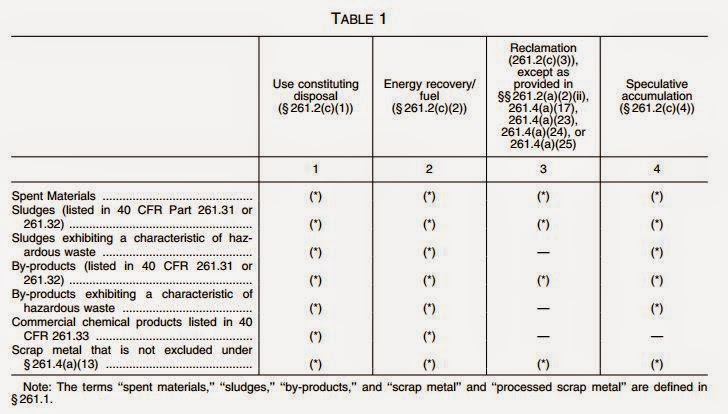
[261.2(c)(3)] Reclaimed. Materials noted with a ‘‘—’’ in column 3 of Table 1 are not solid wastes when reclaimed. Materials noted with an ‘‘*’’ in column 3 of Table 1 are solid wastes when reclaimed unless they meet the requirements of ...Here is where it gets fun kids! Let's look at Table 1:
Let's bring out Matlock to explain this:
Matlock: Do we all agree that Gallo Glass produces a sludge? Do we also all agree that the sludge they produce exhibits the characteristic of hazardous waste, in this case, it exceeds the toxicity threshold in 261.24's Table 1 for arsenic, cadmium, lead, and selenium?
DTSC: Objection!
Judge: Overruled!
Matlock: Do you see, on the EPA's Table 1 which is in 40 CFR 261.2, an item in the first column that sounds a lot like Gallo Glass' EP waste? I think the third item down "Sludges exhibiting a characteristic of hazardous waste" fits the bill pretty gosh darn close!
DTSC: Objection!
Judge: Overruled!
Matlock: So as I was a sayin' we have Gallo Glass's EP sludge clearly identified on Table I do we not? Now my client takes that EP sludge and returns it back into the process. This is an industry best practice used by most glass producers. This, I think we can all agree, meets the definition of recycling does it not?
DTSC: Objection!
Judge: Define for us the term "recycling" Mr. Matlock.
Matlock. Okay, if it please the court, the EPA defines in 40 CFR 261.1(b)(7) that a material is recycled if it is "used, reused, or reclaimed." Now, as I was saying, Gallo Glass recycles this EP sludge by putting it back into the process where it came from. This is recycling in all senses of the word, and. I think we can all agree, meets the EPA definition.
DTSC: Objection!
Judge: Overruled!
Matlock: Now my eyes are not what they used to be when I was just a young sheriff in a small town, so I am going to need some help here. DTSC can you tell me what symbol is noted in forth column over, the one titled "reclamation for the material in the first column that is three down?"
DTSC: Objection!
Judge: Answer the question DTSC!
DTSC: There is a "—" in column 3 of Table 1.
Matlock: And can you tell the judge what the "—" means?
DTSC: Objection!
Judge: Answer the question DTSC!
DTSC: That "—" in the reclamation column means that "sludges exhibiting a characteristic of hazardous waste" are not solid waste when they are reclaimed.
Matlock: And you would agree, DTSC, that reclamation is recycling as per the EPA would you not?
DTSC: Yes, reclamation is recycling under EPA's definition.
Matlock: And you would also agree, DTSC, that you cannot have a hazardous waste without first having a solid waste. Isn't that the way y'all make a hazardous waste determination? Solid waste first?
DTSC: Yes. Solid waste is required to call something a hazardous waste.
Matlock: And in that column there is a "—" symbol which means that Gallo Glass' EP sludge is not a solid waste and therefore is not a hazardous waste! I'm a rational, reasonable man DTSC, and as plain as the nose on my face, Gallo Glass did not generate a hazardous waste!
DTSC: Objection!
Judge: What is your objection DTSC, Matlock's brilliant summary has convinced me.
DTSC: Table 1 only excludes "sludges exhibiting a characteristic of hazardous waste" from being a solid waste if they are reclaimed. Would your honor ask Mr. Matlock to define for him what the definition of reclamation is?
Matlock: Objection!
Judge: Answer the question Mr. Matlock.
Matlock: Er...ah...gosh...here it is...261.1(b)(4) "a material is "reclaimed" if it is
processed to recover a usable product,
or if it is regenerated."
DTSC: And what does your client tell us they are doing with that EP sludge? If you look at number 34 in the compliant you...
Matlock: Objection!
Judge: Answer the question Mr. Matlock.
Matlock: "Defendants claim EP sludge was being used as a substitute for salt cake, a raw ingredient used in the making of glass bottles..."
DTSC: Thank you Mr Matlock. Will your honor agree that what Gallo Glass is doing with the EP sludge is not reclamation and therefore their EP sludge is a solid waste?
Judge: Well...based on that information, I would have to agree with you...
Matlock: Doh!
Announcer: Has Ben Matlock finally met his match? Does Gallo Glass generate an EP sludge that is a hazardous waste? Can this EP sludge be recycled by putting it back into the process? What will happen next is anyone's guess! Stay tuned for our next post: Part 7!
Saturday, March 7, 2015
Bottle of Wine.... Gallo Glass vs. DTSC - Part 5
There is RCRA the Law and RCRA the Regulation.
As generators of stuff, we pay attention to the regulations. Now I know, California has their own take on this. But when you call something a "RCRA hazardous waste" it means under the federal definitions 30 CFR 261.
Your state can be more stringent on what it wants done, but it cannot change this definition. It belongs to RCRA and RCRA regulations for hazardous waste determination begin in 40 CFR Part 261.
Where are we at this point?
Gallo Glass has a sludge
The sludge has four specifically identified heavy metals in Table 1 and would meet the definition of a hazardous waste under 40 CFR 261.24
The EP sludge is being recycled according to Gallo Glass
Does that sound like a reasonable synopsis of what we know at this point? To me it does, so let's move on.
Next post: Part 6
As generators of stuff, we pay attention to the regulations. Now I know, California has their own take on this. But when you call something a "RCRA hazardous waste" it means under the federal definitions 30 CFR 261.
Your state can be more stringent on what it wants done, but it cannot change this definition. It belongs to RCRA and RCRA regulations for hazardous waste determination begin in 40 CFR Part 261.
[261.1] This part identifies those solid wastes which are subject to regulation as hazardous wastes under parts 262 through 265, 268, and parts 270, 271, and 124 of this chapter and which are subject to the notification requirements of section 3010 of RCRA. In this part:
(a)(1) Subpart A defines the terms ‘‘solid waste’’ and ‘‘hazardous waste’’, identifies those wastes which are excluded from regulation under parts 262 through 266, 268 and 270 and establishes special management requirements for hazardous waste produced by conditionally exempt small quantity generators and hazardous waste which is recycled.
This is how you make sausage, so bear with me...
(b)(1) The definition of solid waste contained in this part applies only to wastes that also are hazardous for purposes of the regulations implementing subtitle C of RCRA. For example, it does not apply to materials (such as non-hazardous scrap, paper, textiles, or rubber) that are not otherwise hazardous wastes and that are recycled.
This is kind of important here. If a material is not hazardous and it will be recycled, the EPA is telling us that that stuff is not the Droids they are looking for.
Because we know (assume to know) that the EP sludge is characteristic toxic for arsenic, cadmium, lead, and selenium, (b)(1) applies to Gallo Glass' EP sludge.
![]() |
| Help me 40 CFR 261.2(c)(3) you are my only hope! |
This brings us to the definition of "solid waste" in 40 CFR 261.2. Ya' can't have a hazardous waste unless you have a solid waste. Here is where we make the sausage good!
[261.2(a)(1)] A solid waste is any discarded material that is not excluded...
[261.2(b)(1)] A discarded material is any material which is...
[261.2(b)(1)(B)] Recycled, as explained in paragraph (c) of this section...
Is Gallo recycling the EP sludge? Here is what Gallo says in the March 2, 2015 press release:
Precipitate captured by our air emission controls is comprised of the same raw materials used to make glass so we use it instead of adding new raw materials. The use of precipitate in glass making is recognized throughout the world as the environmentally-sustainable best practice
The DTSC, in number 33 states:
EP sludge is also a "recyclable material"...It's going to get, in my opinion, a little wacky on Gallo Glass' part here. I'll go down what I consider to be the most logical path, in terms of meeting the regulatory definition. As a reminder, I am looking first at EPA's regulations. I'll then look at California's to see if that changes anything.
Where are we at this point?
Gallo Glass has a sludge
The sludge has four specifically identified heavy metals in Table 1 and would meet the definition of a hazardous waste under 40 CFR 261.24
The EP sludge is being recycled according to Gallo Glass
Does that sound like a reasonable synopsis of what we know at this point? To me it does, so let's move on.
Next post: Part 6
Saturday, January 11, 2014
Eviscerating the longstanding principle of CERCLA: Part 3
Looking into the actual Bill that HuffPost wrote about we can find a little bit more about how the majority and minority opinion sees these changes.
EarthJustice has 129 public interest groups urging Congress to oppose this Bill:
Now lets look at the dissenting view on this Bill:
So remove the three year requirement under the SWDA for the EPA to "review, and revise, as the Administrator determines appropriate, regulations promulgated under this Act" and that "unambiguous" thingy goes away.
Could this be what this Bill is all about? "Only three lawsuits have ever been brought to enforce this deadline, and all have been brought in the last year because of significant delays in EPA's coal ash rulemaking." The plot thickens again.
Coal ash aside, that's for another post...maybe...on should it be, or should it not be, a hazardous waste. I still want to know how this Bill "eviscerates CERCLA" and "places the health of our communities and our environment in great danger." At this point the Bill seems aimed at taking away that "unambiguous" dealypopper EarthJustice won in their court challenge in order to get the EPA to decide.
No decision is good for the coal ash guys and also keeps the EPA out of the nasty fight that happens when a proposed rule is put out for public comment. I can't blame the EPA for kicking it down the road, but...their job is to regulate regardless of the pain of that fight. It is, or it is not, hazardous waste.
Dang, when I started I thought this would be a three part post. Title one, two and three of the Bill. But this is going down a rabbit hole I need to explore.
Eviscerating the longstanding principle of CERCLA: Part 4
.
EarthJustice has 129 public interest groups urging Congress to oppose this Bill:
...because these three bills place the health of our communities and our environment in great danger and increase the cost of hazardous waste cleanup for U.S. taxpayers....and here is what the Bill's authors say about their Bill regarding the need for this legislation:
RCRA and CERCLA both contain deadlines that were enacted over thirty years ago and now either are outdated or unnecessary. Section 2002(b) of RCRA was enacted as part of the 1976 Amendments to the Solid Waste Disposal Act at a time when the complexity and volume of regulations was significantly less. To require EPA to review and, if necessary, revise all current regulations under RCRA every three years would pose an unnecessary regulatory burden on the Agency.
Section 108(b)(1) of CERCLA was enacted in 1980 and contains a deadline by which EPA was to identify the classes for which financial responsibility requirements would first be developed. EPA missed the deadline by almost thirty years, but has since completed the task of identifying the classes of facilities. These deadlines are no longer appropriate.
CERCLA section 108(b) gives EPA authority to establish Federal requirements for financial responsibility for various classes of facilities consistent with the degree and duration of risk associated with the facilities' production, transportation, treatment, storage, or disposal of hazardous substances. The intent of section 108(b) was to reduce future reliance on the Hazardous Substances Superfund and to assure the availability of funds to address the release of hazardous substances.
When CERCLA was enacted in 1980, Congress directed the President to identify the classes of facilities that presented the highest risk of injury no later than three years after the date of enactment, and Congress likely intended that the process of establishing financial responsibility requirements would be done quickly. However, for almost thirty years, EPA did not start the process of establishing requirements under section 108(b), leaving States or other Federal agencies to promulgate financial responsibility requirements.
A significant body of State and other Federal law currently exists that requires facilities to provide evidence of financial responsibility. It is important that EPA understand the existing financial responsibility requirements under State or other Federal law because it is unnecessary for EPA to establish financial responsibility requirements under section 108(b) for facilities or classes of facilities that are already sufficiently covered by State or other Federal law or regulations. It also is important that the existing State or other Federal requirements be protected and that compliance with these requirements be counted towards compliance with any new requirements determined to be necessary by EPA.Interesting bit of backstory there. I did not know this.
Now lets look at the dissenting view on this Bill:
The legislation would amend RCRA to repeal a requirement that regulations be reviewed every three years, with the primary effect of blocking ongoing litigation brought by industry and environmental groups.
The legislation would also complicate the process for establishing federal financial responsibility requirements for the most polluting industries, and prevent those requirements from going into effect in some states, potentially leaving cleanup costs to taxpayers.Here is the opposition's arguments:
Although the majority report states that the requirement to review and, if necessary, revise RCRA regulations every three years ``would pose an unnecessary regulatory burden on the Agency'' that requirement is longstanding and there is no evidence before the Committee that it has imposed a burden on the Agency. Democratic members submitted questions to EPA for the record of the hearing on this bill, seeking information about the time spent by staff carrying out this requirement. According to EPA, no staff time (0 FTEs) is used to carry out this requirement.I'll let you decide on that accuracy of that last sentence. That could be true because it was not being performed. Okay, please continue...:
The primary effect of this provision [remove the three year review requirement under SWDA] appears to be to pick winners and losers in pending litigation. The Subcommittee on Environment and the Economy heard at the May 17, 2013, legislative hearing on this bill that only three lawsuits have ever been brought to enforce this deadline, and all have been brought in the last year because of significant delays in EPA's coal ash rulemaking. An attorney bringing one of those suits, Abigail Dillen of EarthJustice, testified that the discussion draft would threaten that ongoing lawsuit.The plot thickens...
In a decision Tuesday, U.S. District Judge Reggie Walton of the D.C. Circuit Court gave the EPA 60 days to file what he calls “a proposed deadline for its compliance with its obligation to review and revise if necessary … regulations concerning coal ash,” as well as any legal reasoning for the timeline. The memorandum follows an earlier judicial order, issued Sept. 30, partly ruling in favor of Earthjustice and 10 other groups in a lawsuit challenging the EPA over its slow regulatory action. (1)Ahhh. So EarthJustice went after the EPA regarding their slow rulemaking for coal ash under the argument that they had three years to "review and revise if necessary." Here is what The Center for Public Integrity writes about this case:
Debate over federal regulation of coal ash has dragged on for decades. After a disastrous December 2008 spill in eastern Tennessee, the EPA pledged to act. In June 2010, the agency announced a proposal to begin regulating the disposal of coal ash, presenting two alternatives in a 563-page draft. Under the first option, the EPA would classify the ash as “hazardous,” triggering a series of strict controls for its dumping. The second option would deem coal ash “non-hazardous” and subject it to less stringent national standards that amount to guidelines for states.
Three years after unveiling its plan, however, the EPA has delayed the rules, sparking the environmental groups’ legal challenge.
In Tuesday’s decision, Walton sided with the environmental groups in finding that, under federal waste law, the EPA has a duty to review and, if necessary, revise rules every three years. But the agency has not done so for rules governing coal-ash disposal since 2000.
“The language is unambiguous in its command,” the judge wrote, “and contains no limitation ending the EPA’s obligation to undertake such reviews and revisions at least every three years.”"Unambiguous in its command."
So remove the three year requirement under the SWDA for the EPA to "review, and revise, as the Administrator determines appropriate, regulations promulgated under this Act" and that "unambiguous" thingy goes away.
Could this be what this Bill is all about? "Only three lawsuits have ever been brought to enforce this deadline, and all have been brought in the last year because of significant delays in EPA's coal ash rulemaking." The plot thickens again.
Coal ash aside, that's for another post...maybe...on should it be, or should it not be, a hazardous waste. I still want to know how this Bill "eviscerates CERCLA" and "places the health of our communities and our environment in great danger." At this point the Bill seems aimed at taking away that "unambiguous" dealypopper EarthJustice won in their court challenge in order to get the EPA to decide.
No decision is good for the coal ash guys and also keeps the EPA out of the nasty fight that happens when a proposed rule is put out for public comment. I can't blame the EPA for kicking it down the road, but...their job is to regulate regardless of the pain of that fight. It is, or it is not, hazardous waste.
Dang, when I started I thought this would be a three part post. Title one, two and three of the Bill. But this is going down a rabbit hole I need to explore.
Eviscerating the longstanding principle of CERCLA: Part 4
.
Eviscerating the longstanding principle of CERCLA: Part 2
The problem with the Bill that HuffPost linked to is that it does not give the reasoning for the Bill. For that, I had to go to House Report. Here is what they have to say about the Bill
Here is the Purpose and Summary:
Basically, it makes it unlikely that any change in the financial assurance requirements in place at this time will change in the future. Although this gives more certainty for businesses in terms of that particular cost, it also makes it much more difficult - as I read it - to obtain "additional financial assurance requirements are necessary to prevent the United States from incurring response costs under section 104 of CERCLA."
That's not good for the taxpayer - in my opinion - but only if the taxpayer is left cleaning up the mess. I am not sure how to look at this in terms of that impact to the taxpayer is actually there. On one hand, it is doubtful that you could ever provide enough financial assurance to cover the response costs possible - look at the BP spill in the gulf. That is, the taxpayer will always be on the hook because at some point the financial assurance will not be enough no matter how high you set it.
On the other hand, and I think most businesses would agree, you could, because of this financial assurance requirement, price a lot of companies out of business because they could not meet it or find and insurance company to offer them that amount of protection. Like it or not, there is a limit of what can be afforded and what an insurer is able to provide (that's why CERCLA says; "To the maximum extent practicable, the President shall cooperate with and seek the advice of the commercial insurance industry in developing financial responsibility requirements").
There is also something else that may be driving this. If you want to stop something from taking place, say a pipeline for example, you could make that financial assurance so high as that it cannot be met. This serves the purpose of an agenda. This also works in stifling competition, by making it so costly that only the big boys can meet it. It works both ways.
Other than this one issue, Title One of this Bill gives me no heartburn. I think the senate could reconcile the possible burden to the taxpayer by requiring a minimum financial assurance equal to the median of what is required in all 50 states. This way California does not dominate on the high side and Texas on the low. Businesses would also have an idea of what the top amount they need would be. This could be looked at every three or five years, giving some measure of certainty.
Eviscerating the longstanding principle of CERCLA: Part 3
.
Here is the Purpose and Summary:
The legislation removes unnecessary and outdated deadlines for certain rulemaking activities to be conducted by the Environmental Protection Agency (EPA) under the Solid Waste Disposal Act (commonly referred to as the Resource Conservation and Recovery Act or RCRA) and the Comprehensive Environmental Response Compensation and Liability Act (CERCLA).
The legislation requires EPA, before promulgating financial responsibility requirements under CERCLA, to evaluate existing State or other Federal financial assurance requirements to determine whether additional requirements are necessary.
Should EPA determine that additional financial assurance requirements are necessary to prevent the United States from incurring response costs under section 104 of CERCLA, the legislation protects the existing State or Federal requirements by requiring that EPA accept compliance with the existing requirements in lieu of compliance with the new EPA requirements.
The legislation also requires that the owner or operator of a facility that stores chemicals on the Department of Homeland Security Chemicals of Interest that are flammables or explosives above the identified threshold, to report the presence of such chemicals to the State emergency response commission.The issue one could make revolves around this:
...by requiring that EPA accept compliance with the existing requirements in lieu of compliance with the new EPA requirements.My read on that is if financial assurance requirements are found necessary by the EPA, that same EPA must accept compliance with existing requirements already in place. Whereas before, under CERCLA, EPA (the President) could say we need this amount, this new law says that the only way to get that is to raise the financial assurance requirements in place under other federal, and now state laws.
Basically, it makes it unlikely that any change in the financial assurance requirements in place at this time will change in the future. Although this gives more certainty for businesses in terms of that particular cost, it also makes it much more difficult - as I read it - to obtain "additional financial assurance requirements are necessary to prevent the United States from incurring response costs under section 104 of CERCLA."
That's not good for the taxpayer - in my opinion - but only if the taxpayer is left cleaning up the mess. I am not sure how to look at this in terms of that impact to the taxpayer is actually there. On one hand, it is doubtful that you could ever provide enough financial assurance to cover the response costs possible - look at the BP spill in the gulf. That is, the taxpayer will always be on the hook because at some point the financial assurance will not be enough no matter how high you set it.
On the other hand, and I think most businesses would agree, you could, because of this financial assurance requirement, price a lot of companies out of business because they could not meet it or find and insurance company to offer them that amount of protection. Like it or not, there is a limit of what can be afforded and what an insurer is able to provide (that's why CERCLA says; "To the maximum extent practicable, the President shall cooperate with and seek the advice of the commercial insurance industry in developing financial responsibility requirements").
There is also something else that may be driving this. If you want to stop something from taking place, say a pipeline for example, you could make that financial assurance so high as that it cannot be met. This serves the purpose of an agenda. This also works in stifling competition, by making it so costly that only the big boys can meet it. It works both ways.
Other than this one issue, Title One of this Bill gives me no heartburn. I think the senate could reconcile the possible burden to the taxpayer by requiring a minimum financial assurance equal to the median of what is required in all 50 states. This way California does not dominate on the high side and Texas on the low. Businesses would also have an idea of what the top amount they need would be. This could be looked at every three or five years, giving some measure of certainty.
Eviscerating the longstanding principle of CERCLA: Part 3
.
Friday, January 10, 2014
Eviscerating the longstanding principle of CERCLA: Part 1
Well Google News piqued my interest again.
Earthjustice claims that Tile One of this Bill will:
Solid Waste Disposal Act 2002
Earthjustice claims that Tile One of this Bill will:
That's a requirement to send a report to Congress before promulgating any financial responsibility requirement. Not sure how either of these changes " fail to ensure full liability for toxic waste cleanup."
Earthjustice claims that Tile One of this Bill will:
This change to 114(d), as I read it (not a lawyer, blaw, blaw, blaw). No wait. This is my dang country and this is my dang Congress writing goshdarn Bills and putting them up for the public to comment. I am the public and this is how I read the goshdarn thing. So there!
114(d) removes from the President this ability:
So there you have the Title One changes. I don't see "evisceration" or "endangering the health of communities" Businesses will still need to meet established federal financial requirements and must now meet state requirements that can be imposed.
That leaves just one more new section to look at. Here is what that one says:
House Republicans Just Quietly Passed A Bill Gutting Hazardous Waste LegislationHuffPost goes on to say:
The Bill, called the Reducing Excessive Deadline Obligations Act, amends both the Solid Waste Disposal Act and the Comprehensive Environmental Response, Compensation and Liability Act (which is commonly known as Superfund)....and...:
The environmental group Earthjustice has said the bill would "gut" the Superfund program,HuffPost was nice enough to give a link to the Earthjustice letter opposing the Bill. There I am told:
The three bills that comprise H.R. 2279 weaken the nation’s hazardous waste laws and place American communities at increased risk of toxic exposure and financial liability in the following ways.
So I read their letter and I read the Bill and I am left with the question of how? I don't know about y'all, but reading legalize stuff takes a bit of time to get into the ol' noggin. Plus, I am not a lawyer, though I have stayed at a Holiday Inn (add drum kerplunk here).
I thought that it might be easier to see what changes were made and how those changes actually look. So here goes a try at the "how."
Earthjustice claims that Tile One of this Bill will:
Eliminate the requirement for EPA to ensure in a timely fashion that its hazardous waste regulations are current, relevant and effective to protect human health and the environment. The bill removes a requirement for periodic review of regulations under RCRA, making the timing of review wholly discretionary.
Here is the change [Words in red are new. Words with a line through them were deleted]
Solid Waste Disposal Act 2002
2002(b) REVISION OF REGULATIONS.—Each regulation promulgatedunder this Act shall be reviewed and, where necessary, revised notless frequently than every three years.
2002(b) REVIEW OF REGULATIONS.—The Administrator shall review, and revise, as the Administrator determines appropriate, regulations promulgated under this Act.Basically each regulation under the SWDA will only need to be reviewed and revised when deemed appropriate. The part dealing with hazardous waste, RCRA, has been on the books since 1980. This would mean that it has been" reviewed and, where necessary, revised" at least 10 times. Most of the rule changes we have seen have been to reduce the regulatory burden by removing regulations that no longer serve a purpose.
Earthjustice claims that Tile One of this Bill will:
Eviscerate the longstanding principle of the Superfund law that polluters must pay for cleanup of hazardous waste releases by allowing insufficient existing requirements to block Superfund obligations, thereby leaving communities unprotected and taxpayers at risk of funding expensive cleanups.CERCLA
108 (b)(1) Beginning not earlier than five years after the date of enactment of this Act, the President shall, promulgate requirements (for facilities in addition to those under subtitle C of the Solid Waste Disposal Act and other Federal law) that classes of facilities establish and maintain evidence of financial responsibility consistent with the degree and duration of risk associated with the production, transportation, treatment, storage, or disposal of hazardous substances.Not sure how that equates to "evisceration" but to each their own.Not later than three years after the date of enactment of the Act, the President shall, as appropriate, identify those classes for which requirements will befirstdeveloped and publish notice of such identification in the Federal Register. Priority in the development of such requirements shall be accorded to those classes of facilities, owners, and operators which the President determines present the highest level of risk of injury.
Earthjustice claims that Tile One of this Bill will:
Fail to ensure full liability for toxic waste cleanup, thus endangering the health of communities, causing significant delays in remediation, and placing a great burden on taxpayers to cover the shortfall, which is often substantial, particularly at hardrock mine sites and large chemical facilities.
108(b)(2) The level of financial responsibility shall be initially established, and, when necessary, adjusted to protect against the level of risk which the President in his discretion believes is appropriate based on the payment experience of the Fund, commercial insurers, courts settlements and judgments, and voluntary claims satisfaction. To the maximum extent practicable, the President shall cooperate with and seek the advice of the commercial insurance industry in developing financial responsibility requirements.The Bill will add this to the end of CERCLA's Section 108:Financialresponsibility may be establishedOwners and operators may establish financial responsibility by any one, or any combination, of the following: insurance, guarantee, surety bond, letter of credit,orand qualification as a self-insurer. In promulgating requirements under this section, the President is authorized to specify policy or other contractual terms, conditions, or defenses which are necessary, or which are unacceptable, in establishing such evidence of financial responsibility in order to effectuate the purposes of this Act.
| Source |
Earthjustice claims that Tile One of this Bill will:
Place burdensome and unnecessary roadblocks to delay establishment of financial assurance requirements to ensure polluters have bonds or other insurance in place to cover the nation’s most costly and high risk Superfund cleanups.CERCLA
114(d)Except as provided in this title, no owner or operator of a vessel or facility who establishes and maintains evidence of financial responsibility in accordance with this title shall be required under any State or local law, rule, or regulation to establish or maintain any other evidence of financial responsibility in connection with liability for the release of a hazardous substance from such vessel or facility. Evidence of compliance with the financial responsibility requirements of this title shall be accepted by a State in lieu of any other requirement of financial responsibility imposed by such State in connection with liability for the release of a hazardous substance from such vessel or facility.
114(d) No owner or operator of a vessel or facility who establishes and maintains evidence of financial responsibility associated with the production, transportation, treatment, storage, or disposal of hazardous substances pursuant to financial responsibility requirements under any State law or regulation, or any other Federal law or regulation, shall be required to establish or maintain evidence of financial responsibility under this title, unless the President determines, after notice and opportunity for public comment, that in the event of a release of a hazardous substance that is not a federally permitted release or authorized by a State permit, such other Federal or State financial responsibility requirements are insufficient to cover likely response costs under section 104. If the President determines that such other Federal or State financial responsibility requirements are insufficient to cover likely response costs under section 104 in the event of such a release, the President shall accept evidence of compliance with such other Federal or State financial responsibility requirements in lieu of compliance with any portion of the financial responsibility requirements promulgated under this title to which they correspond.Okay, that's a pretty significant change.
This change to 114(d), as I read it (not a lawyer, blaw, blaw, blaw). No wait. This is my dang country and this is my dang Congress writing goshdarn Bills and putting them up for the public to comment. I am the public and this is how I read the goshdarn thing. So there!
114(d) removes from the President this ability:
[CERCLA] 108(b)(2) ...The level of financial responsibility shall be initially established, and, when necessary, adjusted to protect against the level of risk which the President in his discretion believes is appropriate based on the payment experience of the Fund, commercial insurers, courts settlements and judgments, and voluntary claims satisfaction...What the new language says is this:
If the President determines that such other Federal or State financial responsibility requirements are insufficient to cover likely response costs...the President shall accept evidence of compliance with such other Federal or State financial responsibility requirements...What this new language appears to do is shift the financial responsibility requirement to what is required under current federal law and allows the states to impose their own requirements. The old language required the state to accept the same requirements. This is kind of a role reversal where it is now the President that must except these financial liability responsibilities imposed by others.
Old: Evidence of compliance with the financial responsibility requirements of this title shall be accepted by a State in lieu of any other requirement of financial responsibility imposed by such State in connection with liability for the release of a hazardous substance from such vessel or facility.
New: the President shall accept evidence of compliance with such other Federal or State financial responsibility requirements in lieu of compliance with any portion of the financial responsibility requirements promulgated under this title to which they correspond.
That leaves just one more new section to look at. Here is what that one says:
SEC. 6. EXPLOSIVE RISKS PLANNING NOTIFICATION. Not later than 180 days after the date of enactment of this Act, the owner or operator of each facility at which substances listed in Appendix A to part 27 of Title 6, Code of Federal Regulations, as flammables or explosives are present above the screening threshold listed therein shall notify the State emergency response commission for the State in which such facility is located that such substances are present at such facility and of the amount of such substances that are present at such facility.
That seems to be there because of West Texas and some of the other hazardous material problems we have had lately. I can't see how that section would give Earthjustice heartburn.
Maybe the other titles will have something that gets close to evisceration.
Next post: Eviscerating the longstanding principle of CERCLA: Part 2
.
Tuesday, September 7, 2010
Part 5: You say perfectly good stuff. They say spent
Our question now revolves around two points of contention. Was the EPA correct in calling Air Products' sulfuric acid "spent" and, was Air Products incorrect when they claimed the sulfuric acid was "not a solid waste?”
The answer hinges on the word spent and how the sulfuric acid was being recycled. So first things first. In my last post we looked at two possibilities for the group into which their sulfuric acid could fall. We decided that by-products could work but wanted to take our chances with the category called "spent materials." If we could argue that the sulfuric was not a by-product and could show it was not a spent material, well then it would not meet the definition of a solid waste as long as we recycled it.
Now we know from the Consent Decree that EPA calls the sulfuric acid "spent" and classified it as a solid waste - which - because it was an acid and contained 2,4-DNT, makes it a hazardous waste. We know also that Air Products contends the sulfuric acid was a "product that was purposefully produced since the inception of its Facility and that this product was not a solid waste or a hazardous waste." The decision was made by Air Products to not call the sulfuric acid they produced a "spent material" for reasons I can only speculate...
Perhaps they felt the sulfuric acid was not contaminated enough to call it a waste since it could be used as a feedstock by another company.
Perhaps they felt the term spent did not attach to the sulfuric acid because they had planned for it to be sent to Agrifos as a feedstock for their use.
Perhaps they saw the sulfuric acid as just another product they produced and the terms spent and recycled did not apply since those terms denote a waste.
The EPA on the other hand saw things differently based on how they defined the term spent.
Nicely played pilgrim! However, the EPA begs to differ on what that word "contaminated" means.
Right now we know two things about Air Products' used sulfuric acid.
Next post: The three recycling methods that cause your recyclable material to become a solid waste.
.
The answer hinges on the word spent and how the sulfuric acid was being recycled. So first things first. In my last post we looked at two possibilities for the group into which their sulfuric acid could fall. We decided that by-products could work but wanted to take our chances with the category called "spent materials." If we could argue that the sulfuric was not a by-product and could show it was not a spent material, well then it would not meet the definition of a solid waste as long as we recycled it.
Now we know from the Consent Decree that EPA calls the sulfuric acid "spent" and classified it as a solid waste - which - because it was an acid and contained 2,4-DNT, makes it a hazardous waste. We know also that Air Products contends the sulfuric acid was a "product that was purposefully produced since the inception of its Facility and that this product was not a solid waste or a hazardous waste." The decision was made by Air Products to not call the sulfuric acid they produced a "spent material" for reasons I can only speculate...
Perhaps they felt the sulfuric acid was not contaminated enough to call it a waste since it could be used as a feedstock by another company.
Perhaps they felt the term spent did not attach to the sulfuric acid because they had planned for it to be sent to Agrifos as a feedstock for their use.
Perhaps they saw the sulfuric acid as just another product they produced and the terms spent and recycled did not apply since those terms denote a waste.
The EPA on the other hand saw things differently based on how they defined the term spent.
"used and as a result of contamination can no longer serve the purpose for which it was produced without processing?"So asking the following two questions:
- Was the sulfuric acid used by Air Products. Yes
- Could it no longer serve its purpose because of contamination? Err...Y...
Nicely played pilgrim! However, the EPA begs to differ on what that word "contaminated" means.
"Regarding whether a material must be nonfunctional to meet the definition of spent material, the fact that a material can continue to be used for its original purpose is not relevant to the issue of whether or not it is a spent material when it is clear from the facts that the material will not be used but instead will be treated by reclamation. The mere potential for continued original use does not preclude a material from being defined as spent. [t]he fact that it is actually removed from service establishes, as to this generator, that it can no longer serve its original purpose."The EPA further goes on to state:
"We have consistently interpreted [the spent material] definition as meaning "materials that have been used and are no longer fit for use without being regenerated."and...
"We thus consider "contamination," as used in the definition of spent material, to be any impurity, factor, or circumstance which causes the material to be taken out of service for reprocessing."OK, so far every one of these explanations has within them the caveat that it is to be reclaimed, regenerated, or reprocessed. What if I am not going to do any of those things and I could use it as is? Well that sends you down a very different path that we will address later. Right now the question is on this particular sulfuric acid and wether or not it meets the definition of spent. So asking the question.
Can Air Products use the sulfuric acid for any other process without reclaiming it, regenerating it, or reprocessing it?Well we don't have that inside information available to us, so all we can go on is that since they could no longer use it themselves, the assumption is that reclaimation, regeneration, or reprocessing would be required in order to make the sulfuric acid usable for them. Because they cannot use it in its present condition because of contamination - it becomes a spent material.
Right now we know two things about Air Products' used sulfuric acid.
- It meets the EPA definition of being recycled
- It meets the EPA definition of spent
Next post: The three recycling methods that cause your recyclable material to become a solid waste.
.
Subscribe to:
Posts (Atom)