Saturday, July 6, 2013

When a Spill Becomes Illegal Disposal. Part 1

My Google News Feed is set to show news stories with the search term "hazardous waste."  When I checked it Friday, this popped up:
Calif. regulators recommend controversial toxic waste dump expansion.
"Toxic waste dump"?  Oh...they must be taking about Kettleman Hills.  How do I know this? I attended a class a while back with a lady who works for waste management as an EHS professional who told me about the request for an expansion and the push back from environmental groups who were working on behalf of the townsfolk to block it.

I also know about Kettleman Hills because I got my start in hazardous waste management in California and that was one of the facilities we used back in 1984.  Why the fuss over expansion of a facility that has been there for well over 30 years?
California regulators are recommending allowing a major expansion of the largest hazardous waste dump in the Western United States, even though some residents blame the dump for birth defects and have opposed the expansion, officials said on Tuesday.
Birth defects?  From the Kettleman Hills landfill?


Kettleman Hills is over three miles from the city of Kettleman out in the middle of nowhere.  Here is what the EPA has to say about the site:
The Chemical Waste Management (CWM), Kettleman Hills Facility is a commercial hazardous waste treatment, storage, and disposal facility located in Kings County, California, south-west of the intersection of Interstate 5 and Highway 41. The CWM Facility handles polychlorinated biphenyls (PCB) waste, non-PCB hazardous waste, and solid waste.
EPA regulates the handling, storage and disposal of PCB waste at the CWM Facility under a TSCA permit. The State of Cali­fornia, authorized under federal law, regulates the handling, storage and disposal of hazardous waste under a Resource and Recovery Act (RCRA) hazardous waste permit.
What about those birth defects?   I do a Google search and I get this:


Hmmm.  "What's the killing the babies of Kettleman City" seems a good place to start.  Dated July/August 2010, it's from Mother Jones which uses real honest-to-goodness journalists.  Yeah it slants to the left, but at least its got some hope of decent reporting.
Maybe it's the toxic waste dump. Maybe the pesticides, or the diesel fumes, or the arsenic. How a small-town mystery could change the way we look at pollution.
There's that word "dump" again.  These landfills are not dumps, especially a hazardous waste permitted landfill that is also permitted to accept PCBs.  But I digress.  Here is what Mother Jones writes:
There are between 30 and 64 births each year in Kettleman City. In 15 of the 22 years since California's public health department began tracking birth defects, all babies in the town were healthy, and in five other years, only one birth defect occurred. But in the last two years and 10 months, residents say, at least 11 babies have been born with serious birth defects. Three eventually died; another was stillborn. Most have cleft lips or palates, and some have other, graver maladies. "When my child was born," Magdalena says, "I thought she was the only one with a deformity. But when it began happening to other babies, I realized there was something abnormal in my community."
Okay, so in 2010, there was seen 11 babies born with birth defects in a 34 month period.  That's way above the "none" for 15 years and the one each for five years.  What's up with that?
Despite Kettleman City's remote setting amid almond groves and tomato fields, its residents are exposed to a startling array of toxic chemicals. Nearly 100 trucks spewing diesel fumes roll through town daily on Highway 41, and many more come by on Interstate 5. More than half of Kettleman City's labor force consists of farmworkers who are routinely exposed to toxic pesticides, and residents can smell the chemicals sprayed on the fields that border the town on three sides. Kettleman City's two municipal wells are contaminated with naturally occurring arsenic and benzene. And there are projects in the works to build a massive natural gas power plant nearby, as well as to deposit 500,000 tons per year of Los Angeles sewage sludge on farmland a few miles from the town.
Diesel trucks...pesticides...arsenic & benzene in the drinking water...sewage sludge on farmland...
But the biggest environmental villain, in the view of local residents, is Waste Management Inc., which operates a vast hazardous-waste dump three miles from town. Waste Management is the nation's largest waste-disposal company, and the Kettleman Hills landfill is the biggest toxic-waste dump west of Alabama, where another Waste Management facility is located in another poor, minority community. California's two other toxic-waste dumps are also located near Latino farmworker towns.
Well now I know where this article is going. Increase in birth defects, hazardous waste landfill 3.5 miles away from the town, minority community...
Last year the Kettleman site accepted 356,000 tons of hazardous waste, consisting of tens of thousands of chemical compounds including asbestos, pesticides, caustics, petroleum products, and about 11,000 tons of materials contaminated with PCBs—now-banned chemicals linked to cancer and birth defects. Waste Management has been seeking permission since 2006 to increase the dump's size by nearly 50 percent.
Let's see how Mother Jones makes the connection.  Me thinks we have another case of what Stephen Colbert calls "truthiness."
Truthiness is a quality characterizing a "truth" that a person making an argument or assertion claims to know intuitively "from the gut" or because it "feels right" without regard to evidence, logic, intellectual examination, or facts.
So let's look at the case Mother Jones makes for making the Kettleman Hills facility the villain.


Next Post: When a Spill Becomes Illegal Disposal.  Part 2

.

Monday, May 27, 2013

West Texas and Ammonium Nitrate: Part 6

Here is what the  Kaufman County LEPC said they would do if one of their ammonium nitrate fertilizer facilities was involved in a fire:
"If it's in the building housing 50,000 pounds of ammonium nitrate we are going to evacuate the area and back off."
Source
I wrote, but did not post this: "Two very simple steps.  Have a community plan and read the ERG and 12 responders would probably - most assuredly - be alive today."

I have changed my mind on this.  I was wrong to conclude along with everyone else that had they only known, had a plan been developed, this tragedy would have been avoided or minimized.  I have changed my mind based on two issues in play that night:
  1. The explosion took place within 20 minutes of the call
  2. The responders were concerned about the release of anhydrous ammonia - a toxic gas - from the tanks that were at the site.
There is a third factor that plays into this for me as well; ammonium nitrate does not normally explode.
Doreen Strickland, president of the volunteer firefighters from nearby Abbott, pulled up to the plant as it exploded. One of her fire trucks was lifted in the air and slammed back down. Some of her men were inside, and she knew they had to be dead. At least three were killed. But she heard no one discuss ammonium nitrate ahead of the massive blast.
"Our main reason for evacuating at that time was because of the heat and intensity of the fire, and it was so close," Strickland said. The anhydrous ammonia "was a major concern." (1)
I write this blog and these posts as a way of helping me understand something that I should understand (because of my job) or because I am curious.  I write in "real time" meaning I look things up on the fly and have no editor other than maybe a couple of days while I re-write it for clarity and grammar.  The basic premise of these posts is to ask a question and then see if I can answer it.  In the process I end up going down a lot of different paths and looking at a lot of information as I try to bring clarity to the topic I am writing about.

So my question now is this; would discussing the ammonium nitrate with Doreen Strickland have changed anything?  I don't know, no one knows that.  I suspect that it would not for the simple fact that ammonium nitrate used to make fertilizer would not have taken precedence over the anhydrous ammonia tanks.  Ammonium nitrate can explode, but so can a can of gasoline or a propane cylinder.

Basically, and this is where I am willing to go with this, what we know about ammonium nitrate is that it does not explode within 20 minutes of a fire being reported.  We know this now, but we did not understand this at the time.

I train folks to protect themselves.  This is why I give my students instruction on how to use a Material Safety Data Sheet (MSDS), the new Safety Data Sheet (SDS), instruction on how to look up information on the internet using CAMEO or WISER, and how to use the Emergency Response Guidebook (ERG).


Source
So let's start there.  Before the explosion what did we understand about ammonium nitrate that is used to produce a fertilizer?

A good place to start is California.  If you buy into the "Texas businesses can do whatever they please" mindset then you must know that California is the polar opposite.

I was looking up the definition for "ammonitrate" which is the term they use in the 2001 Toulouse, France explosion (it is the French term for "granular ammonium nitrate, used directly in agriculture").  This lead me to the California link:

Clicking on that link brings up the EPA's Chemical Emergency Preparedness and Prevention Office (CEPP) "Alert."

Source

This Alert is dated December of 1997.  I Google'd the name and it still shows 1997.  Here is what the EPA's CEPP says and CalEPA presumably supports:
Ammonium nitrate can be exploded under certain conditions. These must include added energy (heat, shock), especially under conditions of confinement or presence of contaminants. Although ammonium nitrate generally is used safely and normally is stable and unlikely to explode accidentally, accidental explosions of ammonium nitrate have resulted in loss of lives and destruction of property. These accidents rarely occur, but when they do, they have high impacts.
That's what I understood about ammonium nitrate.  I was not alone in that understanding:
Ammonium nitrate, in solid or molten form or in solution, is a stable compound and generally is difficult to explode.
Ammonium nitrate by itself does not burn, but in contact with other combustible materials, it increases the fire hazard. It can support and intensify a fire even in the absence of air. Fires involving ammonium nitrate can release toxic nitrogen oxides and ammonia. A fire involving ammonium nitrate in an enclosed space could lead to an explosion. Closed containers may rupture violently when heated.
It has the potential to exploded, but it takes energy to do so:
Ammonium nitrate may explode, however, when exposed to strong shock or to high temperature under confinement. In a large quantity of ammonium nitrate, localized areas of high temperature may be sufficiently confined by the total quantity to initiate an explosion. The explosion of a small quantity of ammonium nitrate in a confined space (e.g., a pipe) may initiate the explosion of larger quantities (e.g., in an associated vessel).
That's what I understand about ammonium nitrate and that's probably what the plant manager - who died with the responders - also understood as well.

It can explode, but it takes certain conditions to do so.  The explosion happened within 20 minutes of the fire being reported.  History does not show a building holding ammonium nitrate exploding when on fire.  That's not what we have seen in the past:
  • 1921 Germany explosion from attempts to break up large piles of solidified ammonium nitrate using blasting explosives.
  • 1947 Texas City - explosion in ship cargo holds (confinement).
  • 1994 ammonium nitrate solution explodes during manufacturing process.
  • 2001 Toulouse, France explosion in process building - unknown cause
  • 2009 Bryan, Texas (100 miles south of West) Fire in fertilizer plant with over 200 tons of ammonium nitrate. No explosion took place.
What we see now is something different.  We still do not know what initiated the blast.  It should not have exploded.  It did, and that requires an answer as to why.

We need to, in my opinion, move away from this idea that had a plan been in place or if everyone would have known about the ammonium nitrate that all of this could have been avoided.

Maybe, but I doubt it.  In 20 minutes of the call it exploded.  Concern over the anhydrous ammonia tanks was not a misguided approach at that time.  Even though ammonium nitrate can explode, it usually does not.  It did not in the fire in Bryan 100 miles south of West in 2009 so why would we expect it to explode here?

So where do we take this from here?  What should we do in the future?


Next post: West Texas and Ammonium Nitrate: Part 7

.

Sunday, May 26, 2013

West Texas and Ammonium Nitrate: Part 5

I am glad I put the kibosh on the direction I was going with this topic.  Actually it was my wife who told me to back off on the indignation.  That was good advice because while I was changing direction I learned of the 20 minute time frame from initial call to explosion.  Maybe others were aware of how quickly it happened, but I was not.  That information, that time frame, changes the dynamics.

In the post I wrote but did not publish I said this: "If you have responsibility for the health and welfare of people you should understand your job well enough to make sound decisions so that you don't hurt or kill people you are supposed to protect."

That assumes that had they had the information on ammonium nitrate's potential to explode it would have changed things.  Had they had an emergency plan in place, drilled on the plan, looked at every thing there was on responding to a fire where ammonium nitrate is involved, the outcome would have been different.

Maybe...but now I am not so sure.

I used to do emergency response to hazardous chemical incidents.  I have done a lot and they are always different.  They involve a lot of assumptions but follow the same basic measures.  Protect public health and minimize environmental harm.  So when I read this:
Associated Press interviews with first-responders suggest that firefighters' foremost fear was a poisonous cloud of anhydrous ammonia.
I went back to my old days as a HazMat responder and looked at it objectively.  What would I have told them to do if I was the guy in charge?

And if I am objective and honest with myself, I would have had them focus on the anhydrous ammonia tanks while we evacuated the people in the isolation area:

2012 ERG
I would have recommended that those folks 1.3 miles surrounding the facility - not just downwind - be evacuated, and until that time we would have concentrated on keeping the anhydrous ammonia tanks from rupturing.  Then I would have recommended, once the evacuation was underway, that since it is a large fire involving ammonium nitrate that we follow the ERG 140 recommendation:

2012 ERG 140

The 1.3 mile evacuation for the anhydrous ammonia would also cover the ammonium nitrate explosion potential.  When public safety was completed then I would have recommended letting it burn.

2012 ERG 140

That's what I would have most likely recommended in an EPCRA LEPC planning meeting and that's what I would have recommended at the time of the response.  In hindsight that would have been the wrong decision, as the AP points out:
They didn't know, and probably could not imagine, that the plant would soon explode into a deadly fireball and lay waste to much of the community. Instead, they were more concerned with preventing toxic gas from leaking out of the facility and drifting into nearby homes.
That's the focus I would have taken even if I knew there was 200 tons of ammonium nitrate in the building that was now on fire.

Why?

Because ammonium nitrate does not normally explode within 20 minutes of catching on fire.  It has the potential to explode, but that requires a shock wave to initiate the decomposition.  Under almost all normal conditions, ammonium nitrate behaves as an oxidizer and in a fire, though the potential for explosion is there, the concern is the intensity of the fire and the release of ammonia gas in the decomposition.

Ammonia nitrate in a facility that makes fertilizer should not explode.  Should not because that's not what we normally see it do.  That's not what it did in 2009 in Bryan, Texas 100 miles South of West, Texas:
Texas farm country is dotted with fertilizer plants in towns served by volunteer firefighters. But a 2009 blaze at the El Dorado Chemical Co. in Bryan, Texas, unfolded much differently than the disaster in West. Bryan firefighters knew a welder had accidentally heated up an ammonium nitrate bin and that the chemical was smoldering. They evacuated the area and let the facility burn to the ground. Nothing exploded. (AP)
Even though, as the AP points out: "...the plant's vast stockpile of a common fertilizer, ammonium nitrate, which can also serve as a cheap alternative to dynamite."

Yes, ammonium nitrate can be used to blow things up.  Farmers use it to remove stumps and rocks.  And yes, in the "1995 Oklahoma City bombing, and authorities said the plant made materials similar to that used to fuel the bomb that tore apart that city's Murrah Federal Building." (1)

But ammonium nitrate is just an ingredient.  The fact that it can be used to make a bomb makes it no different than acetone used to make Triacetone Triperoxide (TATP) or glycerin to make nitroglycerin.


Ammonium nitrate is an oxidizer, not an explosive.  It has the potential to explode, just like a propane cylinder hooked up to your grill.


The "potential" to explode and "will" explode are two different things.  Now in hindsight we can look at ammonium nitrate differently.  But hindsight was not what these guys had in the 20 minutes it took from the initial call to the explosion.

The one common denominator that must be present is an initiating source.  Fire is not normally the thing that does it.  Timmothy McVey lit a fuse to a blasting cap that initiated the ammonium nitrate/fuel mixture in five 55 gallon drums in the back of a Ryder truck.  The Boston Marathon bombers used ordinary fireworks to provide the explosives but that required a blasting cap on a timer to initiate the blast.  Ammonium nitrate can explode in a fire, but it takes a shock wave faster than the speed of sound to do so.  What, in 20 minutes, produced that shock wave that caused the ammonium nitrate to explode?

My focus would have been on evacuation and immediate concern of the anhydrous ammonia tanks rupturing.

My focus now changes with this new information.  How likely is ammonium nitrate to explode when it is involved in a fire?  That's the question we need answered for West.  What initiated the ammonium nitrate?

From there we can come up with better plans on how to store the ammonium nitrate and respond to a fire should that possibility happen.


Next post: West Texas and Ammonium Nitrate: Part 6

Saturday, May 25, 2013

West Texas and Ammonium Nitrate: Part 4

I've been busy with work and have had little time to follow up on this.  Three day weekend, so I am going to try and wrap up my thoughts on this event.

At this point in time, as of today, they do not know what triggered the blast.  They know it was the ammonium nitrate that exploded, they do not know why it did, or what situation enable it to.

What we do know is that the explosion took place about 20 minutes after the initial response by the fire department.  This bit of information changes my original approach.  I'm still on the same track, only that short time span makes it necessary to re-evaluate my recommendations.

Let's continue basically where we left off.  I want to look at this statement by Reuters:
In February 2013, the company submitted its 2012 Tier II report to Texas DSHS. The county's Local Emergency Planning Committee has no record of receiving a copy, said Mike Dixon, a McLennan County attorney.
It is unclear whether the company ever filed a Tier II report with the local fire department.
What is clear is that when the plant caught fire on April 17, people inside the fire trucks and ambulances that rushed to the scene did not know how much ammonium nitrate was on hand or how quickly it could produce a massive explosion. They had never trained for a scenario like the one that unfolded, said firefighter Kevin Maler.
In the 10 years he has served on the West Volunteer Fire Department, Maler said he never saw West Fertilizer's Tier II report. He added that the department never conducted drills to prepare for an explosion at the facility. Those observations were confirmed by other first responders Reuters interviewed who did not want to be named.
"No one ever knew you were going into something like that," Maler said.
It is easy to play armchair quarterback and assign blame.  We Americans are really good at that.  I am writing this knowing - knowing without any reservation - that the statement "No one ever knew you were going into something like that," should not have been an issue for these responders.

A fire in a fertilizer factory assumes that chemicals are present.  This is, or should be, self-evident.  If it is not, then you need to go back to basic training.  That's not meant to be harsh, that's just common sense.

100 miles away in Bryan Texas there was a fire at a fertilizer plant that resulted in the largest evacuation in United States history.  100 miles away.  It did not blow up, but the chemical of concern was ammonium nitrate.

Fertilizer facility = chemicals inside.  Ask question; what chemicals are we dealing with?  Do not proceed until you know what chemicals are present.  Assume that ammonium nitrate and/or anhydrous ammonia are present.  Look in Emergency Response Guidebook to see how to proceed.

2012 ERG
This is where my new information about what took place - the time frame - changes my view on whether this knowledge might have saved them.  Here is what WTNH-TV News 8 "Connecticut's first television station" writes:
West Mayor Tommy Muska said he did not know how much the firefighters knew about the chemicals on the property, but the fire crew included a manager from the fertilizer plant.
Cody Dragoo "would have known exactly what was in there and the dangers that were there," the mayor said, explaining why he believes firefighters were backing away from the flames at the West Fertilizer Co.
They did not get away fast enough. The plant blew up within 20 minutes of the first call for help. Dragoo was among 10 firefighters and paramedics killed in the blast. Two residents helping to fight the fire were also killed, along with two other people.
I am now unsure if that knowledge would have played any difference in the outcome.  20 minutes from call to explosion gives very little time for them to access the situation and focus on life safety of residence and occupants.

They were aware, according to news reports, that anhydrous ammonia was present in tanks, and they were cooling those off to prevent a catastrophic release of the gas, which is a known poison/toxic inhalation hazard.
Associated Press interviews with first-responders suggest that firefighters' foremost fear was a poisonous cloud of anhydrous ammonia. But the greater threat turned out to be the plant's vast stockpile of a common fertilizer, ammonium nitrate, which can also serve as a cheap alternative to dynamite.
In hindsight that's true.  And with this knowledge we may put together a standard operating plan for response to a facility where ammonium nitrate is stored.  I'll focus later on all the dumb things said about ammonium nitrate by the press and the ill-informed.

Here is what the 2012 ERG book says about responding to a large fire involving ammonium nitrate (ERG 140):


Now ammonium nitrate does not care if it is in a cargo tank, trailer, or warehouse floor.  There was a massive fire at the West facility and the ERG says "withdraw and let fire burn."

Simple enough, if they knew they were dealing with ammonium nitrate, which they should of because the fertilizer plant manager was with them, and had they read guide 140 in the 2012 ERG, they would have know to withdraw.  How far?  Well let's see what the ERG says:


Simple! ...until you factor in the anhydrous ammonia.  Let's look at the ERG for that chemical.  When you look up the name "anhydrous ammonia" you notice that it is highlighted in green:


What they teach you (and this includes me as well) in training for a chemical emergency response is this:


Anything in green is recognized as a don't-breath-it-because-it-can-kill-you hazardous materials.


So if the responders and the facility manager understood that there was a fire and that fire was where tanks containing anhydrous ammonia were stored, the emphasis - priority - might have been placed on keeping those tanks from rupturing.  What we teach responders when they learn to use the ERG is that the green highlighted chemical names require them to go to the "Table of Initial Isolation" page where they are told this:


At the point of the response -within that 20 minute window -the responders appear to have been focused on keeping the anhydrous ammonia from being released.  They had two situations going on at once with two terrible outcomes that had the potential to take place.

This changes the dynamics.  And all of this decision making was taking place in the first 20 minutes.


Next post: West Texas and Ammonium Nitrate: Part 5

.

Sunday, May 5, 2013

West Texas and Ammonium Nitrate: Part 3

Here is what we have been told happened in West Texas
Around 7:30 p.m. on April 17, a fire broke out at the West Chemical and Fertilizer Company plant in West, Texas, a small town of about 2,800 people 75 miles south of Dallas. Twenty minutes later, it blew up."
What happened to put the responders in the area where they could be affected by an explosion -should the ammonium nitrate explode - is not known.

I have been struggling with this post.  I am re-writing this one and will delete the one I wrote after this.  I don't want to point fingers, and that's the direction I was going.  The purpose of this blog is to describe complex issues and situations.  I want to educate not pontificate, retaliate, exasperate  or blab on about my indignation over a situation.

So let me change my tune, and write about what happened so we can maybe all get on board and prevent this type of situation from happening again,

When I give my DOT class on transportation of hazardous materials I tell my students that the DOT method for labeling and marking is "all about communication."  You may know what's in the drum, but the emergency responder or the guy off-loading it does not.  So you tell them.

DOT Training Module 3

I tell all my students to know everything important about the chemicals they may come in contact with.  What is the hazard when it is sitting there nicely and what will it do when it spills or is involved in a fire?  If you don't know, ask, Google it, look it up, read the MSDS/SDS  I give everyone my business card with my phone number and tell them to call me for another set of eyes.  I have done this for years now, because the guy who gets hurt is no longer me, but the person who comes in contact with the hazardous material.

It comes down to communication.  Communication, and the ability to understand what it means, is what protects employees and the community.

Let's go back to 1984 in Bopal India.  That catastrophe brought about a new law called the Emergency Planning and Community Right-to-Know Act - or EPCRA.  Under this law, a business that has on site, more than 10,000 pounds of a hazardous chemical must notify the State Emergency Response Committee (SERC), the Local Emergency Response Committee (LEPC), and the local fire department of the chemicals and amounts they have on their property.

Here is how this communication is designed to protect public health:
  • Under the Emergency Planning and Community Right-to-Know Act (EPCRA) Section 311, facilities must submit the same MSDSs they maintain for OSHA to their SERC, LEPC, and local fire department. Or, facilities may choose to submit a detailed list of the same chemicals instead. This is a one-time submittal; facilities have three months after becoming subject to the OSHA regulations to submit their material.
  • Facilities that need to submit MSDSs or chemical lists under Section 311, also need to submit an annual inventory report for the same chemicals (EPCRA Section 312). This inventory report must be submitted to the SERC, LEPC and local fire department by March 1 of each year.
Ammonium nitrate is an OSHA hazardous chemical (oxidizer) so the facility was required to tell all three entities that they had up to 540,000 pounds of ammonium nitrate.

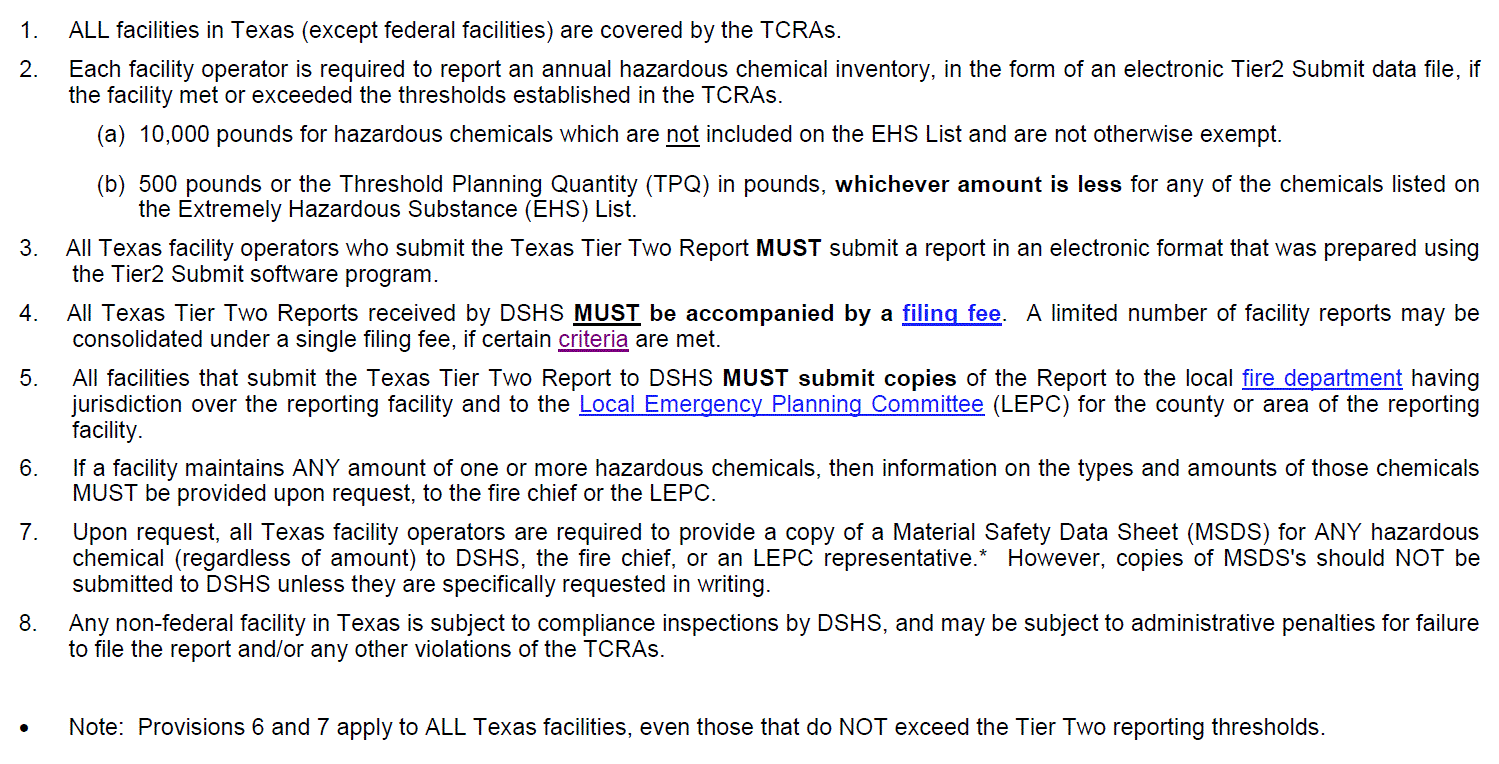
Here is how it is done in Texas:

Source
If you look at number 5 you will see that it is the same requirement as the EPA.

You can see why EPCRA is kind of a good idea.  The LEPC and the Local Fire Department are going to be involved if there is an emergency, so, you know, the guys responding would probably like to know what they might be coming up against.  That's the "communication" part of EPCRA.

If notification is made, the LEPC and the FD can then put forth a plan on how they would respond in the event of all types of anticipated emergencies.  They could visit the plant, meet with the plant personnel, understand the unique properties of the chemicals they have.  They could - with this notification - come up with a plan of response BEFORE there was an emergency.  That, by the way, is why it is called a Local Emergency PLANNING Commission.

So...did this notification take place in West Texas?

Here is what KHOU out of Houston writes:
Each business is required to report its hazardous chemicals to its county. West Fertilizer Co. had, in fact reported its ammonium nitrate to McLennan County.
Here is where fingers start getting pointed.  I don't want to do that, but it is inevitable that it will take place.  I am trying to sell the idea of communication and planning, because it works to minimize risk and protect public health.

KHOU writes:
[Steve] Howie heads the Kaufman County LEPC and said he is familiar with the dangers of ammonium nitrate. A fertilizer storage company similar to the one in West is located near downtown Terrell. He says emergency responders in his community are well aware that a fire in the fertilizer storage building means one thing. 
"If it's in the building housing 50,000 pounds of ammonium nitrate we are going to evacuate the area and back off," said Howie.
That's how they do it in Kaufman County.  In the event of a fire at a plant that houses ammonium nitrate, the fire department has been instructed to "back off."

This fire and explosion happened in West Texas, which is in McLennan County.

According to KHOU:
The federally mandated body of community leaders designed to plan for such hazards did not exist in McLennan County. The official listed as the head of the McLennan County LEPC is County Judge Scott Felton. Felton, appointed to the post last year, told News 8 in an interview that he's never heard of the LEPC.
McLennan County Emergency Operations Coordinator Frank Patterson said he has no knowledge of an emergency planning committee or any meetings with officials in West about potential risks in the community. 
It really is all about communication and planning.  Here is what I have, here is what can happen, here is how we should respond in the event of an emergency.  That's how you have domain over a hazardous chemical.  You respect it and give it what it requires.


Next post: West Texas and Ammonium Nitrate: Part 4

.

Sunday, April 28, 2013

West Texas and Ammonium Nitrate: Part 2


Ignorance that drives opinion that drives policy is what always needs to be fought against.  West Texas is a good case study for this.  I am wanting to answer "the inevitable questions about whether this tragedy could have been prevented."

First, though, I need to get some bad information out of the way and clear up some misunderstanding of how things work.  I do not claim to be an expert on all things environmental, but I have spent over 28 years of my life working in this industry dealing with these chemicals and the regulations that go with them.  When I write about what a particular regulation or laws states or requires I will back it up with a citation.

Here is what the organization "ProPublica" wrote on April 26, 2013:
Here’s what we do know: The fertilizer plant hadn't been inspected by the Occupational Safety and Health Administration since 1985. Its owners do not seem to have told the Department of Homeland Security that they were storing large quantities of potentially explosive fertilizer, as regulations require. And the most recent partial safety inspection of the facility in 2011 led to $5,250 in fines.
Notice all the synonyms they have for conjecture?  One of them is "assumption."  So let us start there and look at the assumption that had the facility been inspected more often, Mr. Ohman and ProPublica "surmise,"  this accident would have been prevented.

Maybe, but most likely not.

First, we have to assume that this explosion was the result of process management that would have been noticed during an inspection.  As of this posting date, we do not know what caused the fire that led to the explosion.  Even ProPublica acknowledges that:
"authorities still don’t know exactly why the West Chemical and Fertilizer Company plant exploded."
To make a statement that it was Gov. Perry's "gamble with the lives of families by not pushing for the strongest safety regulations" is to imply that Gov. Perry has prevented said inspectors and therefore assumes that an inspector would have seen the root cause for this explosion.

Maybe, but most likely not.

In 2009, a little less than 100 miles South from West, Texas, ammonium nitrate in a warehouse at the El Dorado Chemical Co. was involved in a fire.


That fire was the result of this:
The incident that put Bryan on national TV started with a worker welding at the plant, which blends and packages fertilizer and other chemicals. The worker told authorities that a spark caught nearby ammonium nitrate on fire, prompting a call to emergency crews at 11:41 a.m.
Even if the inspector had been there one hour before the welder started, they would not have been able to stop the root cause - the spark from welding - from coming in contact with the ammonium nitrate unless they witnessed the welding that was to take place.  Inspections are designed to make sure regulations are being followed, policy is in place, and to correct those things that are visible and apparent at the time of the inspection.

The inspector might - might - have been able to reiterate safety, but that's only if the inspector was there from OSHA or the TDSHS.  A TCEQ inspector only looks at the parameter relevant to the environmental issue they are there to inspect for.  Would more frequent safety and environment inspections have stopped the el Dorado fire involving the ammonium nitrate?

Maybe, but most likely not.

So, to answer the "inevitable questions about whether this tragedy (El Dorado Chemical fire) could have been prevented," I say, yes it could have.

How?  By making sure that the welder understood the need for a Hot Work Permit and the enforcement of that permit by the company.

The simple use of a Hot work Permit by the welder and the company would have - most likely - most assuredly - prevented a spark from coming in contact with the ammonium nitrate.  Its simple really; no spark, no fire.

Here is why a Hot Work Permit would have worked at the El Dorado Chemical Co. OSHA Regulations, 29 CFR 1910.252 Welding, Cutting, and Brazing:
Before cutting or welding is permitted, the area shall be inspected by the individual responsible for authorizing cutting and welding operations. He shall designate precautions to be followed in granting authorization to proceed preferably in the form of a written permit.
Source
Had that been done, had the welder and the company put two and two together - spark and ammonium nitrate = bad - this fire in Bryan would most likely - most assuredly - not have taken place.

The simple use of a Hot Work Permit, which you can found on the internet using a Google search, asks the following question:

Source
Had these questions been asked and addressed it is unlikely that a fire in the El Dorado chemical Company warehouse would have taken place.  I am going to speculate that this was not done.

See how simple it is?  All it takes is two people understanding why we "make" you do burdensome things like filling out a Hot work Permit.  the welder needs to understand what is going on around him/her and the company needs to make sure that the welder understands what the hazards are in the area they work.

Simple...

So what can we derive from the West Texas situation based on the fact that we do not know what caused the fire?  We can still answer the "inevitable questions about whether this tragedy could have been prevented."  There are two factors in play.  Preventing the fire from starting in the first place and protecting the responders when a fire does take place.

Let's focus on the latter, since that's where the lives were lost.  Once there was a fire in a fertilizer plant that uses ammonium nitrate, could the deaths of 12 responders been prevented?

Maybe not...but most likely yes.

That's what bothers me about all this.  It was a simple matter of understanding what was in the building where the fire was taking place.


Next post: West Texas and Ammonium Nitrate: Part 3

.

West Texas and Ammonium Nitrate: Part 1

I do not want this blog to be political.  That's a difficult task to keep politics out of the conversation.  What I look at and write about is the science behind the decisions and hypothesis.  I do have some "soap box" items that move - or bias - my writing.

First and foremost, what we safety and environmental folks do needs to protect public health, especially worker health, as well as protect the environment.  Second that protection has to be real protection as well as having it based on sound data and analysis.  So if you detect bias in my writing, that is what's driving it.

I set out, since it has been a while - to write on the West Texas explosion from this angle.  What is the science behind the explosion and how can we prevent 12 emergency responders - workers - from getting killed again.  We had just lost two fire fighters in Bryan, Texas, a month ago.  Four guys go in, two get seriously burned and two die.  In West Texas, 12 die.

The way we prevent that from happening is through protocol, training and protective gear. When injury and death occurs, one of those three failed.  One of the hardest things for me to accept, and trust me I tried, is the concept that all worker accidents are preventable.

In West Texas, this was the case for those 12.  It was preventable, and that is what I want to show in these next two or three posts.  Not so much how to prevent it, but why we have the tools in place that will - and in the case of West Texas - should have prevented - or reduced - these deaths.

While doing my research for this post, I came across this:

Source
Governor Perry did not take too kindly to this political cartoon that appeared in the April 25th Sacramento Bee:
"It was with extreme disgust and disappointment I viewed your recent cartoon," Perry wrote in his letter to The Bee. "While I will always welcome healthy policy debate, I won't stand for someone mocking the tragic deaths of my fellow Texans and our fellow Americans," he added. (1)
 Jack Ohman, who drew this editorial cartoon, defends it as follows:
The Texas chemical plant had not been inspected by the state of Texas since 2006. That's seven years ago. You may have read in the news that Gov. Perry, during his business recruiting trips to California and Illinois, generally described his state as free from high taxes and burdensome regulation. One of the burdensome regulations he neglected to mention was the fact that his state hadn't really gotten around to checking out that fertilizer plant. Many Texas cities have little or no zoning, resulting in homes being permitted next to sparely inspected businesses that store explosive chemicals.
The Sacramento Bee defends Ohman:
Jack Ohman's cartoon of April 25 made a strong statement about Gov. Rick Perry's disregard for worker safety, and his attempts to market Texas as a place where industries can thrive with few regulations. It is unfortunate that Gov. Perry, and some on the blogosphere, have attempted to interpret the cartoon as being disrespectful of the victims of this tragedy. As Ohman has made clear on his blog, he has complete empathy for the victims and people living by the plant. What he finds offensive is a governor who would gamble with the lives of families by not pushing for the strongest safety regulations. Perry's letter is an attempt to distract people from that message.
Okay...let's look at this objectively.  I live in Texas.  I teach in Texas.  My students come from Texas.  My clients are little mom-and-pops to large chemical and petroleum facilities.  They come to my environmental classes, as well as our OSHA and emergency response and HAZWOPER and fire fighting and confined space classes because they do not want to hurt their employees or mess up the environment.  They want to reduce their liability and comply with the laws and regulations that are currently out there.

These are Texas businesses and Texans who do this.  If we had a culture of "free from" regulation and inspection these companies and employees would have stopped coming to our classes long ago.

Governor Perry is on his third four year term.  We still have the TCEQ (our environmental agency).  We still have the RRC (environmental agency for oil and gas), and we still have the TDSHS (our OSHA agency).  Our we in Texas as stringent as California and New Jersey?  Nope, but that's where that term "burdensome" comes in.  Just because you have strict environmental and safety regulations does not make your population and work force safer.  Case in point is California's Proposition 65 requirement whereby everything you come in contact with is "known to the state to cause cancer."  I also wrote about New Jersey's requirement to have a one in 1,000,000 cancer risk,  That, by the way, is ten times more protective than California's Prop 65.

Do a bunch of conservative Texans want OSHA and the EPA to go away.  Yes, they sure do.  But that's not how most Texans think, nor is it how Governor Perry has behaved, nor is it the reality.  Before I came to Texas I was born, lived, educated, and did the bulk of my environmental career in California.  So I understand this concept a bit better than most:
More regulation does not automatically make one safer.  Lower exposure does not automatically reduce one's health risk.
How do I feel about this cartoon and the comments made?  I'll let you fill in the caption:


Okay, so here we are getting a bit political.  Let's move away from that angle and address this particular comment from Mr. Ohman:
"So when the plant exploded and killed 14 people, people started asking the inevitable questions about whether this tragedy could have been prevented,"
That's a fair question.  Could it have been prevented?


Next post: West Texas and Ammonium Nitrate: Part 2

.