Showing posts with label TDSHS. Show all posts

Sunday, May 5, 2013

West Texas and Ammonium Nitrate: Part 3

Here is what we have been told happened in West Texas
Around 7:30 p.m. on April 17, a fire broke out at the West Chemical and Fertilizer Company plant in West, Texas, a small town of about 2,800 people 75 miles south of Dallas. Twenty minutes later, it blew up."
What happened to put the responders in the area where they could be affected by an explosion -should the ammonium nitrate explode - is not known.

I have been struggling with this post.  I am re-writing this one and will delete the one I wrote after this.  I don't want to point fingers, and that's the direction I was going.  The purpose of this blog is to describe complex issues and situations.  I want to educate not pontificate, retaliate, exasperate  or blab on about my indignation over a situation.

So let me change my tune, and write about what happened so we can maybe all get on board and prevent this type of situation from happening again,

When I give my DOT class on transportation of hazardous materials I tell my students that the DOT method for labeling and marking is "all about communication."  You may know what's in the drum, but the emergency responder or the guy off-loading it does not.  So you tell them.

DOT Training Module 3

I tell all my students to know everything important about the chemicals they may come in contact with.  What is the hazard when it is sitting there nicely and what will it do when it spills or is involved in a fire?  If you don't know, ask, Google it, look it up, read the MSDS/SDS  I give everyone my business card with my phone number and tell them to call me for another set of eyes.  I have done this for years now, because the guy who gets hurt is no longer me, but the person who comes in contact with the hazardous material.

It comes down to communication.  Communication, and the ability to understand what it means, is what protects employees and the community.

Let's go back to 1984 in Bopal India.  That catastrophe brought about a new law called the Emergency Planning and Community Right-to-Know Act - or EPCRA.  Under this law, a business that has on site, more than 10,000 pounds of a hazardous chemical must notify the State Emergency Response Committee (SERC), the Local Emergency Response Committee (LEPC), and the local fire department of the chemicals and amounts they have on their property.

Here is how this communication is designed to protect public health:
  • Under the Emergency Planning and Community Right-to-Know Act (EPCRA) Section 311, facilities must submit the same MSDSs they maintain for OSHA to their SERC, LEPC, and local fire department. Or, facilities may choose to submit a detailed list of the same chemicals instead. This is a one-time submittal; facilities have three months after becoming subject to the OSHA regulations to submit their material.
  • Facilities that need to submit MSDSs or chemical lists under Section 311, also need to submit an annual inventory report for the same chemicals (EPCRA Section 312). This inventory report must be submitted to the SERC, LEPC and local fire department by March 1 of each year.
Ammonium nitrate is an OSHA hazardous chemical (oxidizer) so the facility was required to tell all three entities that they had up to 540,000 pounds of ammonium nitrate.

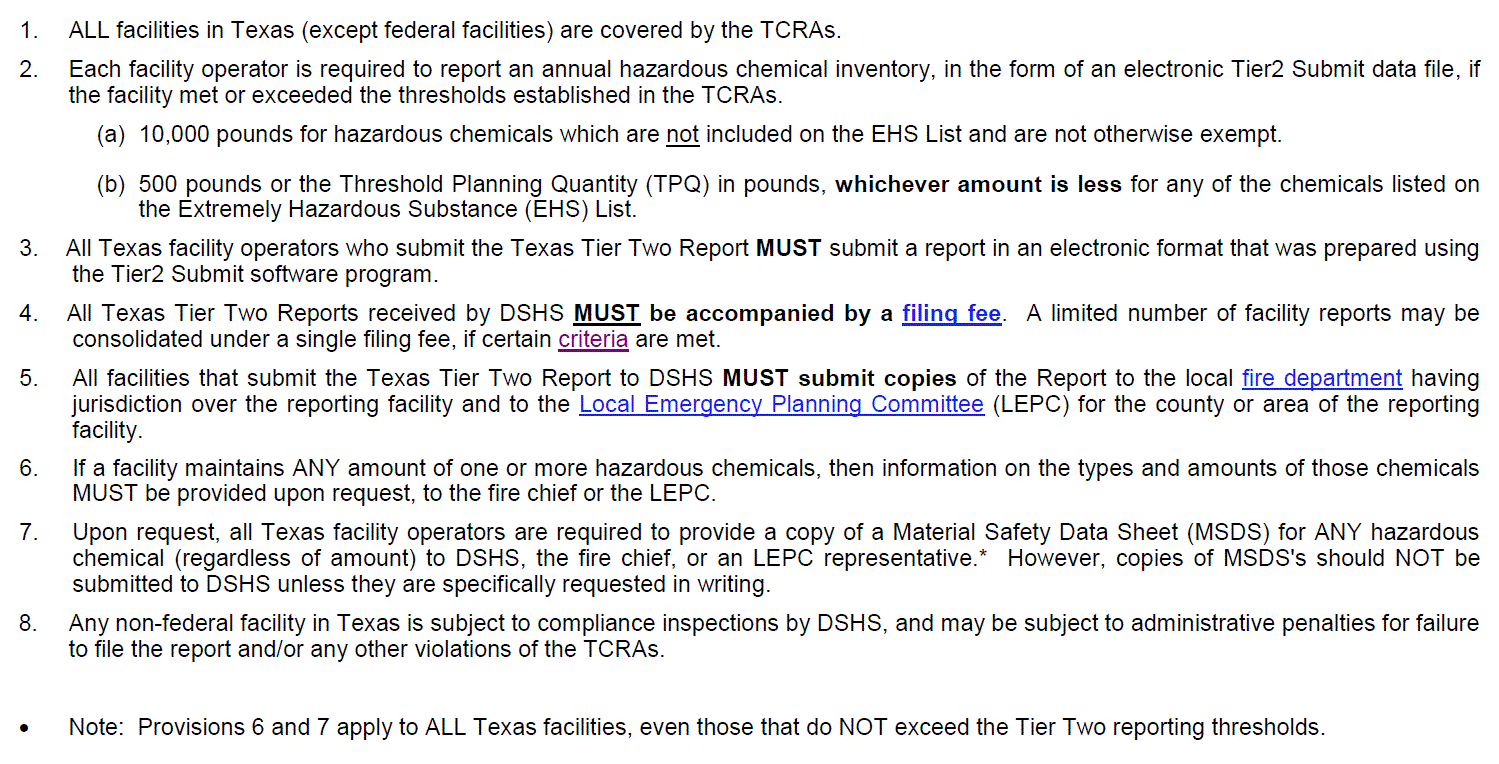
Here is how it is done in Texas:

Source
If you look at number 5 you will see that it is the same requirement as the EPA.

You can see why EPCRA is kind of a good idea.  The LEPC and the Local Fire Department are going to be involved if there is an emergency, so, you know, the guys responding would probably like to know what they might be coming up against.  That's the "communication" part of EPCRA.

If notification is made, the LEPC and the FD can then put forth a plan on how they would respond in the event of all types of anticipated emergencies.  They could visit the plant, meet with the plant personnel, understand the unique properties of the chemicals they have.  They could - with this notification - come up with a plan of response BEFORE there was an emergency.  That, by the way, is why it is called a Local Emergency PLANNING Commission.

So...did this notification take place in West Texas?

Here is what KHOU out of Houston writes:
Each business is required to report its hazardous chemicals to its county. West Fertilizer Co. had, in fact reported its ammonium nitrate to McLennan County.
Here is where fingers start getting pointed.  I don't want to do that, but it is inevitable that it will take place.  I am trying to sell the idea of communication and planning, because it works to minimize risk and protect public health.

KHOU writes:
[Steve] Howie heads the Kaufman County LEPC and said he is familiar with the dangers of ammonium nitrate. A fertilizer storage company similar to the one in West is located near downtown Terrell. He says emergency responders in his community are well aware that a fire in the fertilizer storage building means one thing. 
"If it's in the building housing 50,000 pounds of ammonium nitrate we are going to evacuate the area and back off," said Howie.
That's how they do it in Kaufman County.  In the event of a fire at a plant that houses ammonium nitrate, the fire department has been instructed to "back off."

This fire and explosion happened in West Texas, which is in McLennan County.

According to KHOU:
The federally mandated body of community leaders designed to plan for such hazards did not exist in McLennan County. The official listed as the head of the McLennan County LEPC is County Judge Scott Felton. Felton, appointed to the post last year, told News 8 in an interview that he's never heard of the LEPC.
McLennan County Emergency Operations Coordinator Frank Patterson said he has no knowledge of an emergency planning committee or any meetings with officials in West about potential risks in the community. 
It really is all about communication and planning.  Here is what I have, here is what can happen, here is how we should respond in the event of an emergency.  That's how you have domain over a hazardous chemical.  You respect it and give it what it requires.


Next post: West Texas and Ammonium Nitrate: Part 4

.

Sunday, April 28, 2013

West Texas and Ammonium Nitrate: Part 2


Ignorance that drives opinion that drives policy is what always needs to be fought against.  West Texas is a good case study for this.  I am wanting to answer "the inevitable questions about whether this tragedy could have been prevented."

First, though, I need to get some bad information out of the way and clear up some misunderstanding of how things work.  I do not claim to be an expert on all things environmental, but I have spent over 28 years of my life working in this industry dealing with these chemicals and the regulations that go with them.  When I write about what a particular regulation or laws states or requires I will back it up with a citation.

Here is what the organization "ProPublica" wrote on April 26, 2013:
Here’s what we do know: The fertilizer plant hadn't been inspected by the Occupational Safety and Health Administration since 1985. Its owners do not seem to have told the Department of Homeland Security that they were storing large quantities of potentially explosive fertilizer, as regulations require. And the most recent partial safety inspection of the facility in 2011 led to $5,250 in fines.
Notice all the synonyms they have for conjecture?  One of them is "assumption."  So let us start there and look at the assumption that had the facility been inspected more often, Mr. Ohman and ProPublica "surmise,"  this accident would have been prevented.

Maybe, but most likely not.

First, we have to assume that this explosion was the result of process management that would have been noticed during an inspection.  As of this posting date, we do not know what caused the fire that led to the explosion.  Even ProPublica acknowledges that:
"authorities still don’t know exactly why the West Chemical and Fertilizer Company plant exploded."
To make a statement that it was Gov. Perry's "gamble with the lives of families by not pushing for the strongest safety regulations" is to imply that Gov. Perry has prevented said inspectors and therefore assumes that an inspector would have seen the root cause for this explosion.

Maybe, but most likely not.

In 2009, a little less than 100 miles South from West, Texas, ammonium nitrate in a warehouse at the El Dorado Chemical Co. was involved in a fire.


That fire was the result of this:
The incident that put Bryan on national TV started with a worker welding at the plant, which blends and packages fertilizer and other chemicals. The worker told authorities that a spark caught nearby ammonium nitrate on fire, prompting a call to emergency crews at 11:41 a.m.
Even if the inspector had been there one hour before the welder started, they would not have been able to stop the root cause - the spark from welding - from coming in contact with the ammonium nitrate unless they witnessed the welding that was to take place.  Inspections are designed to make sure regulations are being followed, policy is in place, and to correct those things that are visible and apparent at the time of the inspection.

The inspector might - might - have been able to reiterate safety, but that's only if the inspector was there from OSHA or the TDSHS.  A TCEQ inspector only looks at the parameter relevant to the environmental issue they are there to inspect for.  Would more frequent safety and environment inspections have stopped the el Dorado fire involving the ammonium nitrate?

Maybe, but most likely not.

So, to answer the "inevitable questions about whether this tragedy (El Dorado Chemical fire) could have been prevented," I say, yes it could have.

How?  By making sure that the welder understood the need for a Hot Work Permit and the enforcement of that permit by the company.

The simple use of a Hot work Permit by the welder and the company would have - most likely - most assuredly - prevented a spark from coming in contact with the ammonium nitrate.  Its simple really; no spark, no fire.

Here is why a Hot Work Permit would have worked at the El Dorado Chemical Co. OSHA Regulations, 29 CFR 1910.252 Welding, Cutting, and Brazing:
Before cutting or welding is permitted, the area shall be inspected by the individual responsible for authorizing cutting and welding operations. He shall designate precautions to be followed in granting authorization to proceed preferably in the form of a written permit.
Source
Had that been done, had the welder and the company put two and two together - spark and ammonium nitrate = bad - this fire in Bryan would most likely - most assuredly - not have taken place.

The simple use of a Hot Work Permit, which you can found on the internet using a Google search, asks the following question:

Source
Had these questions been asked and addressed it is unlikely that a fire in the El Dorado chemical Company warehouse would have taken place.  I am going to speculate that this was not done.

See how simple it is?  All it takes is two people understanding why we "make" you do burdensome things like filling out a Hot work Permit.  the welder needs to understand what is going on around him/her and the company needs to make sure that the welder understands what the hazards are in the area they work.

Simple...

So what can we derive from the West Texas situation based on the fact that we do not know what caused the fire?  We can still answer the "inevitable questions about whether this tragedy could have been prevented."  There are two factors in play.  Preventing the fire from starting in the first place and protecting the responders when a fire does take place.

Let's focus on the latter, since that's where the lives were lost.  Once there was a fire in a fertilizer plant that uses ammonium nitrate, could the deaths of 12 responders been prevented?

Maybe not...but most likely yes.

That's what bothers me about all this.  It was a simple matter of understanding what was in the building where the fire was taking place.


Next post: West Texas and Ammonium Nitrate: Part 3

.