Saturday, July 28, 2012

RfD and Consensus...Part 2

Not to beat a dead horse...my gosh, I say that a lot...but it's so applicable here.

If the foundation behind what we consider "safe" is a risk calculation that produces a number expressed in ppm or ppb, how confident are we in the variables used the calculation?  Let's look at the calculation used to derive the Maximum Contaminant Level Goal (MCLG) for drinking water.

The MCL is based on the concept that drinking water should contribute no more than 20% of the contaminant entering into the receptor.  The Drinking Water Equivalent (DWEL) is a calculation that is based on the maximum amount of the contaminant being consumed through drinking water only.

So, if we assume that the human receptor will receive a dose of arsenic from other sources, what would the "safe" level of arsenic need to be for drinking water?

If arsenic comes from no other source other than drinking water, the DWEL calculates the "safe" level as:
  • 0.01 mg/L
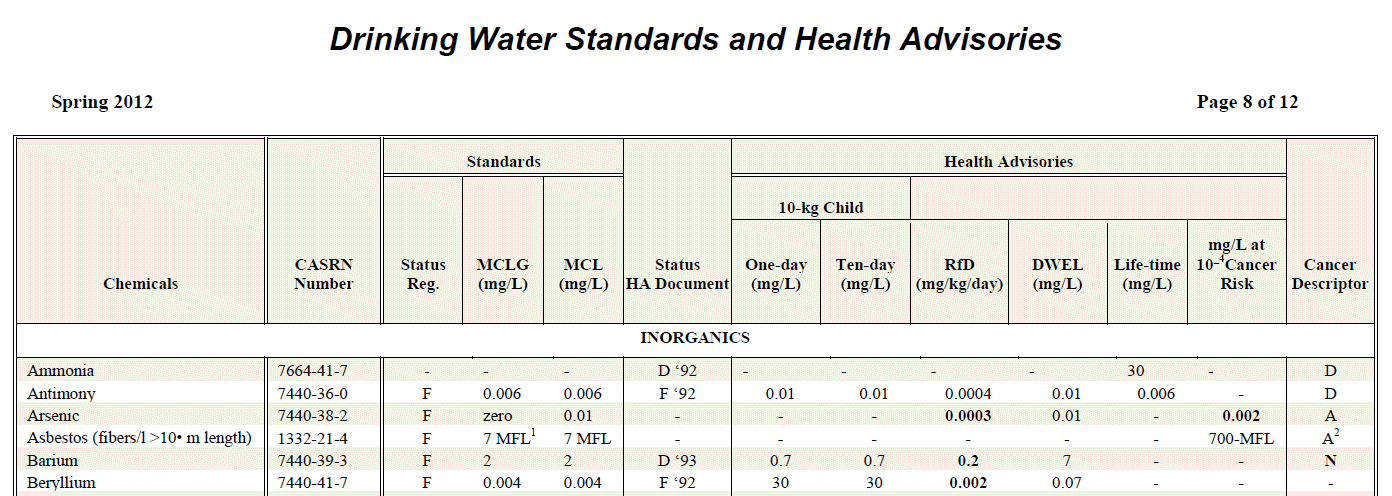
Not to complicate this, bu arsenic is a carcinogen so when we look at the risk of arsenic in drinking water, it is based on non-cancer DWEL (0.01 mg/L) and 1 in 10,000 cancer risk (0.002 mg/L) as follows:
Source

Since these posts are about the reference dose (RfD), I am going to ignore the cancer risk for now.

The formula for the DWEL is:

Source
For arsenic, this would be calculated as follows:
  • (0.0003 x 70)/2 = 0.0105 mg/L or 0.01 ppm or 10 ppb

The MCLG is therefore 20% of that amount, or 0.20 x 0.01 = 0.0021 mg/L.  However (there is always a however) because arsenic is a carcinogen, the MCLG is set at "zero."  The MCL is set at 0.01 which the EPA believes is a reasonable concentration that a water system can treat down to based on current technology and be considered "safe"  Notice how the MCL is set at the DWEL.

For arsenic, we want to see zero but that's not feasible for all drink water suppliers, so an acceptable level of arsenic is deemed to be 0.01 ppm.

So back to the original dead horse statement/question:
If the foundation behind what we consider "safe" is a risk calculation that produces a number expressed in ppm or ppb, how confident are we in the variables used the calculation? 
 For a non-carcinogen, to accept the MCLG one must accept the DWEL.  To accept the DWEL, one must accept the parameters and the values used.  There is little controversy regarding the weight of an adult/child nor on the amount of water consumed, they are averages based on what we have found to be true in the population.  So the only parameter in question, the only value that is paramount is the RfD.

If the "safe" level is to be derived then the RfD must be as bullet proof as possible.  This, is where the fun begins.  The RfD is:
An EPA estimate, with uncertainty or safety factors built in, of the daily lifetime dose of a substance that is unlikely to cause harm in humans. (1)
Let's look at perchlorates for example:
Perchlorate was discovered by the [EPA] in private drinking water wells in a portion of the Deep Creek area of western Spokane County in early 2006. Since that discovery, EPA has sampled additional wells and continues to find perchlorate at low levels across the study area. The perchlorate levels range from non-detected to 3.2 micrograms per liter (ug/l). These levels are not considered an immediate health risk.
For the EPA to make that claim, it had to be based on something...
There are no federal or Washington State drinking water standards for perchlorate. However, EPA uses a 24.5 ug/l perchlorate drinking water equivalent level (DWEL)1 as a preliminary remediation goal (PRG).
You can see why I beat this dead horse.  If the clean up goal is based on the DWEL and the DWEL is based on an "EPA estimate, with uncertainty or safety factors built in, of the daily lifetime dose of a substance that is unlikely to cause harm in humans." that "estimate" better be solid.

For perchlorates, is it solid?
EPA completed its draft toxicological review of perchlorate in 2002, and proposed a reference dose (RfD) of 0.00003 milligrams per kilogram per day (mg/kg/day) based primarily on studies that identified neurodevelopmental deficits in rat pups. 
So 0.00003 mg/kg-day was derived based on a "maternal exposure to perchlorate" that saw "neurodevelopmental deficits in rat pups" The EPA then finds:

Subsequently, NAS [National Academy of Science] reviewed the health implications of perchlorate, and in 2005 proposed an alternative reference dose of 0.0007 mg/kg/day based primarily on the Greer et al, 2002 study. 

Why the increase in what was deemed an acceptable dose (0.00003 to 0.0007)?  Instead of rat pups, we now had data on humans. 

During that study, 37 human subjects were split into four exposure groups and exposed. Significant decreases in iodide uptake were found in the three highest exposure groups. Iodide uptake was not significantly reduced in the lowest exposed group, but four of the seven subjects in this group experienced inhibited iodide uptake. The RfD proposed by NAS [0.0007 mg/kg-day] was accepted by EPA and added to its integrated risk information system (IRIS) in 2005.
So based on one study [Greer] involving 37 human subjects, the RfD is calculated at 0.0007 mg/kg-day based on Iodine uptake.

Is that enough to mandate a cleanup level for a site contaminated with perchlorates?  Well, whatcha got that's better?  You see, that's all we have to go on.  Small studies, most of the time based only on animals.  How confident are we that 10 ppb of arsenic is safe?  That 5 ppb of perchlorates is safe?  If you factor in just how low the dose is that caused the adverse health effect, and then take in the fact that the dose is made even less due to uncertainty, the level we deem is safe is very protective of public health.

That's how it works.  That's how we beat that dead horse,  The question now becomes, how certain are we of the certainty of the RFD.

Next post: RfD and Consensus...Part 3


.

Sunday, July 15, 2012

RfD and Consensus...Part 1

I recently added a section called "consensus" to the Wikipedia page on "Reference Dose."

Yeah, that's what I do for fun.

I was looking for some supporting information to help me put my AHMP presentation together and came across an EPA memo titled:
WASHINGTON STATE DEPARTMENT OF HEALTH’S EVALUATION OF EPA’S PERCHLORATE DRINKING WATER PRELIMINARY REMEDIATION GOAL (PRG).
Back to the question of "safe" is it?  Here is what the memo says about perchlorates found in the Deep Creek area in the state of Washington:
There are no federal or Washington State drinking water standards for perchlorate. However, EPA uses a 24.5 ug/l perchlorate drinking water equivalent level (DWEL) as a preliminary remediation goal (PRG). 
In looking at how perchlorates enter into the human receptor, EPA has decided that the predominate way would be through drinking Deep Creek water which has perchlorate contamination.

Though there is no MCL - "maximum contaminant level" - for perchlorates, the EPA uses the DWEL - "drinking water equivalent level" to establish a "safe level" of perchlorates in the water that may be consumed.

The DWEL is the basis for establishing the MCL, so this is a reasonable approach   The DWEL is calculated for non-carcinogens and uses the reference dose (RfD).

The DWEL, therefore, is defined by EPA as:

"a drinking water lifetime exposure level, assuming 100% exposure from that medium, at which adverse, noncarcinogenic health effects would not be expected to occur."
When the EPA establishes the "safe" level of a contaminant in drinking water it bases it on the "lifetime health advisory" derived as follows:

The Lifetime HA for the drinking water contaminant is calculated from its associated Drinking Water Equivalent Level (DWEL), obtained from its RfD, and incorporates a drinking water Relative Source Contribution (RSC) factor of contaminant-specific data or a default of 20% of total exposure from all sources. 
As you can see, the RfD is the foundation upon which all these "safe" levels are derived.

Where we have confusion is when we compare a concentration in one media - such as apple juice - with the regulatory level established for drinking water.  Without an understanding of the RfD for non-carcinogens and risk factors for carcinogens, comparing what is found in the apple juice to what is acceptable in drinking water will make the apple juice appear to be tainted.

Case in point.  From the Dr. Oz Website

In 2006, the Environmental Protection Agency (EPA) enacted a stringent health standard with respect to arsenic levels in drinking water, stating concentrations should not exceed 10 parts per billion (ppb). Interestingly, the actual goal for arsenic exposure from drinking water, what is termed the maximum contaminant level goal (MCLG), is zero ppb. That bears repeating – the goal is no arsenic in our drinking water. The 10 ppb level is simply as close as we can reasonably get considering our natural exposure to arsenic in the environment and other limitations. At that level, almost all experts agree our drinking water is quite safe.
So if our drinking water is "quite safe" why say this right after?

Shouldn't the same goal or, at the very least, similar science-based exposure guidelines, be in place for the juices we commonly give to our children?
It is, in my opinion, due to a disconnect in how a "safe" level is derived, a disconnect on how the the RfD is calculated, and a disconnect in how a "goal" and "risk" are different.

Let's look at benzene, for example. 

Source
Now benzene is kind of an odd bird, which makes it a good example on how this works.
Because benzene is considered a human carcinogen, there may be some degree of carcinogenic risk even below the MCL. Based upon EPA calculations, the EHP estimates that drinking water containing 5 ppb benzene would be associated with an increased lifetime risk of cancer in the range of between two and eight in one million (2 to 8 excess cancer cases in 1,000,000 people exposed). This estimate is based on a daily intake of two liters of water per day for 70 years. (1)
For this reason - carcinogenicity - benzene is given an MCLG of "0":
MCLG: Maximum Contaminant Level Goal. A non-enforceable health benchmark goal which is set at a level at which no known or anticipated adverse effect on the health of persons is expected to occur and which allows an adequate margin of safety. (2)
The EPA has also developed a toxicity value (Reference Dose or RfD) for non-cancer effects based on a human study.

A decrease in cells which are vital to immune system function (lymphocytes) was the most sensitive effect of several measured blood parameters. The adult drinking water equivalent level (DWEL) for this RfD is a benzene concentration in water of 140 ppb - 0.14 mg/L - ppm.
The benzene DWEL, which is the "lifetime exposure level assuming 100% exposure from that medium," is 0.1 mg/L.  This is based on the following formula:

Source

Plugging the RfD into the formula, we get:
DWEL (mg/L) = (0.001 x 70) / 2 = 0.14 mg/L = 0.1 mg/L or "ppm"
Because we know that there is a risk of cancer, the MCLG is set at zero.  Because we know that zero is unattainable, and we know that there is also a non-cancer risk, we can set the legally enforceable MCL for benzene at 0.005 mg/L or 5 ppb.

When Dr. Oz posts:
Interestingly, the actual goal for arsenic exposure from drinking water, what is termed the maximum contaminant level goal (MCLG), is zero ppb. That bears repeating – the goal is no arsenic in our drinking water. The 10 ppb level is simply as close as we can reasonably get considering our natural exposure to arsenic in the environment and other limitations. At that level, almost all experts agree our drinking water is quite safe.
He is acknowledging that the current standard for arsenic is safe even though the goal is zero.  This is the same with benzene and all the other carcinogens.  We want zero, it is safe at the MCL.  Why is it safe?  Because the MCL and MCLG is set lower than the DWEL:
The MCLG is then derived by considering other known or potential sources of exposure, using the relative source contribution (RSC) factor.
  • MCLG (mg/L) = DWEL x RSC
    The RSC from drinking water is based on actual exposure data, or, if data are not available, a value of 20% is assumed for effects based on lifetime exposure. This allows 80% of the total exposure to come from sources other than drinking water, such as exposure from food, inhalation, or dermal contact. For the few MCLGs based on adverse effects related to exposure in children, an RSC of 100% was usually applied because the source of exposure for the critical study was drinking water. However, in more recent assessments, even when actual data from other sources are available, EPA uses a maximum RSC value of 80% to allow for potential unidentified sources. (3)
    In other words, for a chemical such as benzene, a non-cancer RfD is established that generates a DWEL of 0.14 mg/L.  That DWEL is then multiplied by about 0.8 (80%) to compensate for all the other ways the chemical gets into the receptor.  For benzene, however, the MCLG is set at zero and the MCL - the value set as close to the MCLG as feasible using the best available analytical and treatment technologies and taking cost into consideration - is set at 0.005 mg/L.
    • We consider the DWEL safe because it is based on the RfD.
    • We consider the RfD acceptable because it is based on "an estimate (with uncertainty spanning perhaps an order of magnitude) of a daily oral exposure to the human population (including sensitive subgroups) that is likely to be without an appreciable risk of deleterious effects during a lifetime." (3)
    • The MCL is less than the DWEL
    • The MCLG can be less than the MCL and is set at "zero" for carcinogens.
    How low can you go (/queue music)

    All the way to zero.

    Which brings me back to my original question of the RfD.  If the RfD is the foundation, how confident are we in the number we are using?  As the EPA writes:
    A change in the RfD could lead to a change in the MCLG and thus possibly also in the MCL. (3)
    A good read on all of this can be found here.

    Next post: RfD and Consensus...Part 2


    .

    Sunday, July 8, 2012

    Reference Dose: The foundation of Risk

    I am getting ready to prepare my presentation "Apples, Arsenic, and Risk" for the upcoming 2012 AHMP conference in Alaska September 9 -13 in Anchorage. I wrote a lot on this topic in previous posts and need to pare it down (pun intended).

    One of the most difficult parts of preparing a presentation is finding the starting point from which to tell your story. I can't just stand up there and whine about Dr. Oz and Chuck Norris. Nor can I present a bunch of facts and figures to prove my case. Boring. I get one shot at this, and I need to make it work.

    So, where to start and what to build is where I am in July. I know the story's end, I know the moral, how do I tell it for Environmental Health Safety Professionals who depend on the very information I am going to present but know little about how it works without being condescending, preachy, or uninteresting.

    Sure they understand risk, and regulatory compliance concentrations, and clean up levels, but do they understand why other than that is what they are told - or - what some formula spits out?  Why do we set the limit at 10µg/L for arsenic in our drinking water, 5 mg/L for the level of arsenic in our waste, 0.018 µg/L for ambient water quality criteria, 0.3 mg/L for arsenic in storm water, and 23 µg/L for arsenic in our fruit juice?

    We are dealing with the same chemical, yet depending on where we find it, the values assigning the risk change.  As well it should. It is deemed "safe" if it is below the threshold depending on where we find it and what receptor (animal/plant/human) will be exposed to the arsenic, how much (dose), and length of time exposed (acute/chronic).

    We draw a line in the sand and say "safe" or "presents a risk."  That line in the sand is drawn from a formula that looks at the length of time exposed as well as how the chemical will enter into the receptor. Since I am interested in protecting human health, the receptor will be based on that.

    That formula - for humans - is based on the concept that there is a daily level at which we do not expect harm to take place over a lifetime.  This is what we call the "reference dose" or "RfD."
    RfD: An EPA estimate, with uncertainty or safety factors built in, of the daily lifetime dose of a substance that is unlikely to cause harm in humans.
    The foundation for risk for all chemicals that are suspected to cause harm to human health are based on this concept.  You must accept that concept - that there is an amount that we can consume every day for a lifetime - of a risk that is unlikely to cause harm in humans.

    I've discussed this concept a number of times in previous posts.  This is how we do it in the United States. We set thresholds based on a formula of what we think might take place using a value that we have determined is a "safe" level if there is uptake into the receptor.

    When the FDA says that 23 µg/L for arsenic is the maximum "safe" level in our fruit juice it is basing that level on the amount of juice to be consumed that would be put into the human receptor.  Therefore, if consuming juice - normally - over a lifetime, it would be “unlikely” to cause harm from arsenic.

    When folks like Dr. Oz, Consumer Reports, and Chuck Norris compare the amount of arsenic found in apple juice to the amount of arsenic deemed safe for drinking water - the MCL - they are forgetting that the MCL and FDA concentration deemed "safe" are based on the same foundation; the RfD.  What is different in these two values is what is considered to be "normal" uptake. We drink more water than apple juice therefore we can consume more arsenic in the apple juice and remain safe.

    Why are the two values different?

    Because the RfD states that there is "daily lifetime dose of a substance that is unlikely to cause harm in humans."  Consume less than the RfD and there will "unlikely" be harm.  It is all about the RfD and the dose that delivers that RfD, and the length of time you will be exposed to that dose.

    Chemical Exposure is similar to wealth, only the inverse.  If it takes $2.00 to buy a cup of coffee and you have no money or $1.99, you are in the same predicament - you will have no coffee.  Same goes with chemicals.  If the RfD concept is to be our foundation, then we have to move away from "less is better" and move toward a threshold based on uptake into the receptor.  Below that concentration in the matrix we are exposed to, we are fine.

    Which brings us to another question.  If the foundation is the RfD, then how confident are we in the RfDs we have established?


    Next Post: RfD and Consensus


    .

    Sunday, June 10, 2012

    Typical...just typical. No, but really...typical

    For those of you who don't spend their time as a full-time instructor/trainer, let me tell you about a typical day.  A typical day, just like I had today.

    I teach 8-hour classes.  Last week I did a full week of 8 hour classes, so about 40 hours of training, plus travel and prep to set up the class.  We got back late Friday so I was unable to get my next class - which starts at 0800 Monday, set up during "normal" business hours.

    When you walk into a training class, there is often a bunch of prep work that went into it.  Some classes are easy, show up a half hour early and setup and go.  But this weeks class, one I do to prep folks to sit for the REM or CHMM exam, takes a bit of work to get ready.

    Those who are attending this class are usually a little nervous because of the exam they will often take on Friday.  So having everything laid out and up and running so it starts well sets the tone for the rest of the week.

    So I get to the training room, which has been moved to a different building and will involve carting my stuff from one location about a quarter mile away.  Got it, was prepared for that opening the door.  But the training gods were in a particular feisty mood today and decided I needed a bit of extra effort on my Sunday.

    First, the room had been arranged for a party, so the tables and chairs had to be moved and rearranged.

    Next, the computer says "windows has been updated, you must restart your computer."  OK.

    Computer comes back on, "Adobe Flash has been updated, you must restart your computer."  Really...OK, one more time.

    With the computer updated, I try to access my files, which requires me to log in.  Only it will not take my username or password.  My power point files, which are on the main comp, are not available for the class that starts Monday at 0800, which, as a state agency, is before our computer nerds get in and man the help desk.  Off to get my backup computer which is arranged so that the fixed cords which are all nice and neat and bundled together will not reach the slots on my comp.

    I'll get the coffee ready to go, no coffee.

    Books have a few pages that need to be replaced with current info.  Go to print and they have the copy machine locked up in a room.  Aha!  I know a workaround.  I can sneak through the registration office door and into the admin room where a copy machine is.  Two can play this game!  What, the door is locked, when did they start locking that door?

    No big deal, I can send the print order to the printer in the building I normally train in.  ...and print!.  Drive to that building, unlock the door, go to copy machine, and "Tray D is out of paper".  Load paper.  Done.  Look for three-hole punch, no where to be found.  Place a few single sheet handouts on the copier, press copy, and 30 sheets of barely readable stuff comes out.  No biggie, I can print them Monday at break.  Typical.

    Drive back to the classroom and look for a three-hole punch.  There are two.  One is old and the other looks like it was made when Texas A&M was started in the 1870s.  I'll try the "newer" one.  Funny thing about three-hole punches, they often don't like to let the paper slide under the punch.  Bang on the handle - slide the paper under, adjust the margins, press the lever down...  Funny thing about three-hole punches, they often don't like to let go of the paper once the hole is punched.  Bang it on the desk, one, two, three times the charm.  Paper comes out, and there are only two holes, not three.  Off to get the antique one.

    The prehistoric three-hole punch seems to work without a problem,  Place the paper in, push the lever down, and presto!  Three holes.  Only the holes are too small in diameter for the notebooks I am using.

    OK, we will push that task off for Monday while I go looking for a real three-hole punch.  I know we have one, because I bought a real one - that works for my program a number of years back.  Only thing is, I recently decided not to horde it and thought it would be better to share it.  Someone has my three-hole punch.  Don't make me go all Milton on you my fellow workmates!

    Argg.  Typical...just typical

    Well, at least the air conditioning was working today.  Then again, there is always tomorrow.


    Sunday, May 27, 2012

    GHS...We Have A Problem Here - Part 2

    Let's look at the DOT label for a chemical product which contains "methyl ethyl ketone peroxide" and "cumene hydroperoxide."  According to the supplier, this material is regulated by DOT/IATA as follows:


    This material would be shipped with this DOT/IATA label:

    Under the GHS classification system, an "organic peroxide" is defined as:

    Source
    "Exothermic self-accelerating decomposition" & "explosive" & "sensitive to impact/friction" makes this stuff a concern wouldn't you say?  So it is easy to teach anyone who may come in contact with this material to be careful if they see the DOT label with the red top, yellow bottom and the number "5.2"

    Easy.

    Now let's look at how the new GHS labeling system conveys the hazard of a container of organic peroxide Type D shipped in a box:

    Source

    Which, for our material, the manufacturer identifies all the required information as follows:


    If an organic peroxide is a chemical substance that may undergo "exothermic self-accelerating decomposition" shouldn't that little bit of important information be the first thing the person picking up the product understands about the stuff in the container?

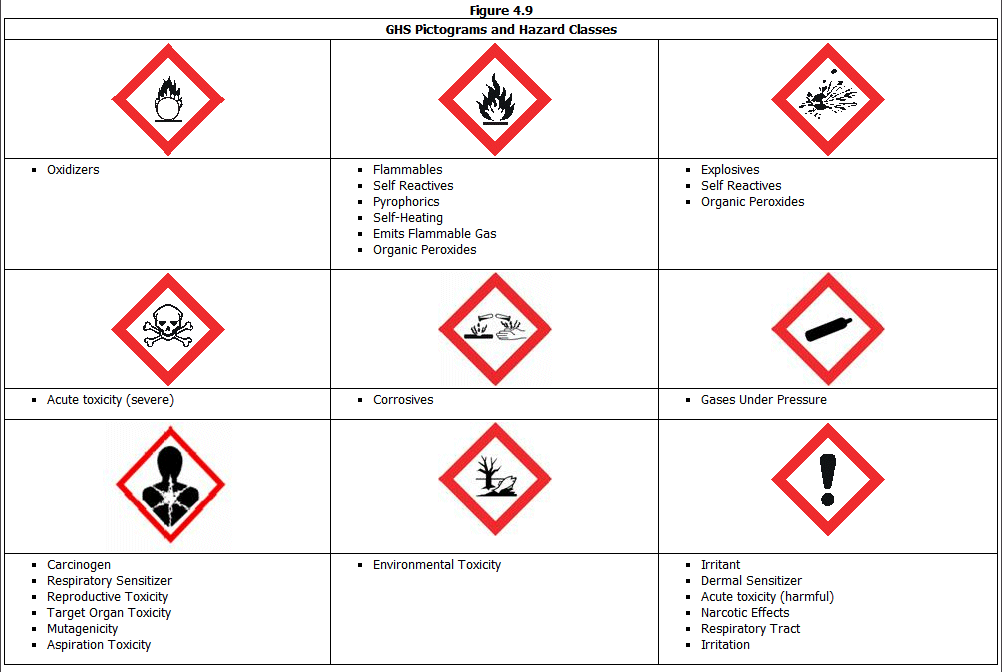
    The GHS pictogram for an organic peroxide is:


    That's the same pictogram used by DOT to describe a flammable liquid, flammable solid, dangerous when wet, spontaneous combustible, and an organic peroxide.

    Source

    Only DOT uses color and a number to differentiate between the different hazards.

    I wish I would have recognized this earlier.  Here is what I recommend as a fix:

    Scrap the GHS pictograms and use a DOT label - including color - in its place for those hazards where a DOT Class 1 through Class 8 label is currently in place.

    Why?

    Because DOTs system of warning = color, symbol, and number - is easy to understand and it works.

    Don't believe me?  Try this experiment.  Show the following labeled and ask the person to tell you what the hazard is of the material inside.


    I'll bet at least 8 out of 10 get it right.

    DOT labels work because they communicate the hazard and can be easily taught and understood.


    .

    GHS...We Have A Problem Here - Part 1

    (Work has kept me on the road and an in a hotel, so my blog time has been interrupted.)

    I'll get back to the RCRA "In The Beginning" posts in a bit.  They involve reading the Federal Register and that ain't a lot of fun to do on a holiday weekend.

    I'm in the process of teaching a bunch of military guys.  Each year I try to change it up a bit and work on a different "theme."  This year we are looking at the DoD's new "Chemical Comparability System" which is a method of determining which chemical products can be stored together.  As part of this training I developed an exercise whereby they break into groups and using MSDS and labels, place the chemical container into the correct Hazard Characteristic Code "HCC" group.

    One of the chemicals I chose uses the new Globally Harmonized System's (GHS) "Safety Data Sheet" or "SDS" which is going to replace the OHSA "MSDS."  Gotta love acronyms to be in this business!

    This particular SDS also gave the new GHS label that was to appear on the container.  "Cool," I thought.  "I'll put that label on my mock chemical container and see if they can determine the HCC."  Only to make it challenging, I did not give them the SDS.

    Now the way the DOD's HCC is designed is to have one of 63 HCCs assigned to every chemical product used by the military so they can be placed into one of 10 primary Hazardous Storage Areas and then segregated further - if required.


    The goal is to have this code placed on the MSDS/SDS in the "Physical/Chemical Properties" section.

    HCC is identified by supplier as "D3"
    Well since it is not an OSHA or GHS requirement, it is going to take a bit of time for each manufactures or supplier to get this info their MSDS/SDS currently used by the troops and support personnel.

    If the MSDS/SDS does not identify the HCC, the person can then look at the DOT transportation label and assign it a "suggested temporary HCC:"


    It's not a bad system, but it relies on the HCC being correctly assigned by the supplier (something the exercise superstitiously discovered) or the container has the DOT shipping label.  But small containers are often shipped in a larger shipping container and do not have the DOT label when removed and placed into facility storage.

    In this case, the container must be labeled to meet OSHA standards (U.S.) - which does not require a pictograph - and soon the new GHS label standards - which does.

    OSHA

    And this is where the breakdown of communication starts.  Can a regular Joe/Jane determine what the hazard of a chemical is from the new GHS label?  According to my exercise, 3 out of the 4 teams can, but it is not because of the label.

    Next post: GHS...We Have A Problem Here - Part 2


    .

    Sunday, April 8, 2012

    RCRA...in the beginning. Part 1

    I have always told my RCRA classes that one day I am going to write the definitive book on the history of RCRA.  By golly, a best seller if there ever was one!

    If you read this blog you can tell I'm a curious kind.  I want to know why things work the way they do.  Why, for example are there five categories of waste numbers?  If there is a "D", "F", "K", "P", and "U" was there ever an "A", "B", or "C:" ?

    I asked this question a long time ago to the EPA and they told me that it was also a question that some of them had asked but apparently been lost somewhere in the history of what took place between RCRA the law and RCRA the regulation.

    So while I was searching for how the Toxicity Characteristic thresholds - D004 - D043 - were established, I came across an EPA document with the very friendly title:

    Identification and Listing of Hazardous Waste 40 CFR§261.4(b): 
    Exclusions: Solid Wastes which are Not Hazardous Wastes.
    A User- Friendly Reference Document
    Version 1: October 2009

    And in this document it linked to two Federal Registers:
    Proposed Rule- Hazardous Waste Guidelines and Regulations. 43 FR 58946, December 18, 1978
    Final Rule, Interim Final Rule and Request for Comments - Hazardous Waste Management System: dentification and Listing of Hazardous Waste. 45 FR 33084, 33120, May 19, 1980
    Interesting, been in the hazardous waste business since 1984 and never read either of these two documents.  The cool thing - if you think historical context is cool - is that the proposed and final rule Federal Registers give the thinking and reasoning behind the actual regulation being established.

    Maybe, I thought, they might shed light on any other letters used for establishing the waste numbers.  Were there other "lists" established in the beginning before the final rule in 1980?

    Well I downloaded them, read them, and, darn, no luck.  Nothing about any "A" list or "M" list.  On the other hand, it did answer some other questions that I have been pondering lately.  That is, what does the number 5 mg/L actually mean?

    If you read my last bazzilion posts on arsenic in apple juice you can see that one of my driving points is that you cannot compare a quantity in one thing with a regulatory threshold established for another thing.  The 10 ug/L arsenic MCL is for drinking water, the amount of arsenic found in apple juice cannot be compared to that number because of how the 10 ug/L was established.  10 ug/L of arsenic MCL is the "safe" level based on drinking 2 liters of water for 70 years.  What arsenic is found in apple juice must be looked at based on how much apple juice is consumed.  That's why the FDA established a safe level of arsenic in apple juice of  23 µg/L.  Quite simply, you drink less apple juice than water so you can consume more arsenic per unit of liquid.

    That's a difficult concept to get across to folks.  But it all comes back to the basic toxicological assumption that there is a dose that will not pose harm.  That dose is based on the concept of unit of substance per unit of body weight per day.  We call this the reference dose and all our thresholds are supposed to be based on this.

    How much, in theory, will the receptor receive - uptake - based on their body weight?  The idea here is that there is an amount per kilogram of body weight that we can assume will pose no adverse health concern over a period of time.  For the public it is 70 years for a chronic health concern, for an employee it is 30 years of exposure based on a 5 day, 40 hour work week.

    What we do is draw a line in the sand - a threshold - that says based on these conditions (time exposed, uptake expected) exposure to below this amount is considered "safe" for the population as a whole.  Now we are very conservative in this approach.  We look at worst-case situations such as little Johnny jumping the fence and placing 40% of his body into the creek water five times a week as well as our uncertainty with the data we have and how what we see in animals might relate to us humans.  

    So the threshold we report as "safe" is in most cases very-very-very safe.  It's not a perfect science, but it is the best we have and because "people demand a number" it allows us to establish a limit - a line in the sand.

    Numbers mean something.  The context behind them is why they have value.  Unfortunately we lose sight of the why we drew the line there and instead focus on the number as if it is sacrosanct.

    And so it goes with RCRA as well.  The arsenic threshold between a RCRA hazardous waste D004 and a non-RCRA hazardous waste is 5 mg/L.  What does 5 mg/L mean, other than you got yourself a hazardous waste?  Why 5 mg/L?  What's it based on?

    Well I found out the answer to that question.

    Next post: RCRA...in the beginning.  Part 2: EP Toxicity


    .