I'm not sure how Gallo Glass manages the EP sludge at their facility. All I have to go on is the DTSC complaint, and that is heavily biased towards the findings the DTSC claims.
In the complaint, the DTSC acknowledges that HSC 25142.2 is in play:
The DTSC then bolsters its position on recycling with this:
It appears to me, that the DTSC takes issue with putting the EP sludge back into the process. Why? is anyone's guess here. Perhaps the arsenic, cadmium, lead, and selenium above TCLP thresholds gives them concern. Though they state in their press release that they have "no evidence that consuming wine stored in these bottles poses a health threat," the thought of putting that stuff - that waste that would be hazardous waste - into wine bottles could be seen as off-putting.
However, if I understand the process Gallo Glass is using, what goes into the EP air pollution control device comes from the raw materials used to make the bottles. In other words, those four metals are in the raw product that creates the EP sludge. Unless the EP sludge is produced from a separate process where those metals are added, the EP sludge would - to me - have the same characteristics as the raw material.
What's important here, if a public health concern, or from DTSC's position, the protection of public health, is what leaches out of the bottles that are made with the EP sludge as an ingredient. I would guess that this has been looked at. The last thing any wine maker would want is to have their product meet the definition of a hazardous waste because it sat in a glass bottle.
Looking at this complaint objectively, it seems the DTSC is unsure of this, though they have had plenty of time to TCLP the wine bottles to see if the EP sludge is impacting the wine that is consumed. Based on their press release, I am guessing that they did sample the glass as they claim they "have no evidence that consuming wine stored in these bottles poses a health threat."
Why the DTSC went after Gallo Glass regarding this process with such gusto seems very heavy-handed. I can find no reason to view the addition of the EP sludge back into the process as anything other than a bona fide recycling process. I can see nothing in the complaint that leads me to see this as "sham recycling." Perhaps Gallo Glass failed to do this in the first place, or failed to respond in a forthright way.
I think the DTSC will not come out a winner on the claim of "surrogate disposal." They probably will get Gallo Glass on the technicality of HSC 25143.9 which states a "recyclable material shall not be excluded from classification as a waste ...unless all of the following requirements are met."
The complaint does provide documentation that EP sludge was not adequately contained. They did get them for daily inspection, signage, employee training, secondary containment, contingency plan, and for failing to obtain a written assessment EP sludge silo tank and its associated ancillary equipment and containment system. They have to do that as part of HSC 25143.9.
What I did read in number 35 was "The EP sludge that did not make it into the silo or furnace was either unlawfully released into the environment or disposed of as a hazardous waste to an authorized landfill. The only issue here is "unlawfully released into the environment" as the furnace is recycling and the landfill is the only legal disposal option for EP sludge not recycled.
The complaint also states:
This may seem a little trivial, but the exemption is only for EP sludge that is recycled. If it is not recycled, it must be managed as a hazardous waste. So this "into the environment" they noticed becomes a big deal for that particular EP sludge. Remember, in California HSC 25143.9 has specific management requirements in order to get exclusion.
So there you have it. 12 posts later and I am done making sausage. I know I said I would talk about the used oil issue, but I changed my mind. It took me 12 posts just to discuss the recycling requirement for the EP sludge
Bottom line. DTSC is wrong on the surrogate disposal claim and Gallo Glass needs to get their house in order and manage the EP sludge as if it is a hazardous waste. That solid waste exclusion goes away real easy if you fail to recycle or manage it correctly.
Thanks for reading if you got this far. I hope it helps you understand the complexity of a simple activity such as recycling.
End
Interesting tidbits of information covering RCRA Hazardous Waste, the Environment, and Public Health.
Showing posts with label RCRA. Show all posts
Sunday, March 8, 2015
Bottle of Wine.... Gallo Glass vs. DTSC - Part 11
Isn't this fun? One little simple question. white/gold or blue/gold dress. Recycling, not a solid waste, hazardous waste, surrogate disposal.
Ten post later and here we are. Closer...but still a bit too far away.
Remember in Part 8 I said:
Then I came across 25143.9.
Because HSC 25143.2(b) allows for recycling that entails the material being "used or reused as a safe and effective substitute..." or "returned to the original process...," and, when doing so, the material being recycled is not considered waste, Gallo Glass did not illegally store or treat a hazardous waste for the EP sludge that was recycled.
All the dominoes they knock over in the complaint have to do with the EP sludge being a hazardous waste. Nothing in the complaint - and I could have missed it - mentions 25143.9. This is going to be an interesting case for the lawyers.
Basically, as I see it, Gallo Glass, as the generator of the EP sludge, made a hazardous waste determination for the EP sludge they removed from the air pollution control device. Since I cannot speak for them, I will hypothetically speak for them.
The end goal for the EP waste was to return it back into the process as a substitute for salt cake. This is a common best practice for other companies who make glass bottles. The use of the EP sludge in place of the salt cake (I am assuming here) saves raw material costs to make the glass bottles and does not create a lessor value bottle. This, for all intents an purposes is what the "returned to the original process...," regulation was designed for.
Because of HSC 25143.2(b), Gallo Glass does not have to consider the EP sludge as a solid waste. Since it is not a solid waste, it is not a hazardous waste and any hazardous waste requirement, as identified in the compliant, is not applicable to the EP sludge.
But there is a catch here. Two of them if you live in California.
The first catch is applicable to both California and the EPA. In order for 261.2(e)(1)(iii) and 25143.2(b)(3) to keep the EP sludge from not being a solid waste, an hence, not a hazardous waste, the EP sludge must be recycled.
"I am going to recycle it" works here provided speculative accumulation does not take place. That is, you need to have a way to recycle it and actually recycle it and not just store it telling everyone its recyclable. I can find no reference to speculative accumulation in the complaint for Gallo Glass.
Gallo Glass appears to have a valid recycling method for the EP sludge. This method seems to be recognized in the industry and is a standard best practice they claim. The fact that is saves landfill space or is more environmentally friendly or sound plays no part here. All that we care about is the material is being recycled and the recycling is a valid recycling method, that is, it is not considered sham recycling.
California adds a second catch to this. HSC 25143.9. This here is very, very important for you California generators. "A recyclable material shall not be excluded from classification as a waste ...unless all of the following requirements are met:"
If you don't recycle it, EPA takes your "not a solid waste away." If you don't do these things in HSC 25143.9, California takes your "not a waste" away.
Here is what California requires Gallo Glass to do for the EP sludge that they want to recycle by returning it back into the process:
It is very easy to screw this up for yourself if you see the material as now just material. It is not. It is a solid waste that you don't have to call a solid waste as long as you legitimately recycle it under 261.2(e)(iii) and manage it as per HSC 25143.9,
Next post: Part 12.
Ten post later and here we are. Closer...but still a bit too far away.
Remember in Part 8 I said:
For the DTSC to claim that what Gallo Glass is doing is not recycling cannot, in my opinion, be supported. Since this is my blog and my opinion, I can speculate all I want. I speculate that DTSC will lose on the issue of "surrogate disposal" for the EP sludge that is returned to the process.I have my doubts now. I am pretty sure that Gallo Glass has some issues with the EP sludge that the DTSC will get them on. In fact, I was going to write about that issue as a way to show how easy it is to mess it all up because of how you manage the waste day-to-day.
Then I came across 25143.9.
A recyclable material shall not be excluded from classification as a waste pursuant to subdivision (b) or (d) of Section 25143.2, unless all of the following requirements are met:I have skimmed over the complaint a number of times and I cannot find reference to this HSC. It is my contention that the DTSC, through this complaint, never considered the recycling as being valid for Gallo Glass. That is, California's own HSC 25143.2(b), was never considered as applicable.
Because HSC 25143.2(b) allows for recycling that entails the material being "used or reused as a safe and effective substitute..." or "returned to the original process...," and, when doing so, the material being recycled is not considered waste, Gallo Glass did not illegally store or treat a hazardous waste for the EP sludge that was recycled.
All the dominoes they knock over in the complaint have to do with the EP sludge being a hazardous waste. Nothing in the complaint - and I could have missed it - mentions 25143.9. This is going to be an interesting case for the lawyers.
Basically, as I see it, Gallo Glass, as the generator of the EP sludge, made a hazardous waste determination for the EP sludge they removed from the air pollution control device. Since I cannot speak for them, I will hypothetically speak for them.
The end goal for the EP waste was to return it back into the process as a substitute for salt cake. This is a common best practice for other companies who make glass bottles. The use of the EP sludge in place of the salt cake (I am assuming here) saves raw material costs to make the glass bottles and does not create a lessor value bottle. This, for all intents an purposes is what the "returned to the original process...," regulation was designed for.
Because of HSC 25143.2(b), Gallo Glass does not have to consider the EP sludge as a solid waste. Since it is not a solid waste, it is not a hazardous waste and any hazardous waste requirement, as identified in the compliant, is not applicable to the EP sludge.
But there is a catch here. Two of them if you live in California.
The first catch is applicable to both California and the EPA. In order for 261.2(e)(1)(iii) and 25143.2(b)(3) to keep the EP sludge from not being a solid waste, an hence, not a hazardous waste, the EP sludge must be recycled.
"I am going to recycle it" works here provided speculative accumulation does not take place. That is, you need to have a way to recycle it and actually recycle it and not just store it telling everyone its recyclable. I can find no reference to speculative accumulation in the complaint for Gallo Glass.
Gallo Glass appears to have a valid recycling method for the EP sludge. This method seems to be recognized in the industry and is a standard best practice they claim. The fact that is saves landfill space or is more environmentally friendly or sound plays no part here. All that we care about is the material is being recycled and the recycling is a valid recycling method, that is, it is not considered sham recycling.
California adds a second catch to this. HSC 25143.9. This here is very, very important for you California generators. "A recyclable material shall not be excluded from classification as a waste ...unless all of the following requirements are met:"
If you don't recycle it, EPA takes your "not a solid waste away." If you don't do these things in HSC 25143.9, California takes your "not a waste" away.
Here is what California requires Gallo Glass to do for the EP sludge that they want to recycle by returning it back into the process:
- The container or tank shall be labeled or marked clearly with the words "Excluded Recyclable Material"
- A business plan that meets the requirements of Section 25504...which specifically address the material or that meet the department's emergency response and contingency requirements which are applicable to generators of hazardous waste.
- The material shall be stored and handled in accordance with all local ordinances and codes...secondary containment...the material shall be stored in tanks, waste piles, or containers meeting the department's interim status regulations establishing design standards applicable to tanks, waste piles, or containers storing hazardous waste.
- If the material is being exported to a foreign country, the person exporting the material shall meet the requirements of Section 25162.1.
It is very easy to screw this up for yourself if you see the material as now just material. It is not. It is a solid waste that you don't have to call a solid waste as long as you legitimately recycle it under 261.2(e)(iii) and manage it as per HSC 25143.9,
Next post: Part 12.
Bottle of Wine.... Gallo Glass vs. DTSC - Part 10
Sausage...yummy sausage...
From what I have been able to gather, California requires a generator to make a hazardous waste determination in a very similar manner as the other 49 states. I am basing this off of a PowerPoint presentation produced by another DTSC guy named Charles Corcoran. Check this slide out. Does that look familiar?
That's from 2007, so I Googled HSC 25143.2 to see what it looks like:
And California - in their own rule and PowerPoint presentation state "shall be excluded from classification as a waste." Not just a hazardous waste, but a waste.
But what about that "Except as otherwise provided in subdivisions (e), (f), and (g)," and "managed in accordance with Section 25143.9." Fair enough. You gonna make sausage, you gonna get your hands dirty making it.
Used oil is part of the complaint. It is not part of the discussion on the EP sludge. So...25143.9(e) is not applicable to the EP sludge.
What about (f)?
This leaves us with (g):
This leaves (f) as the one complaint DTSC can hold out there - again my opinion only - my speculation - my blog - for which Gallo Glass will have to work to show this to have been done.
Remember the DTSC complaint alleges that Gallo Glass did, or did not do, something based on how the DTSC perceives it. Let's look at complaint 34 again.
If you look at (f) closely, it states in 25143.2 "to demonstrate to the satisfaction of the requesting agency or official." You can see in 34 that the DTSC alleges this has not been met.
Does not meeting 25143,2(f)(2) negate 25143.2(b), (c), and (d)? I sure hope not. Because if it does, the DTSC could claim ad nauseam that it has never been demonstrated. This one will be fun for the lawyers if they split hairs here.
This brings us to the last "catch" in 25143.3(b) " recyclable material that is managed in accordance with Section 25143.9." Which, you guessed it, makes us have to look at 25143.9. /sigh.
Next post: Part 11
From what I have been able to gather, California requires a generator to make a hazardous waste determination in a very similar manner as the other 49 states. I am basing this off of a PowerPoint presentation produced by another DTSC guy named Charles Corcoran. Check this slide out. Does that look familiar?
That's from 2007, so I Googled HSC 25143.2 to see what it looks like:
25143.2. (a) Recyclable materials are subject to this chapter and the regulations adopted by the department to implement this chapter that apply to hazardous wastes, unless the department issues a variance pursuant to Section 25143, or except as provided otherwise in subdivision (b), (c), or (d) or in the regulations adopted by the department pursuant to Sections 25150 and 25151.Let's look at "or except as provided otherwise in subdivision (b), (c), or (d)"
(b) Except as otherwise provided in subdivisions (e), (f), and (g), recyclable material that is managed in accordance with Section 25143.9 and is or will be recycled by any of the following methods shall be excluded from classification as a waste:
(1) Used or reused as an ingredient in an industrial process to make a product if the material is not being reclaimed.
(2) Used or reused as a safe and effective substitute for commercial products if the material is not being reclaimed.
(3) Returned to the original process from which the material was generated, without first being reclaimed, if the material is returned as a substitute for raw material feedstock, and the process uses raw materials as principal feedstocks.Does anything in there look familiar as well? Number 2 and number 3 is the same definition as 40 CFR 261.2(e)(1)(ii) and (iii).
And California - in their own rule and PowerPoint presentation state "shall be excluded from classification as a waste." Not just a hazardous waste, but a waste.
But what about that "Except as otherwise provided in subdivisions (e), (f), and (g)," and "managed in accordance with Section 25143.9." Fair enough. You gonna make sausage, you gonna get your hands dirty making it.
(e) Notwithstanding subdivisions (b), (c), and (d), all of the following recyclable materials are hazardous wastes and subject to full regulation under this chapter, even if the recycling involves use, reuse, or return to the original process as described in subdivision (b), and even if the recycling involves activities or materials described in subdivisions (c) and (d):This is the same requirement as 262.2(d) and (e)(2)(i), (ii), (iii), and (iv), California adds a couple more:
Used or spent etchants, stripping solutions, and plating solutions that are transported to an offsite facility operated by a person other than the generator...
Used oilFor Gallo Glass, according to the compliant, there is no indication that the EP sludge is not "inherently waste like" or "used in a manner constituting disposal, or used to produce products that are applied to the land, including, but not limited to, materials used to produce a fertilizer, soil amendment, agricultural mineral, or an auxiliary soil and plant substance" or "burned for energy recovery, used to produce a fuel, or contained in fuels..." or "accumulated speculatively" or "spent etchent" or "used oil."
Used oil is part of the complaint. It is not part of the discussion on the EP sludge. So...25143.9(e) is not applicable to the EP sludge.
What about (f)?
Any person who manages a recyclable material under a claim that the material qualifies for exclusion or exemption pursuant to this section shall provide, upon request...
Any person claiming an exclusion or an exemption pursuant to this section shall maintain adequate records to demonstrate to the satisfaction of the requesting agency or official that there is a known market or disposition for the material, and that the requirements of any exemption or exclusion pursuant to this section are met.
For purposes of determining that the conditions for exclusion from classification as a waste pursuant to this section are met, any person, facility, site, or vehicle engaged in the management of a material under a claim that the material is excluded from classification as a waste pursuant to this section is subject to Section 25185.This requires us to look at 25185.
In order to carry out the purposes of this chapter, any authorized representative of the department or the local officer or agency authorized to enforce this chapter...may, at any reasonable hour of the day, or as authorized ...do any of the following...Okay, so even if it is excluded, the DTSC can still come in and do an inspection.
This leaves us with (g):
...recyclable materials excluded from classification as a waste pursuant to this section are not excluded from the definition of hazardous substances in subdivision (g) of Section 25316.Okay, so excluded from being a hazardous waste does not exclude it from being a hazardous substance.
This leaves (f) as the one complaint DTSC can hold out there - again my opinion only - my speculation - my blog - for which Gallo Glass will have to work to show this to have been done.
Remember the DTSC complaint alleges that Gallo Glass did, or did not do, something based on how the DTSC perceives it. Let's look at complaint 34 again.
If you look at (f) closely, it states in 25143.2 "to demonstrate to the satisfaction of the requesting agency or official." You can see in 34 that the DTSC alleges this has not been met.
Does not meeting 25143,2(f)(2) negate 25143.2(b), (c), and (d)? I sure hope not. Because if it does, the DTSC could claim ad nauseam that it has never been demonstrated. This one will be fun for the lawyers if they split hairs here.
This brings us to the last "catch" in 25143.3(b) " recyclable material that is managed in accordance with Section 25143.9." Which, you guessed it, makes us have to look at 25143.9. /sigh.
25143.9. A recyclable material shall not be excluded from classification as a waste pursuant to subdivision (b) or (d) of Section 25143.2, unless all of the following requirements are met:I'll come back to this one later. It deals with management of the material to be recycled. It is important because of the "shall not be excluded from classification as a waste."
Next post: Part 11
Bottle of Wine.... Gallo Glass vs. DTSC - Part 9
In the complaint, number 33, DTSC claims that because the EP sludge contains arsenic, cadmium, lead, and selenium above the TCLP threshold, the "EP sludge is therefore subject to regulation as hazardous waste under the HWCL once it exits the the EP unit."
The reference DTSC gives is HSC 25201.12. Let's have a look shall we?
Notwithstanding any other provision of law, a hazardous waste facilities permit or other grant of authorization from the department, and payment of any fee imposed pursuant to Article 9.1 (commencing with Section 25205.1), are not required for a facility, with regard to the facility's operation of a physical process to remove air pollutants from exhaust gases prior to their emission to the atmosphere, as permitted by an air pollution control district or an air quality management district, unless a permit is required for that operation pursuant to the federal act. However, the facility is subject to all requirements imposed pursuant to this chapter on hazardous waste generators with regard to any liquid, semisolid, or solid hazardous waste that is generated as part of, and upon its removal from, the air pollution control process.
Okay...so that's about collecting fees for removing air pollutants. The last sentence pretty much clarifies that even if they don't collect a fee on the process, the facility has to comply with all requirements imposed on the waste generated once it is removed from the air pollution control process. Pretty standard legal stuff you see all the time. Just because we exempt you here, does not mean we exempt you there.
Nothing too big of a deal here. Basically while it is in the air pollution control process/device, it is technically in sanctuary from the hazardous waste regulations. Once it leave the sanctuary, all the the requirements imposed on a generator come in to play.
Standard practice there. Nothing in 25201.12 specifically mandates that the EP sludge become a hazardous waste. What 25201.12 does, in my opinion - and a lawyer can tell me I am full of beans here - is state that a hazardous waste determination must now be made on the material that has been removed.
Now we are back to square one. In California, does 40 CFR 261.2(e)(1)(ii) and (iii) apply?
I came across a PowerPoint presentation from a Jeff Van Slooten with DTSC titles "Recycling Exclusions & Exemptions." It is dated January 28, 2009 so this was the thinking back then and the time period of the complaint. Since 2009 things may have changed. If I find that change I'll write about it. This is not an exhaustive research process I do.
Interesting...here is what DTSC's Mr. Van Slooten tells us about why we should recycle:
Wow! That's a far cry from the DTSC who is looking at Gallo Glass. That DTSC claims in number 34 of the compliant that Gallo Glass "reaped a substantial economic benefit by failing to properly dispose of all EP sludge to an authorized disposal facility,"
Wait,,,isn't an economic incentive consistent with the reason we want folks to recycle? Okay, I understand the "all" part of that complaint, and DTSC is correct on that. But the vast majority of this EP sludge is, and was, recycled. Isn't keeping this EP sludge from a landfill (authorized disposal facility) consistent with "concern for the environment?" Doesn't "illegally stored" and "illegally treated" fly in the face of "less regulations" and "no permit to treat HW."
California, through this PowerPoint presentation - and there are others - is telling California generators that recycling waste is a good thing. At the same time, the DTSC looks at a recycling method and chooses to see it as not recycling contradicting themselves as they attempt to build a case.
Please do not get me wrong here. Gallo Glass is not guilt free. What I am focusing on is only one aspect of the compliant. Is the EP sludge that is returned to the process to make glass bottles recycling or is it "surrogate disposal" as the DTSC contends in the complaint.
If it is recycling, then all those benefits outlined in the slide above come into play and the dominoes of "illegally" this and "illegally" that do not fall for the DTSC.
Back to the question at hand. Is the EP sludge, once it is removed from the air pollution control device, a hazardous waste because it contains arsenic, cadmium, lead, and selenium above the TCLP threshold or does the act of recycling, by putting it back into the process, keep it from becoming a solid waste which, you know by now, keeps it from becoming a hazardous waste REGARDLESS of the arsenic, cadmium, lead, and selenium above the TCLP threshold.
Wacky! Let's make sausage!
Next post: Part 10
Bottle of Wine.... Gallo Glass vs. DTSC - Part 8
Interesting....
If you read my 2010 post on a similar case of solid waste determination being the crux of the complaint, you will see that I sided with the EPA's contention. I don't have a dog in this hunt, I go where the evidence takes me.
I happen to agree with Sherlock's reasoning. Gallo Glass generates EP sludge when they produce glass bottles. That EP sludge came from the process and is being returned to the process.
For the DTSC to claim that what Gallo Glass is doing is not recycling cannot, in my opinion, be supported. Since this is my blog and my opinion, I can speculate all I want. I speculate that DTSC will lose on the issue of "surrogate disposal" for the EP sludge that is returned to the process.
They will lose because 40 CFR 261.2(e)(1)(ii) and (iii) were put into the regulations specifically to pull material out of the hazardous waste requirements so that recycling could be facilitated. This goes way back to the late 70's and our antiquated view of recycling. Even the name of the law, "RCRA," alludes to the fact that recovery - recycling - was a necessary and prudent waste management practice.
Soon after the hazardous waste regulations were implemented, congress passed another law - the Pollution Prevention Act (PPA). Under Section 6602 (b) of the Pollution Prevention Act of 1990, Congress established a national policy that:
If you read my 2010 post on a similar case of solid waste determination being the crux of the complaint, you will see that I sided with the EPA's contention. I don't have a dog in this hunt, I go where the evidence takes me.
I happen to agree with Sherlock's reasoning. Gallo Glass generates EP sludge when they produce glass bottles. That EP sludge came from the process and is being returned to the process.
For the DTSC to claim that what Gallo Glass is doing is not recycling cannot, in my opinion, be supported. Since this is my blog and my opinion, I can speculate all I want. I speculate that DTSC will lose on the issue of "surrogate disposal" for the EP sludge that is returned to the process.
They will lose because 40 CFR 261.2(e)(1)(ii) and (iii) were put into the regulations specifically to pull material out of the hazardous waste requirements so that recycling could be facilitated. This goes way back to the late 70's and our antiquated view of recycling. Even the name of the law, "RCRA," alludes to the fact that recovery - recycling - was a necessary and prudent waste management practice.
Soon after the hazardous waste regulations were implemented, congress passed another law - the Pollution Prevention Act (PPA). Under Section 6602 (b) of the Pollution Prevention Act of 1990, Congress established a national policy that:
- pollution should be prevented or reduced at the source whenever feasible;
- pollution that cannot be prevented should be recycled in an environmentally safe manner whenever feasible;
- pollution that cannot be prevented or recycled should be treated in an environmentally safe manner whenever feasible; and
- disposal or other release into the environment should be employed only as a last resort and should be conducted in an environmentally safe manner.
You will notice that recycling is the second preferred method while the forth - landfilling (aka disposal) - is the least preferred.
I speculate - soundly I feel - that DTSC will lose on their claim that adding the EP sludge back into the process is not recycling. Not only does 262.2(e) allow for this, it is also consistent with what the EPA wants:
Some practices commonly described as "in-process recycling" may qualify as pollution prevention. Recycling that is conducted in an environmentally sound manner shares many of the advantages of prevention - it can reduce the need for treatment or disposal, and conserve energy and resources.
If Gallo Glass is correct, that the process of returning the EP sludge back into the process and that method "is recognized throughout the world as the environmentally-sustainable best practice and its use in the glass making process eliminates the need to transport and dispose of it in landfills" then recycling is indeed taking place.
And...if recycling is taking place, then 261.2(e) is being met. And if 261.2(e) is being met, the EP sludge "are not solid waste when recycled." And if the EP sludge is not a solid waste, it cannot be a hazardous waste. And if it is not a hazardous waste, the EP sludge is not a "recyclable material" as the definition in California's HSC 25120.5 only applies to hazardous waste. All of this makes compliant number 33 invalid.
The law and its regulations work both ways. White/gold dress, blue/gold dress, its now down to how you see it. I have presented my evidence and support that it is blue/gold. However, before I move on to show which DTSC claims fall apart and which one's might stick, I need to address the California take on things.
Number 33, in my opinion, flies out the window based on the evidence to the contrary I have presented. So let's look at it.
One small item I have not addressed is the DTSC claim that because the EP sludge contains arsenic, cadmium, lead, and selenium above the TCLP threshold, the "EP sludge is therefore subject to regulation as hazardous waste under the HWCL once it exits the the EP unit."
California can have rules that are more stringent than the EPAs. Is this one of them? If so, then the EP sludge would meet the definition of a hazardous waste based on this one sentence.
My gut feeling is that we will come to the same conclusion even while going throught California's hazardous waste determination process. Based on what I have seen so far, California follows the same path as the EPA. California may have additional rules to follow and may prohibit certain activities, but what we are discussing in complaint 33 deals fundamentally with the claim that the EP sludge is a hazardous waste.
On to the 9th post. If you are still with me, thanks. All of these words to explain the concept of recycling and hazardous waste. Wacky indeed!
Next post: Part 9
Bottle of Wine.... Gallo Glass vs. DTSC - Part 7
That Matlock guy sure did not help Gallo Glass. Can't we find someone a little more 21st century?
How about this guy?
.
Sherlock Holmes: C’mon! Where is your case? Did you eat it?
DTSC: It's not recycling, therefore its surrogate disposal!
Sherlock Holmes: Yes, thank you for your input, but you are missing one, possibly two, additional ways Gallo Glass gets out of this unscathed.
DTSC: No they will not! There was no recycling. Gallo Glass put the EP sludge in silos where it was illegally stored and then illegally treated it in furnaces by adding it to the glass batch ingredient mix from which their glass bottles were made. It's all there in the compliant, number 35 if you care to take a look.
Sherlock Holmes: Dear God. What is it like in your funny little brains? It must be so boring. That Matlock lawyer may have been something big in his time, but the reclamation route he went was pretty sophomoric.
DTSC: And you can do better?
Sherlock Holmes: Gallo Glass puts the EP sludge back into the production process, yet you claim that this is surrogate disposal. If I recall correctly, surrogate disposal is when the recycling material does not contribute any significant element to the product.
DTSC: Yes, that's how the EPA looks at it.
Sherlock Holmes: Yes, its right there on page 487 of that PDF is it not? This seems to be the crux of your argument. It is either recycling or it is not. Deciphering this - it’s the key to throwing your complaint out, or at least a large part of it.
DTSC: We have the law and our regulations that we go by.
Sherlock Holmes: Yes, and so do I. I'll give you the fact that reclamation is not taking place. Mr. Matlock was not too bright to use that as a defense. Are you familiar with the rest of 261.2? The part after (d)?
DTSC: Yes.
Sherlock Holmes: And if I recall from the Matlock transcript, the EPA's definition for recycling is valid. So we can agree that recycling that is not reclamation also takes place when the materials is "used" or "reused."
DTSC: Yes, 261.1(b)(7). It is also a "recyclable material."under our California regulations in the HSC 25120.5 by which it is a hazardous waste that is capable of being recycled because the EP sludge is a residue produced from the EP process.
Sherlock Holmes: Slow down there sir. Let's not confuse two definitions that sound very similar. "Recycling" is a very different definition from "recyclable material." I am still not convinced that Gallo Glass' EP sludge is a hazardous waste. If it is not a hazardous waste, then your "recyclable material" definition would not apply as that definition is for a hazardous waste that is capable of being recycled. You do see the difference don't you?
DTSC: Illegally stored, illegally treated. Surrogate disposal.
Sherlock Holmes: Yes, I figured that ould be your fallback, so let's look at a little closer shall we. Gallo Glass is using the EP sludge in their process to make glass bottles are they not? The question is, can they do that? I'm not so sure yet under your silly California way of looking at waste, but I do have a good handle on how EPA views it.
DTSC: Mr. Holmes, you flatter yourself.
DTSC: "Materials are not solid wastes when they can be shown to be recycled..."
Sherlock Holmes: "...by being used or reused as ingredients in an industrial process to make a product, provided the materials are not being reclaimed." Did I state that correctly?
DTSC: Yes...
Sherlock Holmes: We agreed that there was no reclamation did we not? And didn't you write in your complaint that Gallo Glass was using the EP sludge as and ingredient?
DTSC: They told us they were using the EP sludge as a substitute for salt cake, a raw ingredient used in the making of glass bottles.
Sherlock Holmes: Yes, number 34 in your compliant. And if you will continue reading 261.2(e)(1), roman numeral (ii)...
DTSC: "Used or reused as effective substitutes for commercial products."
Sherlock Holmes: So according to 261.2(e)(1)(ii) "materials are not solid wastes when they can be shown to be recycled by being...used or reused as effective substitutes for commercial products."
DTSC: Yes, but we have not been provided with the requested information necessary to confirm that claim.
Sherlock Holmes: Yes, I read that in number 34. I also read that based on "information and belief" you contend that Gallo Glass "reaped a substantial economic benefit by failing to properly dispose of all EP sludge to an authorized disposal facility."
DTSC: Yes, we also contend that Gallo Glass "failed to demonstrate that its practices qualify as recycling under California law" and "that it also did not comply with requirements for legitimate recycling."
DTSC: "The material must be returned as a substitute for feedstock materials."
Sherlock Holmes: Gallo claims that it is, you claim that it is not. White/gold or blue/gold dress I heard it described as. So if less feedstock is required, less waste is generated, and the bottles do not, as you claim in your press release state that you have "no evidence that consuming wine stored in these bottles poses a health threat," then the caveats in 261.2(e)(2), you can read them...the glass bottles are not "inherently waste-like," "used in a manner constituting disposal or used to produce products that are applied to the land," "burned for energy recovery, used to produce a fuel, or contained in fuels," or "accumulated speculatively." None of those issues were addressed in your complaint as it relates to the process of placing the EP sludge into the furnace to make glass bottles. Is that correct?
DTSC: Yes, none of those caveats are listed in the compliant.
How about this guy?
.
Sherlock Holmes: C’mon! Where is your case? Did you eat it?
DTSC: It's not recycling, therefore its surrogate disposal!
Sherlock Holmes: Yes, thank you for your input, but you are missing one, possibly two, additional ways Gallo Glass gets out of this unscathed.
DTSC: No they will not! There was no recycling. Gallo Glass put the EP sludge in silos where it was illegally stored and then illegally treated it in furnaces by adding it to the glass batch ingredient mix from which their glass bottles were made. It's all there in the compliant, number 35 if you care to take a look.
Sherlock Holmes: Dear God. What is it like in your funny little brains? It must be so boring. That Matlock lawyer may have been something big in his time, but the reclamation route he went was pretty sophomoric.
DTSC: And you can do better?
Sherlock Holmes: Gallo Glass puts the EP sludge back into the production process, yet you claim that this is surrogate disposal. If I recall correctly, surrogate disposal is when the recycling material does not contribute any significant element to the product.
DTSC: Yes, that's how the EPA looks at it.
Sherlock Holmes: Yes, its right there on page 487 of that PDF is it not? This seems to be the crux of your argument. It is either recycling or it is not. Deciphering this - it’s the key to throwing your complaint out, or at least a large part of it.
DTSC: We have the law and our regulations that we go by.
Sherlock Holmes: Yes, and so do I. I'll give you the fact that reclamation is not taking place. Mr. Matlock was not too bright to use that as a defense. Are you familiar with the rest of 261.2? The part after (d)?
DTSC: Yes.
Sherlock Holmes: And if I recall from the Matlock transcript, the EPA's definition for recycling is valid. So we can agree that recycling that is not reclamation also takes place when the materials is "used" or "reused."
DTSC: Yes, 261.1(b)(7). It is also a "recyclable material."under our California regulations in the HSC 25120.5 by which it is a hazardous waste that is capable of being recycled because the EP sludge is a residue produced from the EP process.
Sherlock Holmes: Slow down there sir. Let's not confuse two definitions that sound very similar. "Recycling" is a very different definition from "recyclable material." I am still not convinced that Gallo Glass' EP sludge is a hazardous waste. If it is not a hazardous waste, then your "recyclable material" definition would not apply as that definition is for a hazardous waste that is capable of being recycled. You do see the difference don't you?
DTSC: Illegally stored, illegally treated. Surrogate disposal.
Sherlock Holmes: Yes, I figured that ould be your fallback, so let's look at a little closer shall we. Gallo Glass is using the EP sludge in their process to make glass bottles are they not? The question is, can they do that? I'm not so sure yet under your silly California way of looking at waste, but I do have a good handle on how EPA views it.
DTSC: Mr. Holmes, you flatter yourself.
Sherlock Holmes: Let's get back to 261.2 shall we, specifically (e). Would you be so kind as to read that to me?
DTSC: "Materials are not solid wastes when they can be shown to be recycled..."
Sherlock Holmes: "...by being used or reused as ingredients in an industrial process to make a product, provided the materials are not being reclaimed." Did I state that correctly?
DTSC: Yes...
Sherlock Holmes: We agreed that there was no reclamation did we not? And didn't you write in your complaint that Gallo Glass was using the EP sludge as and ingredient?
DTSC: They told us they were using the EP sludge as a substitute for salt cake, a raw ingredient used in the making of glass bottles.
Sherlock Holmes: Yes, number 34 in your compliant. And if you will continue reading 261.2(e)(1), roman numeral (ii)...
DTSC: "Used or reused as effective substitutes for commercial products."
Sherlock Holmes: So according to 261.2(e)(1)(ii) "materials are not solid wastes when they can be shown to be recycled by being...used or reused as effective substitutes for commercial products."
DTSC: Yes, but we have not been provided with the requested information necessary to confirm that claim.
Sherlock Holmes: Yes, I read that in number 34. I also read that based on "information and belief" you contend that Gallo Glass "reaped a substantial economic benefit by failing to properly dispose of all EP sludge to an authorized disposal facility."
DTSC: Yes, we also contend that Gallo Glass "failed to demonstrate that its practices qualify as recycling under California law" and "that it also did not comply with requirements for legitimate recycling."
Sherlock Holmes: Yes, so would you also contend that disposal in a landfill is a better management practice then recycling?
DTSC: No, as you can read in our press release, we state ”DTSC promotes and supports legitimate recycling."
Sherlock Holmes: So...if this EP sludge was being recycled is a legitimate recycling method, would you allow it?
DTSC: I can't really speak for all of DTSC on that matter...
DTSC: No, as you can read in our press release, we state ”DTSC promotes and supports legitimate recycling."
Sherlock Holmes: So...if this EP sludge was being recycled is a legitimate recycling method, would you allow it?
DTSC: I can't really speak for all of DTSC on that matter...
Sherlock Holmes: I figured as such. Well I will then have to speak my mind on this subject, after all, that's what I was brought in to do. Your complaint rests on the premise that the recycling of the EP sludge is not recycling therefore making the process "surrogate disposal." You claim that Gallo Glass failed to demonstrate to you that their practice of putting the EP sludge back into the process does not qualify as recycling under California law.
DTSC: That is correct.
Sherlock Holmes: Well, while you were confirming what I already know, I looked up your definition of "recycling." According to your California HSC 25121.1, you define recycling as "using, reusing, or reclaiming a recyclable material." That sounds just like EPA's definition, does it not?
DTSC: We also add that it "means the collecting, transporting, storing, transferring, handling, segregating, processing, using or reusing, or reclaiming of recyclable material to produce recycled material."
DTSC: That is correct.
Sherlock Holmes: Well, while you were confirming what I already know, I looked up your definition of "recycling." According to your California HSC 25121.1, you define recycling as "using, reusing, or reclaiming a recyclable material." That sounds just like EPA's definition, does it not?
DTSC: We also add that it "means the collecting, transporting, storing, transferring, handling, segregating, processing, using or reusing, or reclaiming of recyclable material to produce recycled material."
Sherlock Holmes: Precisely! So Gallo Glass takes their EP sludge that is produced when they make glass bottles and puts it back into the process to make glass bottles. By doing this, they contend, the "precipitate captured by our air emission controls is comprised of the same raw materials used to make glass so we use it instead of adding new raw materials." Why are you having a difficult time seeing this as recycling?
DTSC: Err...well Gallo Glass claims they are using it as a substitute for salt cake. You can't just be a substitute. 261.2(e)(1)(ii) states it must be an "effective" substitute. Like we told you, Gallo Glass has not "provided us with the requested information necessary to confirm that claim."
Sherlock Holmes: Okay...and in your complaint you acknowledge that Gallo Glass took a "significant amount" of EP sludge and "added it to the glass batch ingredient mix" and placed it "in the furnace" from which "glass bottles are made." So, if I have this correct, the EP sludge is produced from making glass bottles, it is then put back into the glass bottle making process as a substitute for salt cake, whereby new EP sludge is produced and the process repeats.
DTSC: Yes, but we have no proof that the EP sludge is an effective substitute for salt cake, therefore Gallo Glass "failed to demonstrate that its practices qualify as recycling under California law."
DTSC: Err...well Gallo Glass claims they are using it as a substitute for salt cake. You can't just be a substitute. 261.2(e)(1)(ii) states it must be an "effective" substitute. Like we told you, Gallo Glass has not "provided us with the requested information necessary to confirm that claim."
Sherlock Holmes: Okay...and in your complaint you acknowledge that Gallo Glass took a "significant amount" of EP sludge and "added it to the glass batch ingredient mix" and placed it "in the furnace" from which "glass bottles are made." So, if I have this correct, the EP sludge is produced from making glass bottles, it is then put back into the glass bottle making process as a substitute for salt cake, whereby new EP sludge is produced and the process repeats.
DTSC: Yes, but we have no proof that the EP sludge is an effective substitute for salt cake, therefore Gallo Glass "failed to demonstrate that its practices qualify as recycling under California law."
Sherlock Holmes: Yes, I am well aware of that oft repeated claim. Are you daft? We can agree, can we not, that the EP sludge comes from the process of making glass bottles and it is put back into the process of making glass bottles. Gallo Glass tells us that "the use of precipitate in glass making is recognized throughout the world as the environmentally-sustainable best practice."
DTSC: That's what we acknowledge has happened in our complaint, except that last part...that's what Gallo Glass states.
Sherlock Holmes: Would you read 261.2(e)(1)(iii) for me please?
DTSC: "Returned to the original process from which they are generated, without first being reclaimed or land disposed."
DTSC: That's what we acknowledge has happened in our complaint, except that last part...that's what Gallo Glass states.
Sherlock Holmes: Would you read 261.2(e)(1)(iii) for me please?
DTSC: "Returned to the original process from which they are generated, without first being reclaimed or land disposed."
Sherlock Holmes: Go on...there is more, isn't there?
DTSC: "The material must be returned as a substitute for feedstock materials."
Sherlock Holmes: Gallo claims that it is, you claim that it is not. White/gold or blue/gold dress I heard it described as. So if less feedstock is required, less waste is generated, and the bottles do not, as you claim in your press release state that you have "no evidence that consuming wine stored in these bottles poses a health threat," then the caveats in 261.2(e)(2), you can read them...the glass bottles are not "inherently waste-like," "used in a manner constituting disposal or used to produce products that are applied to the land," "burned for energy recovery, used to produce a fuel, or contained in fuels," or "accumulated speculatively." None of those issues were addressed in your complaint as it relates to the process of placing the EP sludge into the furnace to make glass bottles. Is that correct?
DTSC: Yes, none of those caveats are listed in the compliant.
Sherlock Holmes: I don't know...maybe I am missing something here, but how is this process of putting the EP sludge, that was generated from making bottles, back into the making of glass bottles not recycling? Help me out here, because I am not seeing surrogate disposal. This EP sludge, as I see it, meets either 261.2(e)(1)(ii) or 261.2(e)(1(iii). What more proof do you need then this current method of returning EP sludge back into the glass bottle making process is "recognized throughout the world as the environmentally-sustainable best practice?" It is elementary even to Matlock that what Gallo Glass is doing is recycling within the definition of 261.2 and therefore is not a solid waste which, therefore, makes the EP sludge not a hazardous waste.
Announcer: Has Sherlock Holmes found the smoking gun? Has he deciphered this correctly? What will the DTSC throw at him next? Tune in for the next post, Part 8.
Bottle of Wine.... Gallo Glass vs. DTSC - Part 6
What we know - kind of know - assume to know - based on the compliant and Gallo Glass' Word doc is that the EP sludge is being returned back into the process.
This is, and would be considered to be recycling if you see that dress as white/gold. According to the DTSC press release:
Here is where the lawyers are going to make their pay and the judge and/or jury is going to become cross-eyed.
If it is recycling, the DTSC has no case (okay, they can get them on the spilled material). If it is not recycling they do.
The DTSC calls it "surrogate disposal" which, I believe, is most likely based on this:
If I have said it once, I'll say it again. If you want to do anything other than ship a waste to a hazardous waste permitted facility on a hazardous waste manifest, the burden to prove that it is okay falls on the generator's shoulders.
"Know before you Throw" I Teach my students.
Let's get back to EPA's regulations. Remember that "[261.2(b)(1)(B)] Recycled, as explained in paragraph (c) of this section..." I mentioned in my previous post? Well that's where we need to start with Gallo Glass. Here is what that says:
This is, and would be considered to be recycling if you see that dress as white/gold. According to the DTSC press release:
The complaint, filed in Alameda County Superior Court, alleges the company illegally introduced dust containing lead, arsenic, cadmium and selenium into the manufacture of its wine bottles.Gallo Glass states:
Precipitate captured by our air emission controls is comprised of the same raw materials used to make glass so we use it instead of adding new raw materials. The use of precipitate in glass making is recognized throughout the world as the environmentally-sustainable best practice and its use in the glass making process eliminates the need to transport and dispose of it in landfills.The DTSC thinks the dress is blue/gold:
Here is where the lawyers are going to make their pay and the judge and/or jury is going to become cross-eyed.
If it is recycling, the DTSC has no case (okay, they can get them on the spilled material). If it is not recycling they do.
The DTSC calls it "surrogate disposal" which, I believe, is most likely based on this:
An example the EPA gives is the use of certain heavy metal sludges in the production of concrete. Because the sludges do "not contribute any significant element to the concrete's properties," the EPA said it would not consider this legitimate recycling. An example the Agency gives of legitimate recycling is the use of spent pickle liquor as a phosphorous precipitant in wastewater treatment.What is going to happen here is the splitting of hairs. If this is how the EPA views recycling that is not recycling and is really "surrogate disposal" then the DTSC would most likely take that same approach.
If I have said it once, I'll say it again. If you want to do anything other than ship a waste to a hazardous waste permitted facility on a hazardous waste manifest, the burden to prove that it is okay falls on the generator's shoulders.
"Know before you Throw" I Teach my students.
Let's get back to EPA's regulations. Remember that "[261.2(b)(1)(B)] Recycled, as explained in paragraph (c) of this section..." I mentioned in my previous post? Well that's where we need to start with Gallo Glass. Here is what that says:
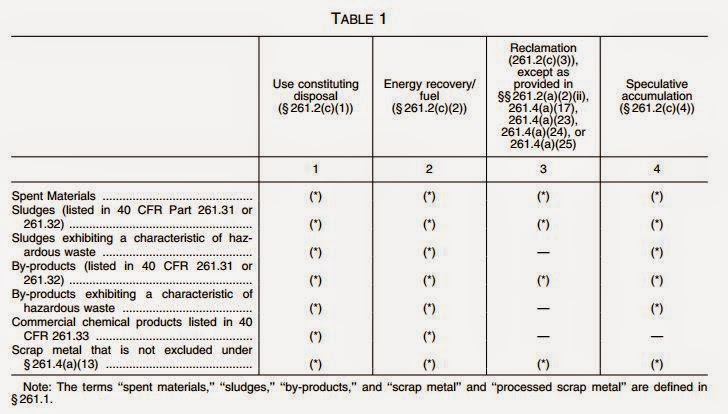
[261.2(c)(3)] Reclaimed. Materials noted with a ‘‘—’’ in column 3 of Table 1 are not solid wastes when reclaimed. Materials noted with an ‘‘*’’ in column 3 of Table 1 are solid wastes when reclaimed unless they meet the requirements of ...Here is where it gets fun kids! Let's look at Table 1:
Let's bring out Matlock to explain this:
Matlock: Do we all agree that Gallo Glass produces a sludge? Do we also all agree that the sludge they produce exhibits the characteristic of hazardous waste, in this case, it exceeds the toxicity threshold in 261.24's Table 1 for arsenic, cadmium, lead, and selenium?
DTSC: Objection!
Judge: Overruled!
Matlock: Do you see, on the EPA's Table 1 which is in 40 CFR 261.2, an item in the first column that sounds a lot like Gallo Glass' EP waste? I think the third item down "Sludges exhibiting a characteristic of hazardous waste" fits the bill pretty gosh darn close!
DTSC: Objection!
Judge: Overruled!
Matlock: So as I was a sayin' we have Gallo Glass's EP sludge clearly identified on Table I do we not? Now my client takes that EP sludge and returns it back into the process. This is an industry best practice used by most glass producers. This, I think we can all agree, meets the definition of recycling does it not?
DTSC: Objection!
Judge: Define for us the term "recycling" Mr. Matlock.
Matlock. Okay, if it please the court, the EPA defines in 40 CFR 261.1(b)(7) that a material is recycled if it is "used, reused, or reclaimed." Now, as I was saying, Gallo Glass recycles this EP sludge by putting it back into the process where it came from. This is recycling in all senses of the word, and. I think we can all agree, meets the EPA definition.
DTSC: Objection!
Judge: Overruled!
Matlock: Now my eyes are not what they used to be when I was just a young sheriff in a small town, so I am going to need some help here. DTSC can you tell me what symbol is noted in forth column over, the one titled "reclamation for the material in the first column that is three down?"
DTSC: Objection!
Judge: Answer the question DTSC!
DTSC: There is a "—" in column 3 of Table 1.
Matlock: And can you tell the judge what the "—" means?
DTSC: Objection!
Judge: Answer the question DTSC!
DTSC: That "—" in the reclamation column means that "sludges exhibiting a characteristic of hazardous waste" are not solid waste when they are reclaimed.
Matlock: And you would agree, DTSC, that reclamation is recycling as per the EPA would you not?
DTSC: Yes, reclamation is recycling under EPA's definition.
Matlock: And you would also agree, DTSC, that you cannot have a hazardous waste without first having a solid waste. Isn't that the way y'all make a hazardous waste determination? Solid waste first?
DTSC: Yes. Solid waste is required to call something a hazardous waste.
Matlock: And in that column there is a "—" symbol which means that Gallo Glass' EP sludge is not a solid waste and therefore is not a hazardous waste! I'm a rational, reasonable man DTSC, and as plain as the nose on my face, Gallo Glass did not generate a hazardous waste!
DTSC: Objection!
Judge: What is your objection DTSC, Matlock's brilliant summary has convinced me.
DTSC: Table 1 only excludes "sludges exhibiting a characteristic of hazardous waste" from being a solid waste if they are reclaimed. Would your honor ask Mr. Matlock to define for him what the definition of reclamation is?
Matlock: Objection!
Judge: Answer the question Mr. Matlock.
Matlock: Er...ah...gosh...here it is...261.1(b)(4) "a material is "reclaimed" if it is
processed to recover a usable product,
or if it is regenerated."
DTSC: And what does your client tell us they are doing with that EP sludge? If you look at number 34 in the compliant you...
Matlock: Objection!
Judge: Answer the question Mr. Matlock.
Matlock: "Defendants claim EP sludge was being used as a substitute for salt cake, a raw ingredient used in the making of glass bottles..."
DTSC: Thank you Mr Matlock. Will your honor agree that what Gallo Glass is doing with the EP sludge is not reclamation and therefore their EP sludge is a solid waste?
Judge: Well...based on that information, I would have to agree with you...
Matlock: Doh!
Announcer: Has Ben Matlock finally met his match? Does Gallo Glass generate an EP sludge that is a hazardous waste? Can this EP sludge be recycled by putting it back into the process? What will happen next is anyone's guess! Stay tuned for our next post: Part 7!
Saturday, March 7, 2015
Bottle of Wine.... Gallo Glass vs. DTSC - Part 5
There is RCRA the Law and RCRA the Regulation.
As generators of stuff, we pay attention to the regulations. Now I know, California has their own take on this. But when you call something a "RCRA hazardous waste" it means under the federal definitions 30 CFR 261.
Your state can be more stringent on what it wants done, but it cannot change this definition. It belongs to RCRA and RCRA regulations for hazardous waste determination begin in 40 CFR Part 261.
Where are we at this point?
Gallo Glass has a sludge
The sludge has four specifically identified heavy metals in Table 1 and would meet the definition of a hazardous waste under 40 CFR 261.24
The EP sludge is being recycled according to Gallo Glass
Does that sound like a reasonable synopsis of what we know at this point? To me it does, so let's move on.
Next post: Part 6
As generators of stuff, we pay attention to the regulations. Now I know, California has their own take on this. But when you call something a "RCRA hazardous waste" it means under the federal definitions 30 CFR 261.
Your state can be more stringent on what it wants done, but it cannot change this definition. It belongs to RCRA and RCRA regulations for hazardous waste determination begin in 40 CFR Part 261.
[261.1] This part identifies those solid wastes which are subject to regulation as hazardous wastes under parts 262 through 265, 268, and parts 270, 271, and 124 of this chapter and which are subject to the notification requirements of section 3010 of RCRA. In this part:
(a)(1) Subpart A defines the terms ‘‘solid waste’’ and ‘‘hazardous waste’’, identifies those wastes which are excluded from regulation under parts 262 through 266, 268 and 270 and establishes special management requirements for hazardous waste produced by conditionally exempt small quantity generators and hazardous waste which is recycled.
This is how you make sausage, so bear with me...
(b)(1) The definition of solid waste contained in this part applies only to wastes that also are hazardous for purposes of the regulations implementing subtitle C of RCRA. For example, it does not apply to materials (such as non-hazardous scrap, paper, textiles, or rubber) that are not otherwise hazardous wastes and that are recycled.
This is kind of important here. If a material is not hazardous and it will be recycled, the EPA is telling us that that stuff is not the Droids they are looking for.
Because we know (assume to know) that the EP sludge is characteristic toxic for arsenic, cadmium, lead, and selenium, (b)(1) applies to Gallo Glass' EP sludge.
![]() |
| Help me 40 CFR 261.2(c)(3) you are my only hope! |
This brings us to the definition of "solid waste" in 40 CFR 261.2. Ya' can't have a hazardous waste unless you have a solid waste. Here is where we make the sausage good!
[261.2(a)(1)] A solid waste is any discarded material that is not excluded...
[261.2(b)(1)] A discarded material is any material which is...
[261.2(b)(1)(B)] Recycled, as explained in paragraph (c) of this section...
Is Gallo recycling the EP sludge? Here is what Gallo says in the March 2, 2015 press release:
Precipitate captured by our air emission controls is comprised of the same raw materials used to make glass so we use it instead of adding new raw materials. The use of precipitate in glass making is recognized throughout the world as the environmentally-sustainable best practice
The DTSC, in number 33 states:
EP sludge is also a "recyclable material"...It's going to get, in my opinion, a little wacky on Gallo Glass' part here. I'll go down what I consider to be the most logical path, in terms of meeting the regulatory definition. As a reminder, I am looking first at EPA's regulations. I'll then look at California's to see if that changes anything.
Where are we at this point?
Gallo Glass has a sludge
The sludge has four specifically identified heavy metals in Table 1 and would meet the definition of a hazardous waste under 40 CFR 261.24
The EP sludge is being recycled according to Gallo Glass
Does that sound like a reasonable synopsis of what we know at this point? To me it does, so let's move on.
Next post: Part 6
Bottle of Wine.... Gallo Glass vs. DTSC - Part 4
Let's look at the facts...as we know them from the compliant.
Show the good people what we have Detective Friday:
The DTSC contends that:
Okay...nothing wrong with that. That's how you recycle glass to make new glass.
This is where, in my opinion, the white/gold or blue/gold color of the dress decision gets made,
There are four things in number 33 that are very critical to the compliant creating the domino effect for all these fines.
If you are unfamiliar with hazardous waste, well, once again, here is where it becomes wacky. You see the term "solid waste" does not mean solid. It has its own definition:
Remember the term "sludge" that the DTSC used for the EP stuff? It meets the RCRA definition of "sludge" because it came for an "air pollution control facility" - the EP Unit.
Now that we have a "sludge" from an air pollution control facility, we have a "solid waste." Once you have a "solid waste" you must make a hazardous waste determination. Based on the compliant, this sludge is a hazardous waste because it exhibits the characteristics for toxicity for D004, D006, D008, and D010.
Case closed! Let's go home!
But...but what about 40 CFR 261.2?
Yeah, about that...
Next post: Part 5
Show the good people what we have Detective Friday:
The DTSC contends that:
Okay...nothing wrong with that. That's how you recycle glass to make new glass.
This is where, in my opinion, the white/gold or blue/gold color of the dress decision gets made,
There are four things in number 33 that are very critical to the compliant creating the domino effect for all these fines.
- "Sludge"
- RCRA hazardous waste
- Toxicity Characteristic Leaching Process (TCLP), and
- "recyclable material"
California is a weird state in terms of how it regulates waste. Back in the 80's and early 90s when I managed waste there, we had no large, small, or conditionally exempt generator status. Everyone was treated the same and everything was a "hazardous waste" in California because they had set the toxicity threshold to 5000 mg/kg LD50.
Number 33 of the complaint calls the EP sludge "a RCRA hazardous waste" because it exhibits the toxicity characteristics under TCLP for "lead, arsenic, cadmium, and selenium" above the regulatory threshold in 40 CFR 261.24 Table 1.
I can find no mention of the DTSC sampling this EP waste and confirming that these four metals were above the threshold. The DTSC claims they are above the regulatory threshold, and, in number 35, the complaint states:
The EP sludge that did not make it into the silo or furnace was...disposed of as a hazardous waste to an authorized landfill.
What I assume now to be true is that the EP sludge must contain these four metals above the toxicity threshold making the waste D008, D004, D006, and D010 characteristic hazardous waste under RCRA.
This means that the process of making glass bottles produces a waste, called "sludge" that meets the definition of a hazardous waste. This, as you have seen me write about before - and here is where it gets wacky - is only true if the EP sludge meets the definition first of being called a "solid waste."
Under RCRA, because of how Congress wrote the hazardous waste definition, only a "solid waste" can become a "hazardous waste."
![]() |
| Source |
![]() |
| Source |
Now that we have a "sludge" from an air pollution control facility, we have a "solid waste." Once you have a "solid waste" you must make a hazardous waste determination. Based on the compliant, this sludge is a hazardous waste because it exhibits the characteristics for toxicity for D004, D006, D008, and D010.
Case closed! Let's go home!
But...but what about 40 CFR 261.2?
Yeah, about that...
Next post: Part 5
Wednesday, September 17, 2014
Dear Sierra Club, Please Stop. Comparable Fuels Rule Part 11
Okay, I'm about done beating this dead horse.
One last time...with feeling. Why the Sierra Club is wrong to claim that:
Molten Metals continues on this line of concern:
The Louisiana Department of Environmental Quality appeared to get what the EPA was doing, especially for Syngas:
Next Post: Dear Sierra Club, Please Stop. Comparable Fuels Rule Part 12 - Fin!
One last time...with feeling. Why the Sierra Club is wrong to claim that:
Today’s court decisions will help cut that pollution down and make our air safer to breathe.I addressed the regulations that were in place previously. Here is what they claim about the rule once it was passed:
Today’s rule contains conditions to assure that burning of comparable fuels will not become part of the waste management problem. The chief condition is limitation on burning to industrial furnaces (as defined in 260.10), industrial and utility boilers, and hazardous waste incinerators. Another condition prevents specification limits for hazardous constituents being achieved by means of dilution, so that the total volume of hazardous constituents emitted from burning comparable fuels would remain comparable to those from burning fossil fuels. The rule also contains notification and record keeping conditions which assure that the fuels meet the specification and will be burned in the requisite type of unit, and that this can be verified objectively by third personsI believe that the regulation they came up with protects public health and the environment. Period. I do not think that vacating this rule will "make our air safer to breathe." Let's look at what the EPA had to say about the that actual regulation while it was being proposed and during the comment period.
CFAP.07.a(commenter 136): 1. Failure to Assess Potential Risks to Human Health and the Environment In the development of the proposed comparable fuel exclusion, the Agency has not conducted even the most cursory analysis of the potential impacts on human health and the environmentThat's a comment from Molten Metals. Ignoring the soap-opera stuff and looking only at the merits of the question, here is EPA's response:
EPA disagrees that it is necessary to evaluate the environmental implications of its comparable fuels approach. The Agency has developed a comparable fuel specification based on the level of hazardous and other constituents normally found in fossil fuels. EPA refers to this as the benchmark approach.
For this approach, EPA set a comparable fuel specification such that concentrations of hazardous constituents in the comparable fuel could be no greater than the concentration of hazardous constituents naturally occurring in commercial fossil fuels. Thus, EPA expects that the comparable fuel would pose no greater risk when burned than a fossil fuel and would at the same time be physically comparable to a fossil fuel, leading to the conclusion that these materials are products, not wastes.
The Agency concludes it has discretion in exercising jurisdiction over waste-derived fuels that are essentially the same as fossil fuel, and since there would not likely be environmental benefits from regulating those fuels (i.e., burners would likely just choose to burn fossil fuels), EPA has decided not to exert regulatory control over comparable hazardous waste fuels meeting the benchmark specifications.
Furthermore, the final rule requires comparable/syngas fuel to be burned only in units subject to Federal/State/local air emission requirements. The Agency believes that limiting the burning of comparable/syngas fuels to industrial furnaces or boilers, or hazardous waste incinerators, along with a certification from the burner, would ensure that the fuel was burned in a manner protective of the environment.There are two things in play here. EPA reasons that what is true for the goose is also true for the gander. Secondly, limiting the burning to only BIFs and hazardous waste incinerators (that must comply with the Clean Air Act) provides protection for the public's health and the environment. I agree.
Molten Metals continues on this line of concern:
CFAP.08(commenter 136): An exemption based on lack of risk should not be abandoned because "this approach has very limited value to the regulated community." The comparable fuels exemption has the potential for becoming de facto exit levels from RCRA, particularly if generators are allowed to blend or treat wastes to meet the exemption levels.
Consequently, the lack of a risk basis for the levels in the instant rulemaking could undermine the risk-based exemption setting process EPA has undertaken in the HWIR rulemaking. In the HWIR rulemaking, exit levels will be based upon a comprehensive evaluation of risks to human health and the environment arising from exposures to releases along a variety of pathways.
If such risk-based exit levels can be overridden by a higher comparable fuels exit level not based upon potential risks, EPA will be both diminishing the importance of the risk evaluation in HWIR and encouraging the combustion of hazardous wastes through a higher exit level. inconsistency would be greatly exacerbated under comparable fuels specifications which lack concentration limits for many contaminants found in wastes, including contaminants contributing to the formation of PICS. The lack of concentration limits for many constituents would stand in stark contrast to the exit levels for hundreds of constituents contemplated in the HWIR rulemaking.
Finally, lacking a risk basis for the exclusion, EPA's rationale for the comparative fuels exclusion is largely the combustion equivalent of the indigenous principle previously articulated by the Agency in attempting to define RCRA jurisdictional limits for K061.
However, the Court in API v. EPA, rejected this limitation to RCRA jurisdiction. Therefore, the similarity of hazardous waste to fossil fuels is by itself not a sufficient basis for a RCRA exemption, absent a compelling demonstration that RCRA controls are not needed to protect human health and the environment.Boy oh boy! Molten Metals pulled no punches. Remember what their motivation was at this time. They had invented a better mousetrap and now the EPA was poised to take a whole bunch of mice out of reach of that trap. The EPA responds:
In regard to HWIR rulemaking, the comparable fuels exclusion would not undermine the risk-based exemption setting process EPA has undertaken in the HWIR rulemaking. The comparable fuels exclusion is conditioned on the waste being combusted, and thus prohibits direct placement on the land. The comparable fuel specifications need not be the same as the HWIR exit levels.
Indeed, the comparison is misplaced. The HWIR proceeding is defining when wastes no longer are hazardous. This proceeding is defining when a fuel-like secondary material is not a waste. (Even viewed from the standpoint of risk -- a misplaced comparison for the reason given -- it should be noted that there could be a legitimate difference between exit numbers for materials which must be combusted and those which could be managed in many other manners, including direct land disposal.)
With regard to API v. EPA, EPA disagrees with the commenter’s point. In the rule referred to by the commenter, the Agency made no attempt to develop hundreds of hazardous constituent levels to show that secondary materials and normal commercial products are comparable. EPA also notes that the principle that a hazardous waste can cease being a waste after treatment is well established in the rules. See §261.3(c)(2)(i) (final sentence).
Therefore, the similarity of hazardous waste to fossil fuels by itself is not a sufficient basis for a RCRA exclusion, absent a compelling demonstration that RCRA controls are needed to protect human health and the environment. Given that a comparable fuel would have legitimate energy value and the same hazardous constituents in comparable concentrations to those in fossil fuel (and satisfies other parameters related to comparability as well), EPA has discretion to classify such material as a fuel product, not as a waste.Molten Metals Continues:
CFAP.07.b(commenter 136): The Agency notes that it "considered" using a risk-based approach to determine the specifications for the comparable fuels exemption (61 FR 17460), but added that it has "insufficient data relating to the types of waste burned and the risks they pose." As a result, EPA is proposing the "benchmark approach" and plans to develop a comparable fuel specification based on the level of hazardous and other constituents normally found in fossil fuels. EPA "would expect that the comparable fuel would pose no greater risk when burned than a fossil fuel and would at the same time be physically comparable to a fossil fuel" but provides no factual support for the expectation.Remember the Court mentioned the "benchmark approach." Here is how EPA responded:
EPA has provided factual support for the expectation that the comparable fuel would pose no greater risk when burned than a fossil fuel and would at the same time be physically comparable to a fossil fuel.
The Agency has explained in detail exactly how the specifications were developed, and how a comparable fuel indeed will have lower concentrations of hazardous constituents than many fossil fuels. Based on the fact that a comparable fuel would have lower concentrations hazardous constituents than many fossil fuels, there is no reason to think that they would burn in a different manner than fossil fuels being replaced.I can see the EPA getting a bit exasperated about this.
The Louisiana Department of Environmental Quality appeared to get what the EPA was doing, especially for Syngas:
We would consider it a great luxury to be able to apply regulations which actually anticipate the process. Otherwise, we face the same old dilemma: Do we act as faithful executors of yet another unintended consequence, or do we yield to Reason and reach for a stilted, but expedient interpretation?The EPA responds:
The final rule also requires comparable/syngas fuel to be burned only in units subject to Federal/State/local air emission requirements. The Agency believes that limiting the burning of comparable/syngas fuels to industrial furnaces or boilers, or hazardous waste incinerators, along with a certification from the burner, would ensure that the fuel was burned in a unit subject to Federal/State/local air emission regulations.
Industrial furnaces or boilers, or hazardous waste incinerators are believed to be a universe of units that are capable of handling comparable/syngas fuels and that would be subject to Federal/State/local air emission requirements.
Next Post: Dear Sierra Club, Please Stop. Comparable Fuels Rule Part 12 - Fin!
Labels:
1984,
261.38,
261.4,
6924(q),
Comparable Fuels,
Earthjustice,
EPA,
HSWA,
RCRA,
Sierra Club
Tuesday, September 9, 2014
Dear Sierra Club, Please Stop. Comparable Fuels Rule Part 10
Golly jeepers! This is my tenth post on this topic. I swear I only though it would take me three. Seems that to support my claim that the Sierra Club and friends are wrong in thinking that the Court's vacating of the Comparable Fuels Exclusion is not going to bring about any of the changes they claim:
The burden is on me to support why they are wrong, and, well its taken me this many posts to get there. Unfortunately, this is not going to be the last one. I have no idea where these blog posts will take me once I start. As I write them, something always comes to the surface that requires research, and that endeavor brings about a new rabbit hole to chase down.
Bear with me, this may seem like an aside, but it plays into the determination of risk. That determination was made by the EPA but not accepted by the Court. Nor did the Court address risk. The Court decided this case on a procedure but if you read between the lines, they, like the Sierra Club and friends, doubt that safety of public health and the environment was adequately addressed when 40 CFR 261.32 was finalized.
The Court eludes to the issue of risk not being addressed (though that is not why they used it) by citing a comment to the proposed 261,38 regulation by Molten Metal Technology Inc. who asserted:
I went looking for this question posed by Molten Metals and was lucky enough to find it on the EPA's website. It's in a document called "Response to Comments Document Hazardous Waste Combustors Revised Standards Final Rule Part I." This quote is attributed to "CFAP.07.c(commenter 136)" which I am going to assume (as I cannot find a key to the numbers) is molten Metals.
Now I am a little embarrassed by not knowing who Micro Metals was. You see, with a Google search I was able to find a Boston University School of Management Case Study on the company:
Here is how the EPA responded:
This created two problems for MMT. One would be the loss of the Listed wastes streams that were going to incinerators, their "first and foremost" competitor, and the second would be their process, CEP, was not using the Listed waste as a fuel, so they could not take that waste in unless it was classified as a Listed Waste. What generator would do that?
So what strategy works best when EPA wants to change a rule that will take away an ongoing revenue source? Muddy the waters with concerns of woe.
Here is where it gets all soap-opera like. Remember Syngas?
Well guess why that regulation is there?
Okay, you get the picture. What about risk? How does the EPA address risk? All this posturing and nonsense (noise) detracts from the real question. Was the public protected by this regulation?
Next Post: Dear Sierra Club, Please Stop. Comparable Fuels Rule Part 11
.
The burden is on me to support why they are wrong, and, well its taken me this many posts to get there. Unfortunately, this is not going to be the last one. I have no idea where these blog posts will take me once I start. As I write them, something always comes to the surface that requires research, and that endeavor brings about a new rabbit hole to chase down.
Bear with me, this may seem like an aside, but it plays into the determination of risk. That determination was made by the EPA but not accepted by the Court. Nor did the Court address risk. The Court decided this case on a procedure but if you read between the lines, they, like the Sierra Club and friends, doubt that safety of public health and the environment was adequately addressed when 40 CFR 261.32 was finalized.
The Court eludes to the issue of risk not being addressed (though that is not why they used it) by citing a comment to the proposed 261,38 regulation by Molten Metal Technology Inc. who asserted:
Therefore, the Agency’s comparable fuels proposal will likely result in higher exemption concentrations than levels that would normally be derived using a risk-based approach. Such an approach would violate the clear Congressional mandate in Section 3004(q) of RCRA to regulate the burning of hazardous waste for energy recovery “as may be necessary to protect human health and the environment.”Ignoring the Court and what they were thinking, I want to address to Molten Metal Technology they think 261.38 will result in a higher concentration of hazardous constituents? I want to also ask, if it does, is the public impacted at a greater risk then burning fossil fuels because of that?
I went looking for this question posed by Molten Metals and was lucky enough to find it on the EPA's website. It's in a document called "Response to Comments Document Hazardous Waste Combustors Revised Standards Final Rule Part I." This quote is attributed to "CFAP.07.c(commenter 136)" which I am going to assume (as I cannot find a key to the numbers) is molten Metals.
Now I am a little embarrassed by not knowing who Micro Metals was. You see, with a Google search I was able to find a Boston University School of Management Case Study on the company:
Just six years since its founding in 1989, Molten Metal Technology Inc. (MMT) was on the verge of huge successes. The company had successfully developed an exciting new technology called Catalytic Extraction Processing (CEP) which would not only break down hazardous and radioactive wastes into benign form but also recycle them back into marketable products.
Now you might be thinking, so what? But that's really kind of relevant here. The Court, out of all the comments, chose the one stating that there will "likely result in higher exemption concentrations than levels that would normally be derived using a risk-based approach" generated by Micro Metals. The Court then uses that question referencing the EPA's decision to use a "benchmark approach" while "rejecting a 'risk' approach."
The Court writes:
Nonetheless, EPA’s response to Molten Metal’s comment suggests that EPA understood Molten Metal to challenge EPA’s statutory authority to exclude comparable fuels in the first place and affirms its authority to do so.
As EPA’s response to Molten Metal’s comment demonstrates, that EPA had statutory authority under section 6924(q) to exempt some hazardous-waste-derived fuels from regulation was a “key assumption” underlying EPA’s exercise of its “discretion to classify such material as a fuel product, not as a waste,” and thereby “exclude” it from section 6924(q)’s ambit.Here is the question from Molten Metals in full:
Here is how the EPA responded:
Section 3004(q) applies to hazardous wastes which are burned for energy recovery. The provision does not speak to EPA’s authority to determine whether particular fuels produced from secondary materials are, or are not, products rather than wastes. It is rational for the Agency to determine, after rigorous examination, that secondary materials which have the same heating values and composition as normal commercial fuels, and the same types and levels of hazardous constituents, are no longer solid wastes.
Now if you think for one minute that the comments posed by Molten Metals was really over concern about the risk to public health and the environment, well you need to get yourself out of Colorado and breath some fresh air. I can't really tell what's in the hearts of the guys who wrote the 30 different comments on every part of this rule and submitted them to the EPA. I can point out this:
MMT was developing excitement around its experimental process for several years. While the process worked in laboratory tests, commercial implementation still lay ahead. The company had carefully orchestrated its commercial demonstration programs to learn from and share with a broad cross-section of industry and government. By the end of 1995, the groundwork was set and Molten Metal was proceeding with its plan to make the transition into full commercialization for addressing the range of issues confronting hazardous and radioactive waste cleanup efforts.Check that date out. When did the Comparable Fuels Exclusion, 261.38 get finalized? 1996. Here is what else we learn:
Molten Metal entered the market during this time of increasing regulatory oversight, intense industry competition and heightened interest in environmental solutions. Armed with a technology it argued to be the most innovative of its class and able to go beyond the traditional paradigm of stabilization or simple destruction, MMT set off to capture waste management opportunities.
The company asserted that the worldwide generation of over 600 million tons of hazardous industrial waste would demand “pollution prevention and recycling solutions like CEP (Catalytic Extraction Processing).” MMT promoted its CEP technology on its regulatory and environmental merits, claiming that it avoided the environmental pitfalls of incineration and landfilling waste, while also sheltering MMTand the end-users from regulatory oversight due to the recycling nature of the process.You see the problem here? MMT, which was :proceeding with its plan to make the transition into full commercialization," was about to lose a big ol' chunk of the easy pickings with this new Comparable Fuels Exclusion. MMT was not going to burn this waste in place of fuel, it would treat the waste as a form of “pollution prevention and recycling solutions."
This created two problems for MMT. One would be the loss of the Listed wastes streams that were going to incinerators, their "first and foremost" competitor, and the second would be their process, CEP, was not using the Listed waste as a fuel, so they could not take that waste in unless it was classified as a Listed Waste. What generator would do that?
So what strategy works best when EPA wants to change a rule that will take away an ongoing revenue source? Muddy the waters with concerns of woe.
Well guess why that regulation is there?
[From EPA] It appears to the Agency, for example, that the Molten Metals operation, which planned to solicit and accept most types of identified and listed hazardous wastes, is easily cognizable as a hazardous waste treatment operation, notwithstanding the syngas generated as an output of the process.
[From CMA - a friend of MMT] In the final rule, EPA should merely clarify that uncontained syngas, or any other gas not confined to a container, is not subject to RCRA regulation. CMA supports EPA's confirming that syngas manufacturing projects are not subject to RCRA - some of CMA's members are participants in Molten Metals Technology's and other syngas projects. However, for EPA to finalize the exclusion as proposed would be to codify implicitly an unprecedented expansion of its RCRA jurisdiction.
[From CMA - a friend of MMT] The Agency notes that "Molten Metal Technology commented that the CEP is not in fact a combustion technology, and the Agency has attempted to reflect this in the definition" of combustion.
[R-P a competitor] R-P opposes the proposed exclusion for synthesis gas fuel (17465) which EPA has expressly included for the catalytic extraction process (CEP) unit developed by Molten Metals Technology (MMT). The CEP "thermal reaction" process proposed by MMT is essentially hazardous waste incineration in a starved air environment (i.e., a pyrolysis reaction).
ENSCO a competitor] ENSCO also opposes the proposed exclusion for synthesis gas fuel (17465). This proposal would allow any combustion unit, disguised as a "desorber" or other alternate technology label device, to partially burn hazardous waste, producing harmful off gases loaded with toxic PICS, dioxin, furan, and metals. EPA states that it is aware of one such process proposed to be operated by Molten Metals Technology (MMT).Judge Judy wrote her biography and titled it: Don't Pee on My Leg and Tell Me It's Raining. If you read these comments you can see where Judge Judy is coming from after listening to all manner of reasoning and justification in her court. Same here with the EPA:
ENSCO also applauds EPA for setting specifications for the full range of hazardous metal and organic constituents under Appendix VIII, and urges EPA to retain this in the final rule.Well of course you do ENSCO!
Okay, you get the picture. What about risk? How does the EPA address risk? All this posturing and nonsense (noise) detracts from the real question. Was the public protected by this regulation?
.
Labels:
1984,
261.38,
261.4,
6924(q),
Comparable Fuels,
Earthjustice,
EPA,
HSWA,
RCRA,
Sierra Club
Subscribe to:
Posts (Atom)