Sunday, October 2, 2011

Laundered Shop Towels: 10 - When is an average not average?

Rule number 5: Always make sure the model and equations reflect reality.


I think I have presented enough justification to throw out Gradient's  "Intake of metals in laundered shop towels via hand contact" equation:


Instead, I believe the CalEPA equation to be a lot more sound and valid for calculating a hand to mouth intake, even though it uses assumptions I think are a bit of a stretch as well.  Still, we need something to quantitatively estimate an intake so we can look at risk, so this equation will have to do for workers using laundered shop towels.

Guideline for Hand-to-Mouth Transfer of Lead through Exposure to Consumer Products: 2011
The CalEPA equation calculates the daily total intake.  To compare apples with apples and oranges with oranges (Rule Number 4), The intake was divided by 70 kg (weight of an adult) to derive a mg/kg-day intake value (see last post).

I commented on how close the CalEPA method intake values match the values I calculated when the Hand to Mouth transfer efficiency (HTE) rate was changed to a more appropriate 6% for an adult.  But that comparison I made is like comparing apples with oranges.

The CalEPA intake is based on a single uptake event and is used as a threshold to meet the California Proposition 65 "Safe Harbor" designation.
A business has “safe harbor” from Proposition 65 warning requirements or discharge prohibitions if exposure to a chemical occurs at or below these levels. These safe harbor numbers consist of no significant risk levels (NSRL) for chemicals listed as causing cancer and maximum allowable dose levels (MADL) for chemicals listed as causing birth defects or other reproductive harm. (1)
As long as a business can keep the exposure below the NSRL or MADL (whichever is lowest) the business does nor have to post Proposition 65 warnings.  The assumption here is that below these levels there would be little risk for cancer or reproductive/birth defects.  What it does not imply is that above those values there is risk.  Risk is related to dose, the lower the dose, the lower the risk.  NSRLs and MADL attempt to draw a line in the sand - one side is "no risk" and the other side is some.

The problem with the Prop 65 notice is that it does not communicate a degree of risk, only that there is risk. One cancer in 99,998 or one cancer in 98 gets the same warning:
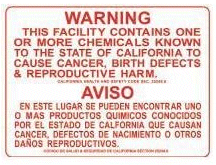

Gradient assumes that laundered shop towels that contain concentrations of metals above these thresholds represent risk to the worker, hence the black and red bar graphic I showed in the first post on this topic:


Source


A bit confusing for it shows copper as having a higher exceedance than lead.  Anyway, it is based on information from this table:

2011 Gradient Study

Ignore the maximum intakes they reported - they are statistically impossible to reproduce in a real world situation (see post).  Look instead at the average (mean) intake value for lead, which is the metal that presents the highest exceedance ratio compared to a threshold.

Using the intake equation Gradient developed for hand to mouth exposure, Gradient reports exceeding the CalEPA MADL and NSRL for lead for average laundered shop towel usage by a worker.

Using the CalEPA equation and the same average towel usage and average lead metal loading used by Gradient, I calculate the following exceedance "ratios" for lead:
  • Intake (lead) = 0.0022 mg/kg-day
  • MADL = 0.0000071 mg/kg-day (0.5 ug/day) (2)
  • NSRL = 0.00021 mg/kkg-day (15 ug/day) (2)
This would generate an "exceedance ratio" of:
  • MADL = 309 x
  • NSRL =  10 x
Well, heck, that's lower but still pretty high.  At least that's what one could reasonably conclude when comparing apples with oranges.

Let's look at the "maximum allowable dose levels (MADL) for chemicals listed as causing birth defects or other reproductive harm."  Here is what the CalEPA based the lead "safe harbor" MADL on:

CalEPA 2008 Page 13

That "safe" value of  0.0000071 mg/kg-day is based on fetal development, which is only applicable to a female worker who is pregnant and using the laundered shop towels.  That "safe" threshold - MADL - is not applicable to a male worker's intake using the same laundered shop towels.

Let's look a bit closer on how that MADL for lead is calculated.
The MADL is the level at which chemicals listed for reproductive toxicity would have no observable effect assuming exposure at 1,000 times that level. (3)
What is the " no observable effect" level?
No-observed-adverse-effect level (NOAEL): The highest tested dose of a substance that has been reported to have no harmful (adverse) health effects on people or animals. (4)
No-Observed-Adverse-Effect Level (NOAEL)—The dose of a chemical at which there were no statistically or biologically significant increases in frequency or severity of adverse effects seen between the exposed population and its appropriate control.  Effects may be produced at this dose, but they are not considered to be adverse. (5: Page 526)
Neither ASTDR nor IRIS identify a NOAEL for lead,  instead they use a blood lead level as a "safe" dose.

So if we assume that the lead MADL is based on an effect to the fetus, and we assume that the lead MADL of 0.5 ug-day is 1000 times lower than the NOAEL, the NOAEL used by CalEPA must be 500 ug-day (0.5 x 1000 = 500).  I can find nothing on how CalEPA derived the value "0.5 ug-day" other than this and this.

A NOAEL of 500 ug-day is equal to 7.14 ug/kg-day or 0.007 mg/kg-day (based on 70 kg body weight).  0.007 = 7.0E-03

Gradient reported an average "typical use" intake for lead of 4.2E-03 (Table 8 Page 13).  Even using all of Gradient's assumptions and their intake formula, the intake they report is below the No-observed-adverse-effect level used by CalEPA (7.0E-03).  An average use of 12 towels per day for five days a week, for 245 days per year for 40 years falls below the lowest concentration reported to show no adverse effects.

Still not convinced that these laundered shop towels pose no increase of risk to a worker, even a pregnant one exposed to a mean concentration of lead at 100 ppm?  Well, let's look at it another way.

What is the amount of lead in soil that would be considered to present a risk for a person who ingests 50 mg of soil each day for a total of 219 days in a year?

In other words, under certain assumptions, what would the clean-up level for the lead in the soil be?

Next post: Laundered Shop Towels: 11 - Lead, a fetus, and a PPM.


.

Saturday, October 1, 2011

Laundered Shop Towels 9 - CalEPA's Lead Intake from Direct Hand-to-Mouth Contact

The equation Gradient has developed to calculate worker intake of metals, such as lead, is based on a number of assumptions.

Not only do we have to accept the mean concentrations Gradient reports for these metal contaminants on the laundered shop towels, but we are also asked to assume that 13% of those contaminants will be transferred from the towel to the hand after the towel had been washed with soap and heat dried.

On top of this, as my last post described, Gradient makes the assumption that each time a laundered shop towel is used, the worker will place his hand to his mouth and 13% of the contaminants on the towel will be transferred to the mouth - intake.

Even if you accept Gradient's intake equation, it is difficult to accept the values they assigned for the assumptions used.

In my last post I detailed why the HTE of 13% Gradient uses is incorrect and an HTE is more appropriated since it involves calculating the HTE using both an adult soil consumption value and an adult hand.

Recalculating the intake values using an HTE of 6% still shows some metals to be above regulatory standards.  This is primarily due to the inappropriateness of calculating the HTE as a ratio of daily soil consumption to amount of soil found on both hands - as was discussed in my last post.

There is a more appropriate way to go about figuring out a hand to mouth transfer, which once again brings up:
Rule number 5: Always make sure the model and equations reflect reality.
Here is how CalEPA looks at lead intake from direct hand to mouth contact, which is the model Gradient should have used to calculate the intake of metals - such as lead - from laundered shop towels.

Source Page 6
Gradient instead calculates a lead intake over a worker's entire working lifetime of 40 years, whereas CalEPA calculates it on a single contact performed i number of times (events).  According to CalEPA:
There can be multiple hand-to-mouth contacts during the use of a given consumer product.  Thus the total direct lead intake via the use of a given consumer product will be the sum of intake from each contact i during product use.
CalEPA modifies the equation above as follows:

Source Page 6
Let's look at how CalEPA calculates the values for these parameters in their equation:

Source Page 11

                                     Surface area (SAD)
Source Page 12
                                    Contact frequency (λD) = Frequency
                         
                                    Exposure Duration (t) = Time


Lhand-D can then be calculated as follows:

Note: To keep consistent with other values used (see below), the surface of the front of the hand will be calculated as 840 (total surface area of both hands) * 0.5 (for one hand) * 0.5 (for the front of the hand).  Thus, the surface area for the front of one hand will be: 210 cm2.  In my previous "fun with graph paper" post, I estimated the surface area to be 188 cm2.

If Lhand-D is:
The lead loading on the part of the hand touching the mouth (not the loading of the whole hand), in units of weight per surface area (e.g., mass of lead per surface area of the fingertip, μg/cm2).
Assuming that 13% of the 75% lead load on the laundered shop towel is transferred to the hand:
  • 0.00127 x 2268 x 0.75 x 0.13 = 0.28 mg
  • 0.28 mg / 210 cm2 = 0.0013 mg/cm2 or 1.3 ug/cm2
 The "part of the hand touching the mouth" or SAD, is calculated as follows: 
Assumed for workers in occupational settings that the surface area of the hands contributing to the hand-to-mouth exposure pathway was 5% of the palmar surface of the hand, or 10 cm2.
Here is what I found in an earlier version of this CalEPA Lead document:

Source 2008

For this post, I will use the adult male SAD of 19 cm2.

Fdirect will be 50% (as per CalEPA)

Contact frequency (λD) will be 1.5 towels per hour (based on 12 laundered shop towels per 8 hour shift)

Exposure Duration (t) will be an 8 hour work shift.

For an exposure period of one day, lead intake during one work day (12 towels in 8 hours) - using CalEPA's equation - can be calculated as follows:
  • Intake = 0.0013 mg/cm2 x 19 cm2 x 0.5 x 1.5/hour x 8 hours =  0.148 mg per work day
  • 0.148 mg per day = 0.148 / 70 kg =  0.0022 mg/kg Intake or 2.2E-03
That's how CalEPA would calculate the intake based on a mean lead concentration of 100 mg and a towel to towel transfer efficiency of 13% - which are the same values Gradient uses in their equation.

Here is how the CalEPA method and equation stacks up against the Gradient equation and assumptions for the metals they reported with concentration exceedance ratios.

CalEPA Formula source

Notice how the CalEPA's equation produces an intake very similar to the values Gradient calculated for cancer intake.  Interesting.

Now lets look at the CalEPA method using an HTE of 6% (see post):


Notice how the CalEPA intake is very similar to the intake values obtained using Gradient's equation with an HTE of 6%.  Interesting.

The question you should now ask is: What equation more accurately estimates the intake if the assumptions used are valid?

I say we go with the CalEPA equation.  Now all we need to focus on will be the assumptions regarding the average load on the towel, the towel transfer efficiency, and the number of laundered shop towels used per day by a worker.  Oh yeah, we will also need to look at the respective "toxicity criteria" these intakes were compared to and how Gradient went about "evaluating the magnitude of the exceedances."

Next Post: Laundered Shop Towels: 10 - When is an average not average?


.

Friday, September 30, 2011

Laundered Shop Towels 8: A child's hand is not an adult's hand

That title is one of those "duh!" types of statements.

So if that's true, why did Gradient base the hand to mouth efficiency (HTE) on studies involving 1-6 year olds?

Not that there is anything wrong with that, but in this case, we are dealing with adult workers and assumptions should have been made using adult data - that was readily available to them.

Gradient states in their 2003 study the following:
Gradient used the median skin surface area data specific to a 1- to 6-year-old child and applied the soil AF derived from Roels to estimate the average mass of soil on the hands for a 1- to 6-year-old child, which is approximately 145 mg for both hands.
A median soil ingestion rate of 38 mg/day for children ages 1 to 6 years was calculated based on a soil ingestion study conducted in Amherst, Massachusetts.
This soil ingestion rate was divided by the hand soil-loading estimate for a child resident (approximately 145 mg on both hands), for a daily HTE value of approximately 0.26 hand loads per day.
In this report, we used half of 0.26 as the HTE value for adults, or 0.13. 
Using a smaller HTE for adults as compared to children is further supported by the United States Environmental Protection Agency's (USEPA) soil ingestion rates:  their recommended mean soil ingestion rate for adults is exactly one-half of the value for children less than 6 years of age (USEPA, 1997a)
That HTE value of 13% was based on dividing the amount of soil a child consumes in a day by the amount of soil both hands of a child can hold (soil-loading).  Read my previous post on this for more information.

That amount, 26%, was then divided in half to represent the HTE for an adult, 13%.

Sounds good until you think about it a little more closely.  See it?  Yeah, you can fly a Russian Antonov An-225 through this one.

According to Gradient, the "145 mg for both hands" was calculated as follows:
Gradient then divided the average amount of soil adhering to the hands by the “available” skin surface of the hands for the average age of the children included in the Roels study (i.e., 11-yearolds) to generate a soil adherence factor (AF) of 1.1 mg/cm2 for both boys and girls.  
The skin surface area of the hands available for contact with soil is assumed to be approximately one-third of the total surface area of both hands.
If that assumption holds true, why didn't Gradient use "one-third of the total surface area of both hands" for an adult?

To get the HTE of 13% the "median soil ingestion rate of 38 mg/day for children ages 1 to 6 years" was divided by "145 mg for both hands."

If we assume (according to the EPA) that the "mean soil ingestion rate for adults is exactly one-half of the value for children less than 6 years of age," wouldn't it have been more appropriate to take one-half of 38 mg/day - 19 mg/day - and divide that by  "one-third of the total surface area of both hands" for an adult?

If that assumptions for a child holds true, this would have been a more appropriate - or scientifically sound - method to calculate the HTE for an adult worker.

You can ask Gradient why they did not use this method to calculate their HTE.  Even more peculiar is why they did not use an established calculation to estimate hand to mouth intake for an adult.  A little bit of Google searching brings up this document from the CalEPA:
Guideline for Hand-to-Mouth Transfer of Lead through Exposure to Consumer Products
Here is what CalEPA says on page 12:
The U.S. EPA Exposure Handbook provides representative hand surface area values for both adults and children in Chapter 6, General Factors for Dermal Route.  Detailed data distributions of hand surface area (mean, standard deviation and percentile distributions) by gender and age are provided in Tables 6-2 to 6-8 (U.S. EPA, 1997). 
Gosh...I wonder what that source is?
U.S. Environmental Protection Agency (U.S. EPA, 1997). Exposure Factors Handbook.  National Center for Environmental Assessment, Office of Research and Development, Washington, DC, EPA/600/p-95/002F a-c.
That sounds familiar...I wonder where I saw that source mentioned before?  Oh, yeah, it was referenced in the 2003 Gradient study on laundered shop towels:

Source: 2003 Gradient Study
Why's that important?  Well in that EPA handbook is data that Gradient should have used.  Here is what CalEPA goes on to say:
From the U.S. EPA Exposure Handbook, the representative value of the surface area of both hands in adults is 750 cm2 for women and 840 cm2 for men. 
I wonder what the HTE would be if we used the values assigned to adults?  Let's see:
"The skin surface area of the hands available for contact with soil is assumed to be approximately one-third of the total surface area of both hands."  So if we multiply 840 by 0.33 we get 274 cm2
"Gradient then divided the average amount of soil adhering to the hands by the “available” skin surface of the hands...to generate a soil adherence factor (AF) of 1.1 mg/cm2 for both boys and girls."  So if we multiply 274 by 1.1 we get 301 mg on both hands, this is the "soil loading" estimate.
If the adult "mean soil ingestion rate for adults is exactly one-half of the value for children less than 6 years of age," we would take 38 mg/day and divided it by 2, which would give us 19 mg/day. 
 "This soil ingestion rate was divided by the hand soil-loading estimate...for a daily HTE value..." So, if we divide 19 by 301 we would get an adult male HTE of  6%.
As I pointed out in a previous post, this method of calculating an HTE is flawed because it assumes all the soil ingested in a day comes solely from the hands.

Still, though, if Gradient was going to calculate an HTE based on this method, it would have made more sense to use adult values, which would have been calculated as 6%.

Does an HTE of 6% instead of 13% affect their findings?

Recalculation - Table 8 of 2011 Study
I had to tweak the "Average Load" values in Table 8 upwards to get the same intake values they calculated.  The values in blue represent the intakes one would see if a 6% HTE was used.  At a 6% HTE, the Exceedance Ratios in Table 8A are changed as follows:


You can see that there are still exceedances, but adjusting just one variable, the HTE, changes the results considerably.  Now, consider the other parameters "assumed" to be correct by Gradient.  Every value that is used that is higher than would actually be in reality (mean. maximum, towel transfer efficiency, number of rags used), exaggerates the "exceedance ratios" Gradient reports.

Yeah...but look at lead!  It's still 273 times higher than CalEPA's MADL.... and five times higher for cancer.  Explain that!

Those exceedance values are only applicable if you accept Gradient's HTE..  Remember, Gradient calculated that percentage based on ALL of the soil consumed in a day coming from the hands.  13% or 6% is based on that premise, which is not the sole mechanism for soil intake into the child or adult. (see post).

A better way to calculate how much lead (metal) would be transferred from the hand to the mouth would have been to use a more plausible calculation....like the one that CalEPA has developed.

Next Post: Laundered Shop Towels 9: CalEPA's Lead Intake from Direct Hand-to-Mouth Contact


.

Thursday, September 29, 2011

Laundered Shop Towels: 7 - Fun with graph paper.

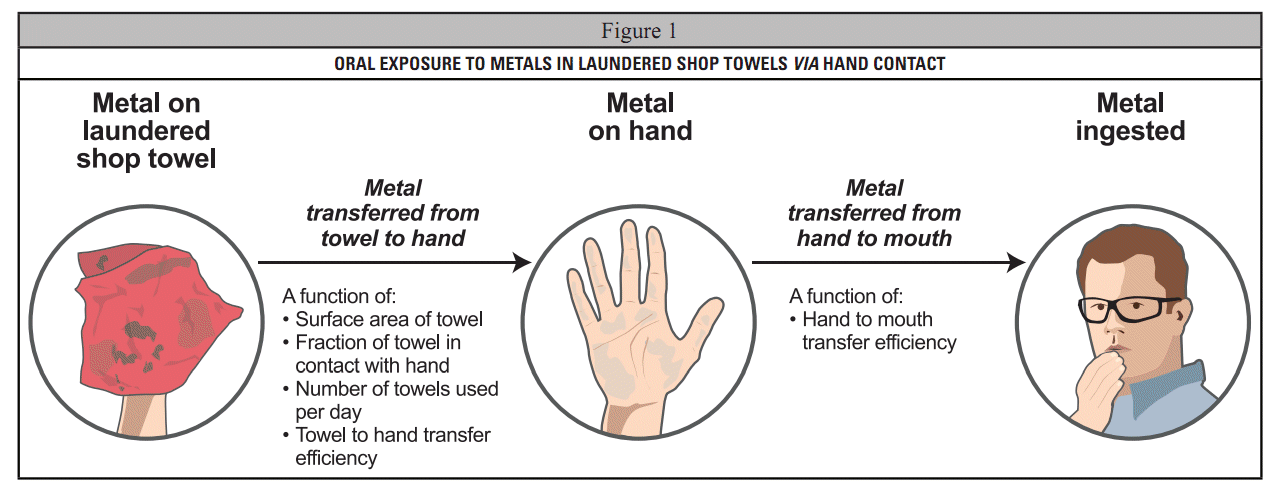
I got to thinking about what is involved in Gradient's model and equation.  That is, if there is intake of lead each and every time a laundered shop towel is handled, how would this transfer from hand to mouth take place in a work environment.

According to the model:

Source
And the equation:

Source

The lead (metal) is transferred to the hand through a "towel to hand transfer efficiency" or "Tt/h" which I discussed in a previous post.  The Tt/h is a unitless number in Gradient's equation, and is a percent (0.13) of what is on calculated to be on the towel (Loadtowel) surface (mean/maximum).

What Gradient's equation states is this.  If the towel contains X amount of lead per square centimeter, the towel will dislodge 13% of X that is on each centimeter of towel.  They then go on to calculate that the hand will only come in contact with 75% (Ftowel)  of the towel's surface area (SAtowel).

On the hand will be 13% of X from 75% of the towel.

Gradient assumes that the towel has the lead (metal) evenly dispersed on each of the 2,268 square centimeters that make up a laundered shop towel's surface area.  The "load" is found on Table 2 of the report.  For lead, it is as follows:
  • Average = 0.0012  mg/cm2
  • Maximum = 0.0075  mg/cm2
If we are looking at the average concentration of lead found (mean) each square centimeter of the towel's surface is considered to contain 0.0012 mg/kg of lead.

The hand, coming in contact with 75% of the laundered shop towel's surface area, is assumed to dislodge 13% of the lead onto the hand. (let's ignore N for the time being)
  • 0.0012 x 2268 x 0.75 x 0.13 = 0.26 mg
Gradient assumes that each towel with an average concentration of 100 mg/kg of lead will place onto the hand 0.26 mg of lead.

This is where it get's a bit...complicated.

Gradient assumes that the hand with the 0.26 mg of lead will come in contact with mouth, and when it does, 13% of that amount will end up in the mouth (intake).

They base that 13% hand to mouth transfer efficiency (HTE) on the how much soil is consumed in a day by a child divided by how much soil is contained on a 1-6 year old's hand.  They then cut that percentage in half because " The smaller HTE value used for adults reflects the reduced hand-to-mouth behavior in people greater than 6 years of age."  You can read more about this in my last post.

But back to where I was going with this.

If the HTE is 13% like Gradient assumes it is, how would 13% of 0.26 mg be transferred from the hand to the mouth?

Rule number 5: Always make sure the model and equations reflect reality.

Regardless of what studies one looks at, the model and calculation you develop must reflect the actual reality for the situation you are describing.

If we are to assume that an employee places his hands to his mouth each and every time they use a laundered shop towel, then we must assume there is a plausible mechanism for this to take place.

If the shop towel transfers and evenly spread out load of lead onto the hand, how much of the hand needs to come in contact with the mouth to transfer 13%?

Gradient assumes that the transfer efficiency is 13%.  That is, if the whole hand was placed into the mouth, only 13% of the lead would come off the hand.

Think about that for a minute.

Gradient is basing the intake on the efficiency of transfer.  That is, each square centimeter of hand surface area that came in contact with the towel can only transfer 13% of that load into the mouth.

This requires one of two things.
  1. The whole contact surface area of the hand is placed into or up to the mouth
  2. The 75% surface area of the laundered shop towel only comes in contact with the the part of the hand that comes in contact with the mouth.
Do any of those two situations seem plausible?

Because the assumption for the HTE is flawed, the amount of metals, such as lead, Gradient calculates getting into the body is flawed as well.

And this is why my question of "how" is important.

To have 13% lead transfer from the hand to the mouth, either the whole hand is placed into the mouth or licked, or 13% of the surface area of the hand is contacted with the mouth for 100% transfer efficiency (which is not what their equation is based on).

Let's assume that we have 100% transfer efficiency (which is not supported by any of the studies they looked at).  How much surface area of the hand would need to come in contact with the mouth?

Once again, we need to look at Gradient's model and equation.  Gradient assumes that only one hand is used in their equation, which means that the total amount of lead, 0.26 mg, will reside on one hand and it will be that hand that contacts the mouth.  It also appears that they assume only the front of the hand (palm and inside fingers/thumb) come in contact with the towel.

So here is what I did, when I got to thinking about this.

How much surface area of an employees hand would come in contact with the laundered shop towel?

This required a one centimeter by one centimeter sheet of graph paper, and a pen.


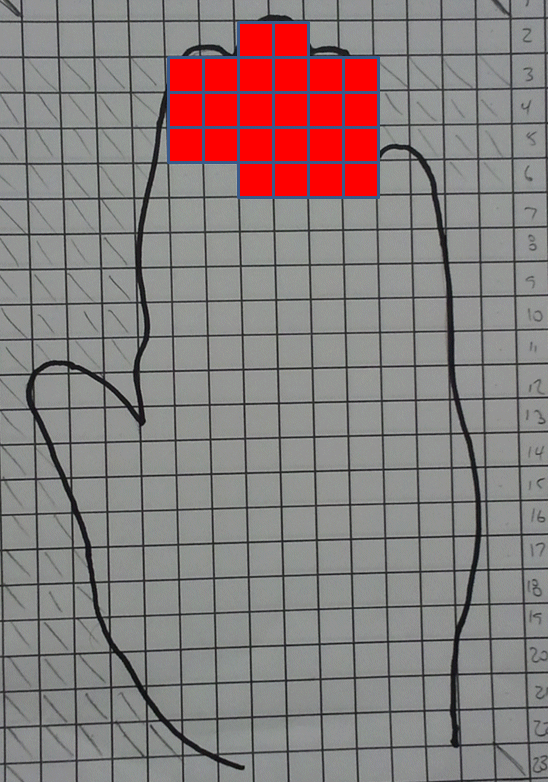
I roughly calculated the surface area of my hand by taking the total surface area of the box (345 square centimeters) and subtracting the number of boxes outside of the outline (157).  Based on my calculations (and you can see why I am not an engineer), the surface area of my hand that could come in contact with a laundered shop towel is 188 square centimeters.

I'm stepping out on a limb here, but assuming I have a two dimensional flat surface hand, how much of that surface area represents 13%?

For the finger tips, it looks like this:

Red blocks = 13% of total hand surface area


For the palm, it looks like this:

Red blocks = 13% of total hand surface area

It is reasonable, I think, to assume that if the hand contacts the mouth it would do so either at the fingertips or the palm.  The question then comes down to this:
  1. Is it reasonable to assume that much of the fingertips or palm will contact the mouth each and every time an employee picks up a laundered shop towel?
  2. Is it reasonable to assume that 100% of the metal in that area will be removed from the hand and put into the mouth?
In the two graphics above, each red square assumes a transfer efficiency (HTE) of 100%.  In gradients equation, the hand to mouth transfer efficiency (HTE) is 13%.  In order to get to get 13% of 0.26 mg of the lead now on the hand into the mouth, how much surface area of the hand needs to contact the mouth?

Gradient assumes that 75% of each square centimeter of the laundered shop towel transferred onto the hand 13% of the load.

If the "average" load for lead is 0.0012 mg/cm2, then  0.26 mg total of lead must be transferred onto the front of the hand.  If we assume a 13% HTE (as Gradient does) how much surface area of the hand would need to contact the mouth to give an intake of  0.34 mg of lead (0.26 x 0.13)?

In order for Gradient's equation to work, the metal must be evenly distributed all over the face of the hand.  If you assume that it is on the fingertips only, then the assumption is the fingertips are the only part of the hand that contacts the mouth.  Same goes for the palm.

But that's not what their equation assumes.  It assumes a transfer efficiency of 13% each and ever time the laundered shop towel is used.

How is this done?  Gradient assumes that the entire surface area of the hand contacts the mouth.

In order to get 0.34 mg of lead into the body, a hand with the surface area of 188 square centimeters must have 0.014 mg of lead on each square centimeter (0.26/188), assuming a HTE of 13%.

To limit the part of the hand to the mouth, condenses the amount of contaminant per square centimeter and also assume that only that part of the hand will contact the mouth.

For a hand with a surface area of 188 square centimeters that will contact 75% of the laundered shop towel, Gradient's calculation assumes that this much of the hand will have contact with the mouth.


That's right, each and every one centimeter square box inside the outline of my hand will need to contact the mouth each and every time a laundered shop towel is used.

Do the math:
  • 0.0012 x 2268 x 0.75 x 0.13 x 0.13  = 0.034 mg of lead into the mouth.
Question: How much of the hand must come in contact with the mouth if there is a 13% HTE that takes place each and every time a laundered shop towel is used?

Answer: The whole surface of the hand.

Does that look anything like their graphic is showing?


Does their equation represent reality for a worker using a laundered shop towel?

Still not convinced that their report is flawed and that laundered shop towels do not pose an increase in risk even remotely close to their calculations??

Read on.


Next post: Laundered Shop Towels 8: A child's hand is not an adult's hand.


.

Wednesday, September 28, 2011

Laundered Shop Towels: 6 - Finger Lickin' Good!


The basis for Gradient's model is that each laundered shop towel will transfer 13% of the load from 75% of the towels surface area onto the hand.  The hand will then be placed to the mouth and 13% of what is on the hand will be transferred into the mouth.  That second "13%" transfer is what Gradient calls a hand to mouth efficiency - "HTE" - value:
The HTE transfer is based on estimates of the amount of soil transferred by children from the surface of their hands to the mouth, where it is subsequently ingested, but is adapted for adults, based on a lower HTE value, to be consistent with the lower ingestion rate of adults. (Page 9)
Here is how Gradient came up with this value (excerpt from their 2003 study)
Daily Hand to Mouth Transfer Efficiency. To estimate the amount of metal on the hands that might be ingested via hand-to-mouth contact, we used a hand transfer efficiency, or HTE parameter, of 0.13. 
The HTE parameter quantifies the fraction of material on the hands that is likely to be transferred to the mouth and ultimately ingested. 
The HTE transfer is based on estimates of the amount of soil transferred by children from the surface of their hands to the mouth, where it is subsequently ingested.
Gradient used the median skin surface area data specific to a 1- to 6-year-old child and applied the soil AF derived from Roels et al. (1980) to estimate the average mass of soil on the hands for a 1- to 6-year-old child, which is approximately 145 mg for both hands. 
Gradient then combined the estimate of soil loading on the hand with an estimated soil ingestion rate to derive the hand transfer efficiency (HTE) value, which is an estimate of the fraction of the mass of soil adhering to the hands that would need to be ingested to yield the estimated daily soil ingestion rate. 
Read that last paragraph again.  I'll wait.  And while you are reading it, here is some music to set the mood.  With that premise, Gradient came to this:
A median soil ingestion rate of 38 mg/day for children ages 1 to 6 years was calculated based on a soil ingestion study conducted in Amherst, Massachusetts. 
This soil ingestion rate was divided by the hand soil-loading estimate for a child resident (for a child resident (approximately 145 mg on both hands), for a daily HTE value of approximately 0.26 hand loads per day.
If you are reading this and paying close attention you will see what they have done and why it should be viewed as inappropriate for this study.  If you want to read about the Amherst, Massachusetts, you can see a summary about it here.  Let's look at the first part of the abstract for the Calabrese & Stanek paper:
Sixty-four children aged 1-4 years were evaluated for the extent to which they ingest soil. [t]he present study included a number of modifications from the Binder et al. study. The principal new features were (1) increasing the tracer elements from three to eight; (2) using a mass-balance approach so that the contribution of food and medicine ingestion would be considered; 
See it? 
"contribution of food and medicine ingestion would be considered"
The "median soil ingestion rate of 38 mg/day" is based on the amount of soil consumed from ALL sources, not just from the hands.  Gradient has based the HTE on 38 mg/day of soil intake coming from the hands only.

For this to be true, the soil on the hands, 145 mg, would need to be placed on the hands - no more - no less - and no other soil consumed in the day.  To obtain an HTE of 0.26 all the soil intake had to come from the hands - both of them.

Gradient assumes that the child licks, touches, contacts the mouth with both hands so that 0.26 of the soil on both hands is transferred to the mouth.  The 38 mg/day is from all sources, including dust, mouth soil on surfaces, food, and contact with other sources throughout the day.

Gradient goes on to say:
In this report, we used half of 0.26 as the HTE value for adults, or 0.13. The smaller HTE value used for adults reflects the reduced hand-to-mouth behavior in people greater than 6 years of age. 
Using a smaller HTE for adults as compared to children is further supported by the USEPA soil ingestion rates: their recommended mean soil ingestion rate for adults is exactly one-half of the value for children less than 6 years of age.

I assume that the HTE is the same for one hand (their model) as for both hands.  Basically, as I understand it, Gradient assumes that 13% of what is on the hand will be transferred to the mouth.

You can see where they came up with that 13%.  It assumes that because 38 mg/day of soil is consumed for a child, and an adult consumes half that amount, it all had to come from the hand.

That's not true of course, soil consumption comes from many sources in a day, not just from the hands.  But I'll go with it for now...I'll assume that there is a transfer rate of 13% of the load on the hand into the mouth.

And once again I am perplexed to understand how that would happen.  What's the mechanics involved?

Kimberly-Clark tells us that "an average person touches their face 16 times per hour."  Does that mean a worker places one hand to his mouth each time he picks up a laundered shop towel?

And when the worker places his hand to his mouth, does he lick his fingers or rub his lips over the surface of the hand that contacted the towel?  And if this happens each and every time 12 towels are used per day, how much area of the hand would need to contact the mouth so that 13% of the load that is evenly distributed on the hand is transferred to the mouth?

For Gradient's model and equation to hold true, the hand must contact the mouth and 13% of what is on the hand must transfer to the mouth.  How?

Next post: Laundered Shop Towels: 7 - Fun with Graph Paper


.

Tuesday, September 27, 2011

Laundered Shop Towels: 5 - That's quite a load

I've tried to make a case in my last four posts about why the concentration of contaminants used in Gradient's equation are most likely higher than what would be normally found in a laundered shop towel.

Additionally, because Gradient used the actual maximum concentration they detected instead of a statistical maximum "exceedance ratio," the maximum intake value is calculated higher than is statistically possible.  I've dealt with a lot of contaminated rags in my career, and I rarely see heavy metal levels that high in dirty rags!  Those concentrations identified by Gradient are for laundered shop towels - clean ones!

Without seeing the actual analytical reports (which I have requested from Gradient) I have to assume that the values identified in Table 2 of their 2011 Study are actually what was found.

Let's look at lead for example.  If lead has a mean concentration of 100 mg/kg and a maximum concentration of 600 mg/kg, then I will assume that those values are accurate.

Once again, we need to assume that these values accurately reflect what would indeed be found on a laundered shop towel.  If you can't accept this assumption as valid, then you cannot proceed to the next step in the model they are using.  Gradient has calculated an intake based on a model that proposes that the laundered shop towel transfers its heavy metals to the hand and the hand then transfers them to the mouth.

With that model and equation you can calculate the uptake which is what they call intake.


Gradient has developed an equation to calculate the intake expected for a worker handling these laundered shop towels.  That equation looks like this:

The first parameter, Load, is based on the following assumptions (see study Table 2 notes):
  • The laundered shop towel contains either a mean or maximum amount of the heavy metal in mg/kg
  • The laundered shop towel weighs 0.0283 kg
  • The laundered shop towel has a surface area of 2,268 square centimeters (cm2)  
The Load - in mg/cm2 - is derived from the following:
[mean or maximum concentration x 0.0283] / 2,268
For example, the average (mean) Load for lead is:
[100 mg/kg x 0.0283 kg] / 2,268 cm2 =  0.0012 mg/cm2
What that lead Load value represents is the following:
The contaminant is evenly distributed on the laundered shop rag so that each square centimeter (cm2) of cloth contains 0.0012 mg of lead.
This is important because the hand to mouth transfer is based on how much of the cloth will contact the hand (Ftowel) and how much of the contaminant will be transferred from the cloth to the hand (Tt/h).

There is another assumption here that is implicit.  That is, the contaminant is not spread evenly on each side of the cloth, but instead is assumed to be on whatever side that will come in contact with the hand.  There is nothing wrong with that assumption, but for that to be true, other assumptions will need to be true as well.

How much - and where - the contaminant is on the towel does not matter at this point.  What matters is the assumption that it is evenly distributed so that the three other parameters...
  1. Ftowel = Fraction of towel in contact with hand (unitless);
  2. Tt/h = Towel to hand transfer (unitless);  
  3. HTE = Daily hand-to-mouth transfer efficiency (day-1)
...will work to derive an amount of metal entering into the worker's mouth.

You can read Gradient's Study to see why certain values were used by the authors. For example:
  • Gradient "assumed," based on professional judgment, that the hand (single) would contact approximately 75% of the total surface area of a laundered shop towel, under typical laundered shop towel usage.
What Gradient basis their intake values on involves a worker coming into contact with 75% of the Load (Ftowel).  For the heavy metal lead, it would be calculated as follows::
  • 0.0012 mg/cm2 x 2268 cm2 x 0.75 = 2.72 mg = Ftowel
What that Ftowel value represents is the amount of lead the worker is exposed to when his/her hand comes into contact with the laundered shop towel.  Exposure represents the total (mean or maximum) heavy metal available for intake.  Gradient's model now assumes that the hand WILL make contact with the mouth each time a laundered shop towel is handled.

Gradient assumes that even though the towel contains a mean total amount of lead (2.83 mg), only 75% of that lead will come in contact with the hands.  That is, only 2.72 mg is available to be transferred from the towel, based on the lead being evenly distributed on the laundered shop towel at 0.0012 mg/cm2.

The next part of the equation is where their assumptions really start to be stretched to the point of implausibility.  Gradient assumes that the hand (single) comes in contact with the 75% of the towel and 13% of the contaminant on the towel is then transferred to the hand.  This is what they call "towel to hand transfer," referenced as "Tt/h" in the equation.

There is nothing wrong with this logic, unless you take issue with the fact that these towels have been washed in hot water, with soap, and dried under a high temperature. To assume that 13% of whatever contaminants are in the towel can come off onto the hands is a bit of a jump here. (see post)

OK, so let's give them a 13% transfer from the towel to the hand - for now.  The next parameter, "daily hand-to-mouth transfer efficiency" (HTE) is where you really need to stretch your beliefs.

Gradient's model and calculation assumes that each worker that picks up a laundered shop towel will transfer 13% of what is on the towel onto the hand - and then - 13% of what is on the hand will be transferred into the mouth.

So for lead, that amount transferred to the mouth would be calculated as follows:
  • 2.72 mg x 0.13 x 0.13 = 0.046 mg
That number, 0.046 mg, is the amount of lead Gradient's calculation determines the worker will ingest when they use one single laundered shop towel.

How did they come up with that second value of 13%?  Read their Study, but I'm going to tell you that its origination does not matter.  What matters is this:
How will the lead on the hands be transported into the mouth?
What other studies have calculated are not important unless they involve workers who use shop towels or some other contaminated material.  How does the hand transfer the contaminant to the mouth?  Gradient assumes that it takes place - and they assume it happens each and every time a worker uses a laundered shop towel.  They call this value in the equation the Hand to Towel Exchange ration (HTE)

Rule Number 5: Always make sure the model and equations reflect reality.

What Gradient says about their HTE value is this:
The HTE transfer is based on estimates of the amount of soil transferred by children from the surface of their hands to the mouth, where it is subsequently ingested, but is adapted for adults, based on a lower HTE value, to be consistent with the lower ingestion rate of adults. (Page 9)
Gradient's assumption is that because children transfer soil from their hands to their mouth, adults will do so as well - but at a lessor rate.  So 13% of the load on the hands will be transferred to the worker's mouth.

Once again I need to ask: How?  How does a worker get the lead off of their hand and into their mouth?


Next Post: Laundered Shop Towels: Finger Lickin' Good!


.

Monday, September 26, 2011

Laundered Shop Towels: 4- The red bar and the "three sigma" rule

In my last post I looked at how the concentration of heavy metals used to determine the Load value used in the calculation was derived.

Using the mean concentration derived from highly variable data (Standard Deviation is higher than the mean) biases the "exceedance ratios" to look higher than they really are.

Using the maximum contaminant levels detected to derive an "exceedance ratio" presents a situation that is near impossible to reproduce.  The maximum values they used create exceedance ratios that would never be found in the real world - you know - the world in which the worker holds the baby and is asked "why take the risk?"  That world.

Let's start at the beginning....

The equation Gradient uses to calculate these "exceedance ratios" assumes the following:
The worker will use 12 towels per day, five days a week, for 49 weeks in a year, for 40 years for a total of 117,600 laundered towels.
Source: Leach Presentation at 2011 AHMP conference
Let's assume that Gradient's assumption is reasonable, that a worker could, indeed, come in contact with 117,600 laundered towels over their working lifetime of 40 years.

Let's assume also that each time they use one of these 12 laundered shop towels per day, they place their hand to their mouth and the contaminant on their hand is transferred to their mouth - just like in Gradient's graphic below:

From: Gradient 2011 Paper
Regarding presenting data using the "maximum" level of metals found, the question that should have been asked by the authors is; can we reasonably assume that every one of these 117,600 towels could contain the maximum concentration of contaminants that was detected on the 23 sets of laundered shop towels analyzed?

The answer is unequivocally "no" - you cannot assume that.  It is so astronomically small a chance as to be impossible for this situation to ever take place (would probably have a better chance of getting hit by a falling satellite).  The three authors and Gradient should have recognized this and left it out of their study.  Instead they report it and Kimberly-Clark puts a bow on it and parades it out for all the world's workers to see:

Source

But let's say for the sake of discussion, that the towels could contain, for example, a maximum concentration of lead - reported by Gradient to be as high as 600 mg/kg.  What would be the chance of that happening, based on the mean value and Standard Deviation they reported for lead?

Statistically speaking, if the mean is the average concentration for the population (laundered shop towels), and if the data is normally distributed (bell curve), we would assume that 99.73% of the lead concentrations (low to high) found on a laundered shop towel would fall within three Standard Deviations from the mean ("three sigma" or "3 x SD").

Let's look at the maximum values Gradient reported:

From: Data entered into spreadsheet from Gradient 2011 Study
Notice the values in red?  Those values are more than three times the Standard Deviation from the mean.  These values - statistically - would appear only 0.27% of the time a laundered shop towel is sampled.

A more scientifically valid description of those red maximum values would have been to call them "outliers."  Gradient indicates that they removed outliers, but they used them to calculate the maximum intake values.

Why does this matter?  Well for one thing, statistics play into the equation and model Gradient developed for their Study.  If you are going to use a mean, then you need to use everything related to how that mean was calculated and what the mean states.  This brings forth the concept of the "three-sigma" rule.

Why is that important?  Because if the mean of the population of laundered shop towels is X, then the probability of finding a shop towel with a concentration slightly higher than three times the Standard Deviation becomes less than 3 in 1000 (0.99730).

How would this probability work out in the methodology Gradient has set forth in their model and calculation?

Out of 117,600 laundered shop towels, 352 towels could be encountered in a 40 year span of time with a heavy metal concentration at the maximum just above the concentration at the mean plus 3 x SD.  The further from the mean the lower the probability of seeing that value becomes.

Source
Which brings up the heavy metal contaminant: lead.

Lead is the one heavy metal that Gradient and Kimberly-Clark claim presents an intake risk that is; "3,600 times higher than agency exposure guidelines."

The maximum concentration value Gradient used in their equation to determine the Load is 600 mg/kg.  That concentration is just shy of 4 x SD, which tells us that it has a probability of occurring around one (1) time for every 15,000 towels used - or 8 times in a 40 year time period.

What Gradient and Kimberly-Clark want you to accept as a real risk is that with odds of 1 in 15,000, you - the worker - could reasonably come in contact with a laundered shop towel that exposes you to 600 mg/kg of lead each and every time you pick up a laundered shop towel.   They want the worker to accept that this can be done 117,600 times in a row, for 40 years, to give you a 3,600 times higher exposure to lead than acceptable under California's Proposition 65 lead MADL.

In order to obtain an intake exposure to more than 3,600 times the "toxicity criteria" for lead, a laundered shop towel must contain 600 mg/kg of lead each time it is picked up.  Statistically, with a mean of 100 and a Standard Deviation of 139, the chance of getting a towel with that concentration of 600 mg/kg is 1 in 15,000, unless you don't want to believe their mean and Standard Deviation reported.

Was this a blunder on their part?

Rule Number 2: Always look at the data used.

This maximum intake situation is not probable, not possible, not statistically valid.  And all we have looked at is just the data used to calculate the "load" portion in their equation.

Once again, we could stop right here and hold the Gradient findings presented in the study up as invalid.    Right now, the use of incorrect mean and maximum Load values relegates this paper to inaccurate, misleading, and heavily biased towards a conclusion of elevated risk.

But once again, where's the fun in stopping now?  There is more to influence the calculation of "intake" than just heavy metal concentrations they report are in/on the laundered shop towels.

No wonder Kimberly-Clark and the The Association of the Nonwovens Fabrics Industry (INDA) love this paper.

To reiterate....
  • Rule Number 1: Always read the report the findings/recommendations were based on.
  • Rule Number 2: Always look at the data used.
  • Rule Number 3: Always check the assumptions used to derive the model that drives the conclusion.
  • Rule Number 4: Compare apples with apples and oranges with oranges.
  • Rule Number 5: Always make sure the model and equations reflect reality.

Next post: Laundered Shop Towels: That's quite a load


.