Showing posts with label safety. Show all posts

Sunday, September 1, 2013

Public Sector Employees, Texas, and Confined Space - Part 3

I contact Governor Perry's office and stumped them with my question "Is Governor Bush's 1995 Executive Order still in effect?"

They would get back with me...and they did.  Apparently it was put into Texas Law in the .  I was then told to contact    and they would be able to answer my question more specifically.  I missed his call back, so here I am without a definitive answer.

However, armed with this new information, or at least the path to move forward on. I went back to Google and searched for "Texas state employees compliance with OSHA."

This brought me to the webpage of the Texas Workforce Commission (TWC).  Why my original searches did not show this page, well, is frustrating.  So based on what Governor Perry's office told me, public employee health and safety regulations, at least for us Texas State employees, is under risk, which is under workman's comp.

Source
You can see that I was getting close with my poking around as I had already looked at hazcom.  So what does that tiny print say?
  • The state agency in Texas with the greatest authority in the area of workplace safety is the Texas Department of Insurance, the Division of Workers' Compensation of which has enforcement responsibility for the Texas Workers' Compensation Act
  • The main workplace safety resource information for Texas is on the TDI Web site. 
  • The Workers' Compensation Division's OSHCON Department provides workplace safety and health consultations to Texas employers, including free OSHA compliance assistance.
So what does the Texas Department of Insurance, the Division of Workers' Compensation Chapter 401 of the Texas Labor Code say about having to comply with health and safety regulations or policy for public sector employees?

Let's look at definitions first.  If you recall, the OSHA law excludes public sector employees because state and local entities are not defined as an "employer."  Here is what Texas Chapter 401 says:
"Employer" means, unless otherwise specified, a person who makes a contract of hire, employs one or more employees, and has workers' compensation insurance coverage.  The term includes a governmental entity that self-insures, either individually or collectively.
Okay...now we are getting somewhere.  Since I am not a lawyer, I can't say definitively who is, or who is not covered by that.  What I am going to do is look at it with the same eyes that a public works manager - who is not a lawyer - would use. When I read "The term includes a governmental entity that self-insures, either individually or collectively," I understand that to mean both state and local public entities that employee folks just like me.

I am going to ask if my understanding is correct when I call the TWC guy back this week.  That guy, I have been told, is a lawyer and he works for the TWC.

Getting close...so close...


Next Post: Public Sector Employees, Texas, and Confined Space - Part 4

.

Sunday, August 25, 2013

Public Sector Employees, Texas, and Confined Space - Part 2


Governor Rick Perry wants me dead!

Well at least that might be the conclusion from reading this guy's blog on the subject of OSHA and public sector employees:


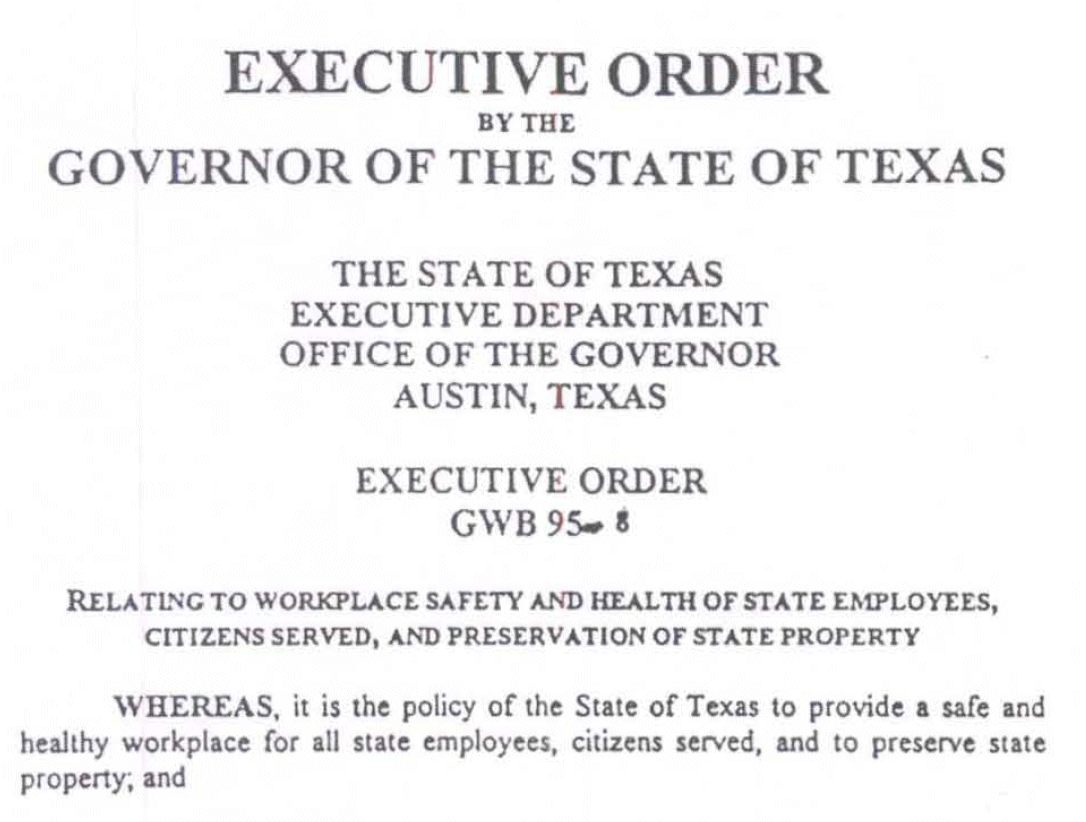
Okay, so maybe Rick Perry does, but George Bush, the guy that was governor before Perry and the second Bush to become President, cared about my health and safety.

Source
I am going to check this week to see if that's still in effect.  Apparently, way back in 1995, Governor George Bush decided that public sector state employees in Texas warrant health and safety protection consideration.  That's his signature and it has the official seal.  Texas does not want me dead!

So what do I know about OSHA-like protection for public sector employees?  I am looking at this from how we do it in Texas, a state without a formal OSHA approved plan.  Here is what Texas Governor George Bush said in his Executive Order:
WHEREAS, state government should lead by example by complying with all applicable federal, and state laws, standards, rules, regulations and guidelines;
What that tells me, or at least how I read it, is that we don't need no stinkin' special rules for protecting state workers in Texas.  We are supposed to live by the rules currently in place.

So, in Texas, me, as a state employee, is protected.  My employer, the Texas A&M University System, is supposed to have a "comprehensive written risk management/safety programs" according to the Executive Order.

Do we have one for entry into a confined space?

The way I write this blog is to ask a question and then in real time look for the answer.  I do this (the vast majority of the time) without knowledge of what the answer will be, and have decided that, good, bad, or indifferent, I will report what I find.  I don't know if we have one, I suspect we do, but I need to check.

And...

Source
Pew!  That would be embarrassing if we did not.  So for me, a state worker, working for the Texas A&M University System, my employer has developed a safety plan for me if I work in a confined space.  That manual tells me this:
It is the policy of Texas A&M University (TAMU) that any individual entering into a confined space on TAMU property will do so in accordance with the procedures outlined in the Confined Space Program and 29CFR1910.146.
So, without OSHA oversight, without specific state regulations for confined space entry in place, Texas has told my employer you need to protect your workers.  And my employer has said, well heck, let's just comply with OSHA, because, you know, they already have confined space requirements, let's not reinvent the wheel!

I started with this question:
Question:  Do public sector employees need to comply with any safety regulations regarding entry into a confined space?
I can answer it now.
Answer:  If by public sector employee you mean a Texas State employee, then yes, we have safety regulations regarding entry into a confined space.
But what about public sector employees who are not state employees but work for a local municipality?

Hmmm...good question.


Public Sector Employees, Texas, and Confined Space - Part 3

.

Saturday, August 24, 2013

Public Sector Employees, Texas, and Confined Space - Part 1

Question:  Do public sector employees need to comply with any safety regulations regarding entry into a confined space?

Answer: I don't know.

Really?  That's my answer to that question?  "I don't know."

Yeah, that's right.  At this point in time I don't know.  So I am going to find out.

Here is what I understand at this point in my quest:
The protections of the Act are extended to all private sector workers. However, the specific requirements of the Act have created a patchwork of coverage for workers in the public sector. Some of these workers are covered by the Act while others are not.
That's from a document by OSHA called " Evaluating the Status of Occupational Safety and Health
Coverage of State and Local Government Workers in Federal OSHA States."  Texas, the state I work in, is a Federal OSHA state.  That means that we do not have our own OSHA regulations which are known as a "state approved plan." According to OSHA:
There are currently 22 States and jurisdictions operating complete State plans (covering both the private sector and State and local government employees) and 5 - Connecticut, Illinois, New Jersey, New York and the Virgin Islands - which cover public employees only. (Eight other States were approved at one time but subsequently withdrew their programs).
So if only 27 states have rules covering public sector employees, where does that leave guys like me, a Texas State employee?  Why am a I not covered under the same employee safety rules when I do similar jobs, like entering a confined space, trenching and shoring, wearing a respirator, and other hazardous operations, just like my counterparts in the private sector?

Here is what OSHA says about that:
Section 2(b) of the Act states that it is the purpose and policy of Congress “. . . to assure so far as possible every working man and woman in the Nation safe and healthful working conditions and to preserve our human resources.”
Well me and my fellow state employees are "working man and woman" so what part of the word "every" do we not meet?  Here is what OSHA says about that:
...because the definition of an employer in Section 3 of the Act specifically excludes: “. . . the United States or any State or political subdivision of a State . . .,” their workers are not provided the Act’s protections.
Really?  Thanks 1970's congress!  OSHA says
As a result, while all private sector workers are protected under provisions of the Act, all public sector workers are not. Only Section 18(b) State Plan states must provide OSHA protections for public sector workers.
Because Texas is not one of the 27 states with a State Plan I guess we are SOL on having to meet any type of confined space safety requirements.  Pop the top and enter!

No...that can't be right...can it?  Here is what I found out from that OSHA document:
Two states, Alabama and Delaware, had no recognizable occupational safety and health programs for public sector workers at either the state or local government level. These states had no OSH legislation enacted nor Governors’ Executive orders establishing a program comparable to the standards, or providing the protections equivalent to the provisions of Section 18(b) of the OSH Act.
But then I see this:

I'm confused, perplexed, and, well...

You mean to tell me that me and my 936,999 fellow public sector employees are provided no safety and health protection?  That can't be right...can it?


Next post: Part 2

.

Sunday, October 17, 2010

Beyond Compliance: Part 3 - The Economy of Safety

In my 26 years in the EHS biz, there are a few things I now know to be true.  One of them is the dynamics in play within an organization are the reason a certain behavior - good or bad - is seen.  This is particularly true for behavior that directly affects employee health and safety as well as overall public health.

Because safety directly impacts both the individual as well as the employers bottom-line, certain basic economic principles come into play. Greg Mankiw, a professor of economics at Harvard University, identifies four factors in how decisions are made.
  • People Face Tradeoffs. To get one thing, you have to give up something else. Making decisions requires trading off one goal against another. 
  • The Cost of Something is What You Give Up to Get It. Decision-makers have to consider both the obvious and implicit costs of their actions. 
  • Rational People Think at the Margin. A rational decision-maker takes action if and only if the marginal benefit of the action exceeds the marginal cost. 
  • People Respond to Incentives. Behavior changes when costs or benefits change.
In the economy of safety, the value placed on "it" will dictate the dynamics put into play and the behavior - or culture - obtained.  If the four principles outlined above are true, then you can see how difficult the job is for the EHS manager.  Lets look at the first bullet:
  • People Face Tradeoffs.
Now start with the first sentence.  "To get one thing, you have to give up something else."  In other words, taking this basic attitude of behavior, to get employee safety, you have to give up time, comfort, efficiency, money, profitability....

I mean, what other way can one see it?  To require my radio tower climber to go above and beyond the OSHA requirements by mandating he use 100% fall protection, the climber and the company has to give up something.  So in this situation we have three actors who have three different perceptions of the second bullet also in play:
  • The Cost of Something is What You Give Up to Get It.
If as the EHS guy I demand 100% fall protection, the cost to me is relatively nil.  I am asking the climber to give up speed (and in some cases also his 'manliness') and I am asking my employer to absorb the cost in extra time and equipment necessary to meet my cost.  That - in a nut shell - is what is given up.  The "it" on the other hand is a reduction in the risk of the climbers death (likely) or injury as well as protecting my employer from the lawsuit(s) and costs that will most likely result if the climber falls.

So it is the "get it" where the value has to be assigned.  "Safety First" can be a slogan only or it can be a mindset.  If the culture within the organization does not place a value on safety that exceeds the value of everything else it strives for, the dynamics put into play will only be as much as the value assigned.  Which leads to the third bullet:
  • Rational People Think at the Margin.
Define rational please?  Do you really think the radio tower climber in my previous post is a rational decision-maker?  To him and to many of his cohorts, he most certainly believes himself a rational person.  Were the OSHA employees responsible for putting in the "qualified climber" exemption for 100% fall protection rational?  What about the employers who know their employees climb without 100% fall protection, do they not see themselves as rational?

So again, we are at a cross-roads on how much value is to be assigned to safety.  That value is what will drive the given that a "rational decision-maker takes action if and only if the marginal benefit of the action exceeds the marginal cost".  What is the benefit of 100% fall protection in the case of this particular radio tower climber?  Will 100% fall protection only provide a marginal benefit?  Will that benefit exceed the cost?

For the life of me, I cannot see how anyone could look at that radio tower video and not come to the conclusion that 100% fall protection provides a benefit that exceeds the cost.  But the reality is that people come to a conclusion that the cost of 100% fall protection is too great a price to pay.  Hence the video.

And the question is why?  There are a whole gaggle of explanations for this, including:
  • I have never had a problem all the other times I've done it.
  • Our competitors don't use it.
  • If it was that serious, OSHA would require it,
So here we are back at square one.  It is my job as the EHS guy to look at things based on a rational that places the highest value on something that is hard to quantify; risk.  Everything presents a risk to something perceived as valuable.  There is no such thing as zero risk, so every time you are sent out to do a job, there is the chance that you will be injured or killed.  It is my responsibility to minimize that risk based on making rational decisions where the benefit (employee/public health) will exceed the cost (time and money).

So when it comes to the mantra of "Safety First" I am your one and only rational decision-maker.  Which leads to the most important factor in how people makes decisions:
  • People Respond to Incentives.
Behavior changes when costs or benefits change.  I can easily force an employee to do it my way if I have the power to fire them.  This, however, requires my 100% attention to their every effort.  Ask any parent of a toddler how difficult it is to keep them safe 100% of the time.  No, forced behavior will not work just by itself, instead it needs something else, more of a carrot on a stick.  An incentive.  You would think that the incentive to live would be motivation enough for a radio tower climber, but the reality shows otherwise.  No, something else is needed, just what that "something" is depends on a number of factors in play.

Bottom line - EHS speaking that is - is that behavior will not change if the perception by both management and employees - that safety - or the environment - is not seen as valuable.  I am making the argument here for beyond compliance - that doing more than what is required has a benefit.  Unfortunately that benefit is never going to be seen if you do it my way.  I can lower your workers comp only so much by my effort, after a certain point the very nature of the business dictates the cost.  What you will never see - if I do my job correctly - is an unnecessary or preventable death, injury, illness, or environmental impact.  How do you quantify something not happening, especially if has never happened in the past? 

 To be effective, EHS must live in a culture that values it the same way it values money.  Upper management is critical to this endeavor.  The shift away from incentives to enforcement by the EPA and OSHA is not going to reap the benefits they think it will.  Most simply because of bullet number four:
  • People Respond to Incentives.
The loss of EPA's Performance Track and a new emphasis on enforcement will make the EHS managers job much harder in convincing management to go above and beyond what the regulatory agency holding the hammer is asking for.  It is all about the perception of value here.  Like it or not, that's how we humans roll.

I can give my employer peace of mind, I can give employees a safe work environment, I can protect public health and minimize environmental impacts.  I can do all of these things if - and only if - I don't ignore some basic economic principles.  But even if I take them all into account, nothing moves forward without a commitment to a principle; Safety First or Beyond Compliance.  This type of culture will all lead to a better work environment.  You just gotta believe it will, or- bottom-line speaking - see it as valuable.

Next post:  Risk perception vs. cost:  Cheap graphics to illustrate a point.

.