Showing posts with label Texas. Show all posts

Sunday, September 1, 2013

Public Sector Employees, Texas, and Confined Space - Part 3

I contact Governor Perry's office and stumped them with my question "Is Governor Bush's 1995 Executive Order still in effect?"

They would get back with me...and they did.  Apparently it was put into Texas Law in the .  I was then told to contact    and they would be able to answer my question more specifically.  I missed his call back, so here I am without a definitive answer.

However, armed with this new information, or at least the path to move forward on. I went back to Google and searched for "Texas state employees compliance with OSHA."

This brought me to the webpage of the Texas Workforce Commission (TWC).  Why my original searches did not show this page, well, is frustrating.  So based on what Governor Perry's office told me, public employee health and safety regulations, at least for us Texas State employees, is under risk, which is under workman's comp.

Source
You can see that I was getting close with my poking around as I had already looked at hazcom.  So what does that tiny print say?
  • The state agency in Texas with the greatest authority in the area of workplace safety is the Texas Department of Insurance, the Division of Workers' Compensation of which has enforcement responsibility for the Texas Workers' Compensation Act
  • The main workplace safety resource information for Texas is on the TDI Web site. 
  • The Workers' Compensation Division's OSHCON Department provides workplace safety and health consultations to Texas employers, including free OSHA compliance assistance.
So what does the Texas Department of Insurance, the Division of Workers' Compensation Chapter 401 of the Texas Labor Code say about having to comply with health and safety regulations or policy for public sector employees?

Let's look at definitions first.  If you recall, the OSHA law excludes public sector employees because state and local entities are not defined as an "employer."  Here is what Texas Chapter 401 says:
"Employer" means, unless otherwise specified, a person who makes a contract of hire, employs one or more employees, and has workers' compensation insurance coverage.  The term includes a governmental entity that self-insures, either individually or collectively.
Okay...now we are getting somewhere.  Since I am not a lawyer, I can't say definitively who is, or who is not covered by that.  What I am going to do is look at it with the same eyes that a public works manager - who is not a lawyer - would use. When I read "The term includes a governmental entity that self-insures, either individually or collectively," I understand that to mean both state and local public entities that employee folks just like me.

I am going to ask if my understanding is correct when I call the TWC guy back this week.  That guy, I have been told, is a lawyer and he works for the TWC.

Getting close...so close...


Next Post: Public Sector Employees, Texas, and Confined Space - Part 4

.

Sunday, August 25, 2013

Public Sector Employees, Texas, and Confined Space - Part 2


Governor Rick Perry wants me dead!

Well at least that might be the conclusion from reading this guy's blog on the subject of OSHA and public sector employees:


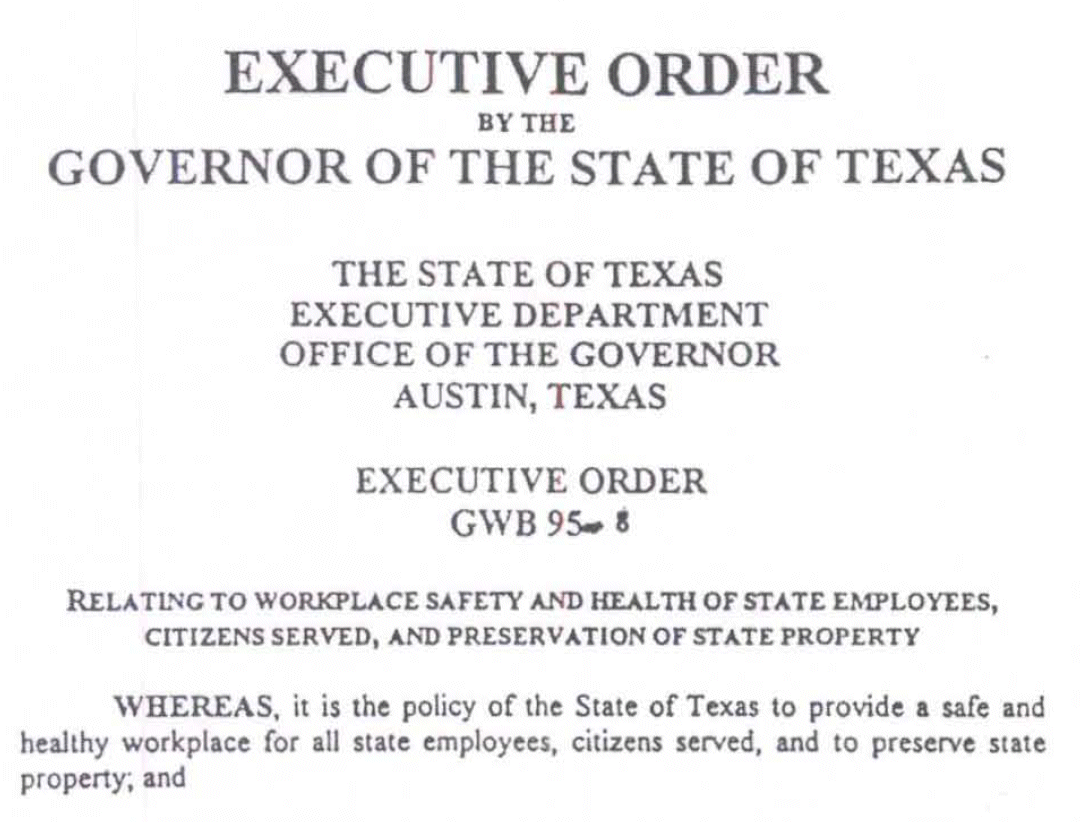
Okay, so maybe Rick Perry does, but George Bush, the guy that was governor before Perry and the second Bush to become President, cared about my health and safety.

Source
I am going to check this week to see if that's still in effect.  Apparently, way back in 1995, Governor George Bush decided that public sector state employees in Texas warrant health and safety protection consideration.  That's his signature and it has the official seal.  Texas does not want me dead!

So what do I know about OSHA-like protection for public sector employees?  I am looking at this from how we do it in Texas, a state without a formal OSHA approved plan.  Here is what Texas Governor George Bush said in his Executive Order:
WHEREAS, state government should lead by example by complying with all applicable federal, and state laws, standards, rules, regulations and guidelines;
What that tells me, or at least how I read it, is that we don't need no stinkin' special rules for protecting state workers in Texas.  We are supposed to live by the rules currently in place.

So, in Texas, me, as a state employee, is protected.  My employer, the Texas A&M University System, is supposed to have a "comprehensive written risk management/safety programs" according to the Executive Order.

Do we have one for entry into a confined space?

The way I write this blog is to ask a question and then in real time look for the answer.  I do this (the vast majority of the time) without knowledge of what the answer will be, and have decided that, good, bad, or indifferent, I will report what I find.  I don't know if we have one, I suspect we do, but I need to check.

And...

Source
Pew!  That would be embarrassing if we did not.  So for me, a state worker, working for the Texas A&M University System, my employer has developed a safety plan for me if I work in a confined space.  That manual tells me this:
It is the policy of Texas A&M University (TAMU) that any individual entering into a confined space on TAMU property will do so in accordance with the procedures outlined in the Confined Space Program and 29CFR1910.146.
So, without OSHA oversight, without specific state regulations for confined space entry in place, Texas has told my employer you need to protect your workers.  And my employer has said, well heck, let's just comply with OSHA, because, you know, they already have confined space requirements, let's not reinvent the wheel!

I started with this question:
Question:  Do public sector employees need to comply with any safety regulations regarding entry into a confined space?
I can answer it now.
Answer:  If by public sector employee you mean a Texas State employee, then yes, we have safety regulations regarding entry into a confined space.
But what about public sector employees who are not state employees but work for a local municipality?

Hmmm...good question.


Public Sector Employees, Texas, and Confined Space - Part 3

.

Saturday, August 24, 2013

Public Sector Employees, Texas, and Confined Space - Part 1

Question:  Do public sector employees need to comply with any safety regulations regarding entry into a confined space?

Answer: I don't know.

Really?  That's my answer to that question?  "I don't know."

Yeah, that's right.  At this point in time I don't know.  So I am going to find out.

Here is what I understand at this point in my quest:
The protections of the Act are extended to all private sector workers. However, the specific requirements of the Act have created a patchwork of coverage for workers in the public sector. Some of these workers are covered by the Act while others are not.
That's from a document by OSHA called " Evaluating the Status of Occupational Safety and Health
Coverage of State and Local Government Workers in Federal OSHA States."  Texas, the state I work in, is a Federal OSHA state.  That means that we do not have our own OSHA regulations which are known as a "state approved plan." According to OSHA:
There are currently 22 States and jurisdictions operating complete State plans (covering both the private sector and State and local government employees) and 5 - Connecticut, Illinois, New Jersey, New York and the Virgin Islands - which cover public employees only. (Eight other States were approved at one time but subsequently withdrew their programs).
So if only 27 states have rules covering public sector employees, where does that leave guys like me, a Texas State employee?  Why am a I not covered under the same employee safety rules when I do similar jobs, like entering a confined space, trenching and shoring, wearing a respirator, and other hazardous operations, just like my counterparts in the private sector?

Here is what OSHA says about that:
Section 2(b) of the Act states that it is the purpose and policy of Congress “. . . to assure so far as possible every working man and woman in the Nation safe and healthful working conditions and to preserve our human resources.”
Well me and my fellow state employees are "working man and woman" so what part of the word "every" do we not meet?  Here is what OSHA says about that:
...because the definition of an employer in Section 3 of the Act specifically excludes: “. . . the United States or any State or political subdivision of a State . . .,” their workers are not provided the Act’s protections.
Really?  Thanks 1970's congress!  OSHA says
As a result, while all private sector workers are protected under provisions of the Act, all public sector workers are not. Only Section 18(b) State Plan states must provide OSHA protections for public sector workers.
Because Texas is not one of the 27 states with a State Plan I guess we are SOL on having to meet any type of confined space safety requirements.  Pop the top and enter!

No...that can't be right...can it?  Here is what I found out from that OSHA document:
Two states, Alabama and Delaware, had no recognizable occupational safety and health programs for public sector workers at either the state or local government level. These states had no OSH legislation enacted nor Governors’ Executive orders establishing a program comparable to the standards, or providing the protections equivalent to the provisions of Section 18(b) of the OSH Act.
But then I see this:

I'm confused, perplexed, and, well...

You mean to tell me that me and my 936,999 fellow public sector employees are provided no safety and health protection?  That can't be right...can it?


Next post: Part 2

.

Sunday, August 14, 2011

Seven Deadly Sins: Oil & Gas gets away with nothing.

Out of town...again.  Starbucks and the local newspaper...
A spokeswoman for the Environmental Working Group, a coalition of community and environmental organizations, said the panel’s draft recommendations were “disappointing.”
“They do state some obvious grievances with fracking — such as the general need for more regulation, air pollution controls and more disclosure from companies,” said Leeann Brown in an e-mail. “However, they refuse to reference the seven deadly sins of the fracking industry — the exemptions from seven major environmental and health protection laws.” (Can't find the link, but this was basically what was printed)
Seven deadly sins of the fracing industry?  Well that got my curiosity up, so with a little bit of research I found them, here.  The basic contention is that the Oil & Gas industry "enjoys sweeping exemptions from provisions in the major federal environmental statutes intended to protect human health and the environment.
  1. Comprehensive Environmental Response, Compensation, and Liability Act
  2. Resource Conservation and Recovery Act
  3. Safe Drinking Water Act
  4. Clean Water Act
  5. Clean Air Act
  6. National Environmental Policy Act
  7. Toxic Release Inventory under the Emergency Planning and Community Right-to-Know Act
There they are, the seven deadly sins.  You can read the paper to find out why the author,  Renee Lewis Kosnik, MSEL, JD, Research Director, Oil and Gas Accountability Project (a project of Earthworks, 2007), believes these exemptions are should be done away with.  

What I want to do is to try and show how an exemption or exclusion does not mean the varmint is gettin' away with somthin'.  I call this blog the "Wacky World of Waste" for a reason, and that reason is because of how absurd regulations can be, especially how the Resource Conservation and Recovery Act (RCRA) identifies what is a hazardous waste.  If you ever attend my Hazardous Waste Management course, you will hear me say two things (spoiler alert!)
  1. Check you logic at the door.
  2. It's about the definition, not the hazard.
The reason I am writing about these "seven deadly sins" is because I was made aware of them on August 11, 2010 just like many other folks who read the same syndicated article that appeared in many other newspapers.  Quoting Earthworks' Leeann Brown's contention that the oil and gas industry "refuses to reference" these exemptions implies that there is something sinister going on.

If you take Earthworks word for it, there is.  But is there?

First of all, lets get one thing straight.  There are a lot of reasons for providing an industry or activity an exemption.  Sometimes they are purely political, but most of the time there are sound reasons for doing so. The bottom line question that must always be asked is does the exemption contribute to the problem or is it benign?

In the case of Oil & Gas, Earthworks contention is that these seven exemptions are allowing this industry "to streamline their piracy and contamination of the American public."  In other words, if we were to do away with these exemptions and exclusions, oil and gas would no longer be legally allowed to "contaminate" our land, air, and water.  This statement by Earthworks implies that the Oil & Gas industry is at this very moment unfettered by any laws and regulations regarding environmental contamination and pollution.

That is untrue.

Let's look at Texas.  Texas, as you might expect is very - and I mean VERY - Oil & Gas Friendly.  So Friendly in fact that they allow Oil & Gas to be regulated not by the State's EPA, the TCEQ, but by an industry loving Rail Road Commission (RRC). Surely under this cozy relationship Oil & Gas would be allowed to do what ever it pleases in pursuit of good ol' Texas T.

So let's look at how Texas Regulates Oil & Gas under the RRC: (Source)
In Texas, fracing is not formally regulated. The only regulations that apply to fracing operations also apply to all other oil and gas operations. The RRC promulgates and enforces regulations related to oil and gas matters and has jurisdiction over all “oil and gas wells in Texas; persons owning or operating pipelines in Texas; and persons owning or engaging in drilling or operating oil or gas wells in Texas.
Like all oil and gas development in Texas, fracing operations require the RRC to issue a permit authorizing drilling and/or deepening of a well.
Besides the standard permitting, two key areas where the RRC’s regulations have an impact on fracing operations (other than standard permitting):
  • 16 TAC § 3.8 “Water Protection”
  • 16 TAC §3.13 “Casing, Cementing, Drilling, and Completion Requirements.” 
In addition to permitting regulation, §3.8 also regulates the storage, transfer and disposal of oil and gas wastes. Presumptively, this includes any fracing fluids that are brought back to the surface as part of oil and gas production.
Earthworks contends that the "seven deadly sins" allow Oil & Gas to "contaminate the American public" by allowing "toxic chemicals and hazardous wastes [to permeate] the soil, water sources and the air threatening human health to an alarming extent." (1)

Well here is what 16 TAC § 3.8 “Water Protection” has to say about that:
(b) No pollution. No person conducting activities subject to regulation by the commission may cause or allow pollution of surface or subsurface water in the state.
That, by the way, is the first regulation you come to after "(a) definitions."  Now let's look at how Texas defines "pollution:"
(a)(28) Pollution of surface or subsurface water--The alteration of the physical, thermal, chemical, or biological quality of, or the contamination of, any surface or subsurface water in the state that renders the water harmful, detrimental, or injurious to humans, animal life, vegetation, or property, or to public health, safety, or welfare, or impairs the usefulness or the public enjoyment of the water for any lawful or reasonable purpose.
In Texas, Oil & Gas is regulated quite significantly by the RRC (2).  If Texan's don't allow the Oil & Gas industry to pollute under their industry friendly regulations, isn't it quite possible that federal regulations prohibit the same thing?

Basically it comes down to this: If the Oil & Gas industry is prohibited from causing or allowing "pollution of surface or subsurface water in the state" would removing those seven exemptions and exclusions change anything?  

The need for additional permitting or regulation will not stop something that is not there in the first place.  If, as Earthworks contends, Oil & Gas is allowing "toxic chemicals and hazardous wastes [to permeate] the soil, water sources and the air threatening human health to an alarming extent," why is this being allowed to happen under current law?

It is not happening.

And if any company sets out to operate in a way that does threaten public health or the environment, no amount of permitting, rules, regulations, or laws will stop them.  So for these bad apples, inspection and enforcement is the only option - unless you propose throwing the baby out with the bathwater.  

In her report, Earthwork's Renee Lewis Kosnik writes: "it is time regulators focus on the adequacy of existing regulations to protect human health and the environment from the real and potential dangers of the oil and gas industry’s waste."  Well they have:
"The [RRC] commission's strict rules in effect now on how wells are constructed have protected and continue to protect groundwater.  The decades-long safety record on fracking in Texas backs this up." (3)
But what about Jefferson County, Alabama's Peg Hocutt "mysterious ailments affecting everyone in the area and tap water that smelled of petroleum?"

Yeah...about that...

Next post: Seven Deadly Sins: 22 years ago there was a problem.


.