Showing posts with label blood-lead levels. Show all posts

Monday, January 25, 2016

Flint Water: A Political Football. Part 9

How about some data from a non-governmental source?
Sept. 24-25, 2015: A group of doctors led by Dr. Mona Hanna-Attisha of Hurley Medical Center in Flint urges the city to stop using the Flint River for water after finding high levels of lead in the blood of children. State regulators insist the water is safe.
Here is how this played out:
In August, Hanna-Attisha looked back at the lead tests of 1,750 children taken at a local hospital. She and colleagues released the results at a news conference in September.
Her findings:
“We found that when we compared lead levels before and after the [water] switch, the percentage of kids with lead poisoning doubled after the switch,” she said last week. “In some neighborhoods, it tripled. And it all correlated with where water lead levels were the highest.”
And the state's response to her work:
State officials questioned the findings and accused Hanna-Attisha of causing unnecessary hysteria. The state has since agreed that her data were accurate.
Let's look at her work and judge it for what it shows.

What's interesting here is that she asked a question that should have been obvious to the MDHHS.  Was there a difference between children's blood-lead levels (BLL) before the water change and after.  And more specifically, in zip codes where the leaching of lead would most likely take place.

You can look at her presentation here.  I am going to showjust her methodology and findings below.

First, her methodology:


She looked at the same period of time, pre-switch and post-switch. Was there a statistical difference between the period pre-switch and the same period post-switch?


Her analysis of the BLL data pre and post-switch shows affirmative. Before the switch 2.1% of the children in those zip codes in Flint had elevated BLL.  After the switch it was 4%.  That's a pretty good indication that the water is the culprit.

But wait a minute.  Maybe its not the water and something else going on! Okay, fair question. How about we look at the children in that immediate area, but not in the zip codes where they used Flint water.  If we see an increase in their elevated BLL then we can rule the water out as a soul source contributer. Does that sound reasonable?


No statistical change.  What happens if we look at the BLL of children where Marc Edwards found elevated levels of lead above 15 ppb in the tap water samples they took? We'll call that data "High-water lead."


Putting it all together we get this:


Just in case you have had enough of the "golly we goofed" quotes, let's look at this talking point prepared in November 18, 2015 by the MDHHS:


And y'all never saw a reason for this level of testing while all this was going on?

But you did see a reason to question Hanna-Attisha's data on September 25th, correct? From an email for Gerlyn Lasher with MDHHS to the Governor's chief of staff Dennis Muchmore:


Notice how he put the quotes around the word data?

On October 2nd we get this statement from MDHHS Director Nick Lyon in the Governor's press release:
State health experts said there has been an increase in elevated childhood blood lead levels in some specific communities. Initial analysis of MDHHS data found that blood lead levels of children in Flint have followed an expected seasonal trend. While this analysis for Flint as a whole remains true, a comprehensive and detailed review brealking down data by ZIP codes with the city revealed that MDHHS data is consistent with a study presented recently by Hurley Children's Hospital.
Look everyone, we found the same thing! Dr. Lyon continues:
"While we cannot conclusively say that the water source change is the sole cause of the increase, this analysis supports our efforts as we take active steps to reduce all potential lead exposures in Flint," 
Dude, give it up...its the water.

Let's take a look at Marc Edwards' data next.


Next post: Flint Water: A Political Football.  Part 10

Flint Water: A Political Football. Part 8

September 24-25th:
A group of doctors led by Dr. Mona Hanna-Attisha of Hurley Medical Center in Flint urges the city to stop using the Flint River for water after finding high levels of lead in the blood of children. State regulators insist the water is safe. [source]
On September 25th we get the "political football" email:
The DEQ (Department of Environmental Quality) and DCH (Department of Community Health) feel that some in Flint are taking the very sensitive issue of children's exposure to lead and trying to turn it into a political football claiming the departments are underestimating the impacts on the populations and particularly trying to shift responsibility to the state," said Muchmore. [source]
All of this data coming in and the MDEQ and the MDCH - the agencies with public health responsibility - tell the Governor's man that it ain't their fault.

The wheels have come off and they all know it.

These dates on the timeline are when it can reasonably be assumed that it is known.  It would be very odd that before that date parties that have something to do with this issue had no idea what was being looked at.

So let's look at blood-lead levels.

Before I knew about the work of Dr. Hanna-Attisha, I saw this table in the Detroit Free Press:
Detroit Free Press
When I saw this I thought, 'well there is not a difference between 2014-2015 when the water was from the Flint River and 2012-2013 when the water was from Detroit!'

That's what I saw. That's what I see. And I was told this by the MDHHS:
Michigan Department of Health and Human Services spokeswoman Angela Minicuci told the Free Press on Thursday that the increase was "seasonal and not related to the water supply."
Look at the graph MDHHS provided in September:

September 2015
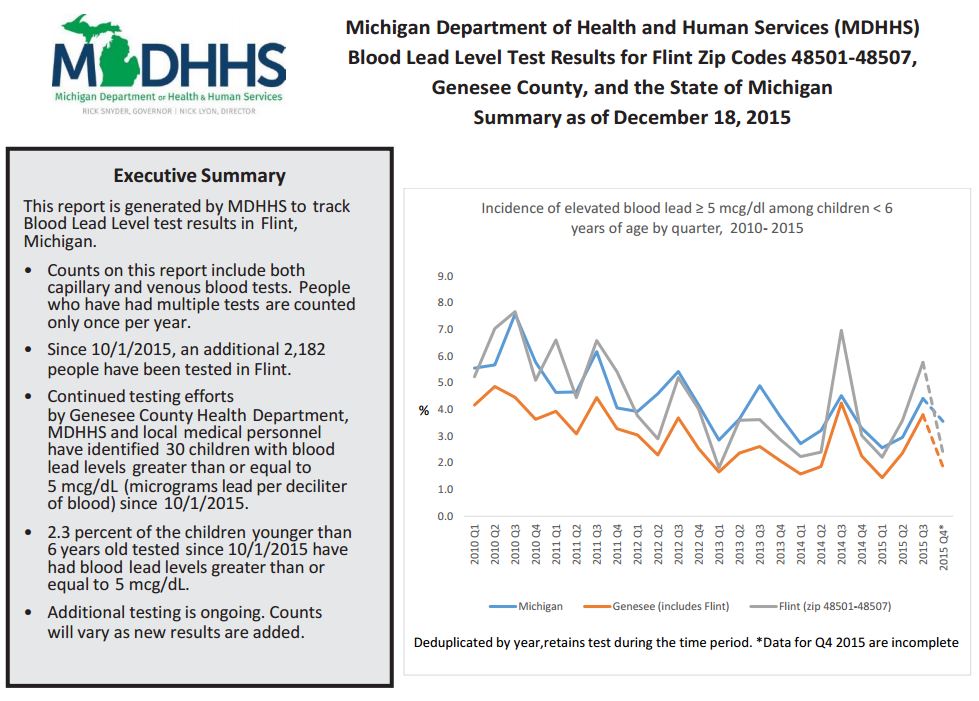
This graph looks at the number of children with elevated blood-lead levels (EBL) per quarter.  .

I have looked at the data the MDHHS provides and I cannot make anything out as bad.  Maybe I am missing it, but what they provided does not indicate a problem.  And that, could be why they did not see it. The data is in there, but it is covered up and not obvious.
"This is definitely being driven by a little science and a lot of politics," Wes Priem, an Industrial Hygiene Manager with the Healthy Homes Section of the Michigan Department of Health and Human Services, said in September 2015.
That's an interesting quote and tells you where there conventional wisdom was coming from.
In preparation for a late-September 2015 press conference and in response to data released by Edwards, Michigan Department of Health and Human Services Director Nick Lyon emailed fellow staff, "I would like to make a strong statement with a demonstration of proof that the lead blood levels seen are not out of the ordinary and are attributable to seasonal fluctuations."
On Thursday night, I shared this thinking as well.  But then I got some data...
"It wasn't until later that MDHHS epidemiologists took a more in-depth look at the data by ZIP code and confirmed an increase outside of normal trends,"
December 2015

The graph presented in December it looks at the incidence of EBL per quarter and looks at it based on zip codes.  This removes the noise generated from all the other data points so you can see there is a significant spike.  To be honest, these graphs are all over the place, but they do show similar peaks and valleys.

Still...
January 23, 2016: The Michigan Department of Health and Human Services' own review last July showed a spike in blood-lead levels in Flint children in the months after the city switched its water supply to Flint River water. "If I knew then what I know now ... We needed a much more robust analysis," Dr. Eden Wells, Health and Human Services' chief medical executive, said Friday.
Which brings me back to looking at this in contexts, as a whole. New water source, complaints, EPA Del Toral memo, lead found at the Walters home, Walters' kids with an increase in blood-lead levels.  What more do you need to see to conclude that a closer look is necessary?  that's not hindsight in my opinion.
"We should have torn it up and apart and gone up and down with that (data). That wasn’t done. "When I think about how Flint citizens have just had one thing after another — not just over the past two years, but many, many years — I wish that was not a missed opportunity." [source]
There seems to be a lot of "golly, if I had only known!" coming from Michigan's governmental agencies responsible for protecting public health.

Enter Dr. Mona Hanna-Attisha of Hurley Medical Center in Flint.

 Next post: Flint Water: A Political Football.  Part 9