Showing posts with label Hanna-Attisha. Show all posts

Wednesday, January 27, 2016

Flint Water: A Political Football. Part 12

Speculation: The Flint Water System was not set up to treat drinking water, especially the type of water, with its wacky water chemistry. They lacked the knowledge, the chemistry, and treatment prowess necessary to get this done in 10 months when the Flint River spigot was turned on.

Can that be supported?

Let's look at this.
  • April 25, 2014: Pipes carrying Flint River water are opened; the Detroit supply is shut off.
  • February 18, 2015  The City of Flint tests the drinking water at the Walters residence. Tests reveal high lead in the drinking water (104 ug/L)
That Feb 18th date is critical on what was known by whom and when.  Look what also happened on February 18th:
"The city has reduced levels of TTHM, and now all (testing) sites are in compliance," said Rob Nicholas, vice president for Veolia, the consultant that city officials introduced during a news conference just last week. "(The problems) are less about the water itself and more about the (transmission pipes)." [source]
Who or what is Veolia?
Veolia is the world's largest water services and technology company. Its team started work in Flint last week and is being paid $40,000 to assess how city water is tested and distributed, including water treatment processes and operations, laboratory testing and analysis. [source]
"Last week" would have been around February 11th. The Flint River water has been flowing into the Flint Water pipes now for around nine months.  The City of Flint now brings in Veolia to report on whats going on. Here is what we are told on March 12, 2015:
The City of Flint has made a number of good decisions regarding treatment changes that have improved water quality. However, this is a very complex water quality issue and the City is seeking additional advice on what to do to ensure healthful drinking water for the community.
Let's look at this change described in Del Toral's EPA memo:
  • March 2015: The City of Flint increases the Ferric Chloride dosage used in the filtration process to improve the removal of disinfection byproduct precursor material, in an effort to lower the TTHM levels.
  • March 03, 2015: The City of Flint re-tests lead levels in drinking water at Walters’ residence. The lead level measured is 397 ug/L
You do see the dates, and you do see the findings, correct?
The review of the water quality records during the time of Veolia’s study shows the water to be in compliance with State and Federal regulations, and, based on those standards, the water is considered to meet drinking water requirements. [source]
Consultant speak for 'WE never said it was safe...'

But I digress. Can I support my speculation that the City of Flint, a purchaser of treated water for many years, was in no way, shape, or form to treat water being pulled from the Flint River. All of these issues can be blamed on the decision to use Flint River water without an adequate understanding of not just how to treat it, but having the ability, know-how, and understanding of how to treat that water.

Let me show you exhibit one from the Veolia report:
The amount of testing and resulting changes in chemical dosages, along with monitoring the impact on the water, will require a well-documented process that all operators follow. An example of this is jar testing, which is used by the operators to identify the most effective chemicals and dosages to optimize treatment.
No jar testing kind of means ya aint ready for water treatment.  Its kind of like not having a pipe wrench when you call yourself a plumber.
The staff understands the basic treatment process but needs further practice and training to become proficient in the use of routine process control to adjust for water quality.
Flint River water was way beyond 'basic' treatment.
...that a desired water treatment quality is defined and variations from it signal alarms and that the staff knows what to do when the water quality setpoints begin to drift away from its desired quality levels. 
Figuring this out 10 months into the use of the water is...well...a sign that you ignored the folks telling you not to go this route.  Flint was not ready to treat Flint River water. I think if you ask enough people that were present during this discussion, you will find this was known at the time but ignored by a higher up. Once that happened everyone falls in line, gives their tacit approval while holding up their proof that they tried to let them know.

But the engineers agreed to it! Yeah...just like they did with the Challenger disaster.

Okay...so file this one under my pipe wrench analogy as well:
The City has already purchased a TTHM analyzer but should also consider a TOC analyzer that can be an online continuous device to provide immediate information on influent and effluent levels of TOC. 
Really...and you call yourself a drinking water producer?

And now, exhibit two!
A good demonstration of skill level is for the staff to become certified by the State as a licensed water plant operator. Many utilities now require all operators to hold at least the minimum certification level as a starting point and offer incentives to increase their certification level.
So...they had no certified staff responsible for treating this water?  They did not understand this skill level when they decided to treat the Flint River water?

How we got to today is a decision to treat Flint River water without the capability and knowledge required to treat it.

SPECULATION: Someone brought this up to the folks in charge at the appropriate time. I guarantee it! Someone told them it was going to be a problem and what those problems would be. Someone - or a bunch of them - understood the water chemistry issues.

Next post: Flint Water: A Political Football.  Part 13


Flint Water: A Political Football. Part 11

So what's it all about Alfie?

Ready for some speculating? Because that's where this here post is going to go.

How did this happen, not how as in they used Flint River water, duh! Or its because they were run by Democrats, or because of genocide.  All of those are put out there as theories, but they really can't explain the "how."

Let's start with this document:

...in particular Question 5's answer.  The question is not important, nor is the contaminant.  What is notable is this part of the response:
What we discovered is that as water travels through the 600 miles of the City’s distribution mains it will, at times, reside in the system for up to 3 or 4 weeks. Water purchased from [Detroit Water and Sewerage Department] DWSD is drawn from Lake Huron, chlorinated, and then travels over 80 miles to reach the City. By the time the water reaches Flint it is stable and capable of withstanding this type of residency time within the system. Water drawn from the Flint River, specifically in summer months when the temperature is fluctuating, is more susceptible to being impacted by variables such as high residency times and increased chemical reaction.
It's all about water chemistry and they were unprepared to handle it. Now let's go back to the decision to use the Flint River as their water source.
On March 25th 2013, after evaluating cost comparisons for a permanent water source approv[ed] a resolution to purchase water from the Karegnondi Water Authority (KWA).
This is important to understand,  Before the Flint River was used as the water source, the city of Flint purchased water from the DWSD.  The resolution passed was to start purchasing the water from KWA.

The word to focus on is purchase.
On April 17th, 2013 DWSD sent a letter terminating the existing water service contract between the City of Flint and Detroit.  With the termination set to take effect 12 months later on April 17th 2014, a gap was created between the end of the DWSD contract and the start of the KWA.
This "gap" is where the problem began.  Their answer, to use the Flint River, was the wrong decision to make.  Not wrong in hindsight, but wrong because of that word "purchase" used previously.
On June 29th 2013, following many preliminary discussions on how the City would fill the interim gap, a formal, all day meeting was held at the Flint Water Plant with all interested parties including City of Flint Officials (COF), representatives from the Genesee County Drain Commissioners Office (GCDC), the Michigan Department of Environmental Quality (DEQ), and the design engineers from the previous plant upgrade Lockwood, Andrews, and Newnam (LAN).
We learn this from a deposition on an unrelated issue:
Ambrose [Flint's financial manager] testified under oath in 2014 that Kurtz [Flint Emergency Manager at the time] considered using water from the Flint River for the city’s drinking water, but rejected it after consulting the Michigan Department of Environmental Quality. The plan was found “not to be feasible,”
That took place in December of 2012.  Here is where it gets good...
“Who determined it wasn’t feasible?” the attorney asked. 
“It was a collective decision of the emergency management team based on conversations with the MDEQ that indicated they would not be supportive of the use of the Flint River on a long-term basis as a primary source of water,” replied Ambrose.
“What was the reason they gave?” asked the attorney
“You’ll have to ask them,” Ambrose replied.
On June 29th 2013 to April 25th, Flint needed to switch from a purchaser of water to a treater of drinking water. That's 10 months to build the capacity - both in capability and structure -to treat drinking water.

Why is this problematic?  Let's look at this May 2013 report from their neighbor, the City of Cleo, who is also a purchaser of drinking water.

Water systems who purchase drinking water don't treat water.  They pass it on, make sure they monitor it, and, for the most part, set it and forget it.  The job to treat and make sure it is safe is the producer of the drinking water, which was Detroit for many years..

Speculation: The Flint Water System was not set up to treat drinking water, especially the type of water, with its wacky water chemistry. They lacked the knowledge, the chemistry, and treatment prowess necessary to get this done in 10 months when the Flint River spigot was turned on.

They were aware of the need to do so, it appears:
It was understood that the Flint River would be subject to temperature variations, rain events, and have higher organic carbon than Lake Huron water and would be more difficult to treat. These facts were balanced against a licensed staff, LAN engineering’s extensive experience in this field, advanced equipment that Flint has for treatment, and support from the DEQ.
 In hindsight that was underestimated and in my opinion folly to think they could.


Next post: Flint Water: A Political Football.  Part 12

Tuesday, January 26, 2016

Flint Water: A Political Football. Part 10

I looked at Marc Edwards' numbers and did some calculatin'

Source

Here is what the Virginia Tech Research Team tell us:
Over the weekend, we analyzed all samples shipped to Virginia Tech from Flint to date. Flint residents have already returned an astonishing 84% of the sample kits we sent out (252 out of 300 samples). 
The protocol they used can be found here:
Students and scientists (see About Us) at Virginia Tech assembled and shipped 300 kits for Flint residents to sample their water and get it analyzed for lead. The kits comprise of three bottles (1L, 500 mL and 250 mL ones) and an instruction sheet for sampling tap water. All 300 kits were sent out August 14th (Friday) and reached Flint on August 19th (Wednesday). 
The Excel file I downloaded,  Flint-Samples-FINAL.xlsx, contains 300 sample points (I am kind of confused as to why this number does not match with the statement above) from which three samples were collected at each point:
  • Pb Bottle 1 (ppb) - First Draw
  • Pb Bottle 2 (ppb) - 45 secs flushing
  • Pb Bottle 3 (ppb) - 2 mins flushing
The average lead concentration reported on the sheet for the first draw is 10.646 ppb.  I took all these sample results and recalculated using Excel's statistical function and I got the same number.

I then looked to see what the largest number reported was for each of the three sample columns. With this many sample points you can see a trend.  Since these samples were collected by the homeowners, the possibility of human error in sampling bottle identification is high.

That being the case, I felt that three samples were incorrectly identified, so I removed them from the rest of the data points.  This left 297 sample points from which to run some calculations.

What I wanted to see was if there was a difference between the first draw and a flush.  The problem with this data as presented was that sample 97 reported results in this order:
  1. 7.244
  2. 1051
  3. 1.328
It is possible that 1051 ppb is a legit number, but it appears doubtful that the 45 second flush would produce such a high number when the first draw was only 7.2. Additionally, this one numbers skews the results for the 45 second draw too much to make a comparison between first draw and flushes appropriate.

Removing samples from the data is a judgement call, and I think I can justify removing them in an effort to get a truer picture of what is going on.  I also removed samples 258 and 24 because I think they are in the wrong order - their removal changes the average but still shows a drop in lead when a flush was used.

So here are my results.  For 297 sample points:


As you can see, there is a reduction in the amount of lead found in the 45 second sample and even less in the 2 minute flush sample.  This supports the contention that the flushing requirement Flint was having the homeowners perform to meet the Lead and Copper Rule was most likely under reporting the lead.

What's important here is to not get caught up in the averages. This data came from a mix of homes in Flint.
Flint’s non-profit group Water You Fighting For? is helping coordinate distribution of these kits to volunteering homes 
There are, as the Williams' sample results showed - when compared to their neighbors -, houses within Flint that are more impacted then others.  

There is overwhelming evidence that there is lead present in Flint's water and it is higher in lead than water produced by Detroit.
Response:  We coordinated a citizen sampling event of homes in Detroit during 2010, and confirmed that Detroit water met Federal Standards—Flint’s water does not. 
What is more telling as to the extent of the problem is the spike in elevated blood-lead levels that I wrote about in my last post.  Exposure is problematic, uptake is worst when you know it has happened, but proof of an elevated level found children under five...well that's pretty damning evidence that you have a problem.

So what can we take away from all of this?


Next post: Flint Water: A Political Football.  Part 11

Monday, January 25, 2016

Flint Water: A Political Football. Part 9

How about some data from a non-governmental source?
Sept. 24-25, 2015: A group of doctors led by Dr. Mona Hanna-Attisha of Hurley Medical Center in Flint urges the city to stop using the Flint River for water after finding high levels of lead in the blood of children. State regulators insist the water is safe.
Here is how this played out:
In August, Hanna-Attisha looked back at the lead tests of 1,750 children taken at a local hospital. She and colleagues released the results at a news conference in September.
Her findings:
“We found that when we compared lead levels before and after the [water] switch, the percentage of kids with lead poisoning doubled after the switch,” she said last week. “In some neighborhoods, it tripled. And it all correlated with where water lead levels were the highest.”
And the state's response to her work:
State officials questioned the findings and accused Hanna-Attisha of causing unnecessary hysteria. The state has since agreed that her data were accurate.
Let's look at her work and judge it for what it shows.

What's interesting here is that she asked a question that should have been obvious to the MDHHS.  Was there a difference between children's blood-lead levels (BLL) before the water change and after.  And more specifically, in zip codes where the leaching of lead would most likely take place.

You can look at her presentation here.  I am going to showjust her methodology and findings below.

First, her methodology:


She looked at the same period of time, pre-switch and post-switch. Was there a statistical difference between the period pre-switch and the same period post-switch?


Her analysis of the BLL data pre and post-switch shows affirmative. Before the switch 2.1% of the children in those zip codes in Flint had elevated BLL.  After the switch it was 4%.  That's a pretty good indication that the water is the culprit.

But wait a minute.  Maybe its not the water and something else going on! Okay, fair question. How about we look at the children in that immediate area, but not in the zip codes where they used Flint water.  If we see an increase in their elevated BLL then we can rule the water out as a soul source contributer. Does that sound reasonable?


No statistical change.  What happens if we look at the BLL of children where Marc Edwards found elevated levels of lead above 15 ppb in the tap water samples they took? We'll call that data "High-water lead."


Putting it all together we get this:


Just in case you have had enough of the "golly we goofed" quotes, let's look at this talking point prepared in November 18, 2015 by the MDHHS:


And y'all never saw a reason for this level of testing while all this was going on?

But you did see a reason to question Hanna-Attisha's data on September 25th, correct? From an email for Gerlyn Lasher with MDHHS to the Governor's chief of staff Dennis Muchmore:


Notice how he put the quotes around the word data?

On October 2nd we get this statement from MDHHS Director Nick Lyon in the Governor's press release:
State health experts said there has been an increase in elevated childhood blood lead levels in some specific communities. Initial analysis of MDHHS data found that blood lead levels of children in Flint have followed an expected seasonal trend. While this analysis for Flint as a whole remains true, a comprehensive and detailed review brealking down data by ZIP codes with the city revealed that MDHHS data is consistent with a study presented recently by Hurley Children's Hospital.
Look everyone, we found the same thing! Dr. Lyon continues:
"While we cannot conclusively say that the water source change is the sole cause of the increase, this analysis supports our efforts as we take active steps to reduce all potential lead exposures in Flint," 
Dude, give it up...its the water.

Let's take a look at Marc Edwards' data next.


Next post: Flint Water: A Political Football.  Part 10

Flint Water: A Political Football. Part 8

September 24-25th:
A group of doctors led by Dr. Mona Hanna-Attisha of Hurley Medical Center in Flint urges the city to stop using the Flint River for water after finding high levels of lead in the blood of children. State regulators insist the water is safe. [source]
On September 25th we get the "political football" email:
The DEQ (Department of Environmental Quality) and DCH (Department of Community Health) feel that some in Flint are taking the very sensitive issue of children's exposure to lead and trying to turn it into a political football claiming the departments are underestimating the impacts on the populations and particularly trying to shift responsibility to the state," said Muchmore. [source]
All of this data coming in and the MDEQ and the MDCH - the agencies with public health responsibility - tell the Governor's man that it ain't their fault.

The wheels have come off and they all know it.

These dates on the timeline are when it can reasonably be assumed that it is known.  It would be very odd that before that date parties that have something to do with this issue had no idea what was being looked at.

So let's look at blood-lead levels.

Before I knew about the work of Dr. Hanna-Attisha, I saw this table in the Detroit Free Press:
Detroit Free Press
When I saw this I thought, 'well there is not a difference between 2014-2015 when the water was from the Flint River and 2012-2013 when the water was from Detroit!'

That's what I saw. That's what I see. And I was told this by the MDHHS:
Michigan Department of Health and Human Services spokeswoman Angela Minicuci told the Free Press on Thursday that the increase was "seasonal and not related to the water supply."
Look at the graph MDHHS provided in September:

September 2015
This graph looks at the number of children with elevated blood-lead levels (EBL) per quarter.  .

I have looked at the data the MDHHS provides and I cannot make anything out as bad.  Maybe I am missing it, but what they provided does not indicate a problem.  And that, could be why they did not see it. The data is in there, but it is covered up and not obvious.
"This is definitely being driven by a little science and a lot of politics," Wes Priem, an Industrial Hygiene Manager with the Healthy Homes Section of the Michigan Department of Health and Human Services, said in September 2015.
That's an interesting quote and tells you where there conventional wisdom was coming from.
In preparation for a late-September 2015 press conference and in response to data released by Edwards, Michigan Department of Health and Human Services Director Nick Lyon emailed fellow staff, "I would like to make a strong statement with a demonstration of proof that the lead blood levels seen are not out of the ordinary and are attributable to seasonal fluctuations."
On Thursday night, I shared this thinking as well.  But then I got some data...
"It wasn't until later that MDHHS epidemiologists took a more in-depth look at the data by ZIP code and confirmed an increase outside of normal trends,"
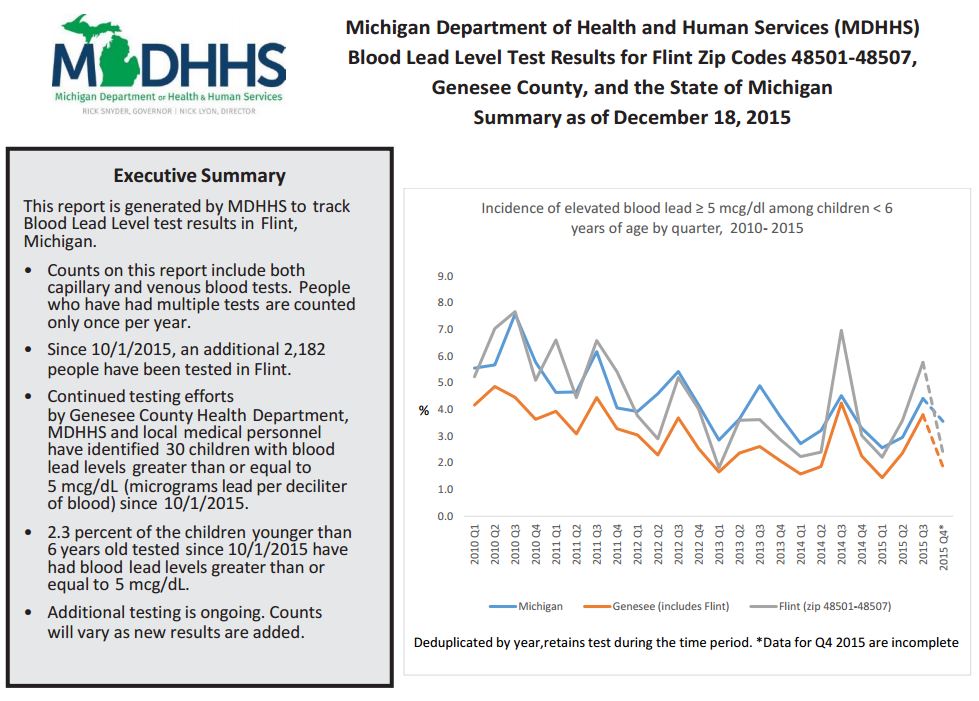
December 2015

The graph presented in December it looks at the incidence of EBL per quarter and looks at it based on zip codes.  This removes the noise generated from all the other data points so you can see there is a significant spike.  To be honest, these graphs are all over the place, but they do show similar peaks and valleys.

Still...
January 23, 2016: The Michigan Department of Health and Human Services' own review last July showed a spike in blood-lead levels in Flint children in the months after the city switched its water supply to Flint River water. "If I knew then what I know now ... We needed a much more robust analysis," Dr. Eden Wells, Health and Human Services' chief medical executive, said Friday.
Which brings me back to looking at this in contexts, as a whole. New water source, complaints, EPA Del Toral memo, lead found at the Walters home, Walters' kids with an increase in blood-lead levels.  What more do you need to see to conclude that a closer look is necessary?  that's not hindsight in my opinion.
"We should have torn it up and apart and gone up and down with that (data). That wasn’t done. "When I think about how Flint citizens have just had one thing after another — not just over the past two years, but many, many years — I wish that was not a missed opportunity." [source]
There seems to be a lot of "golly, if I had only known!" coming from Michigan's governmental agencies responsible for protecting public health.

Enter Dr. Mona Hanna-Attisha of Hurley Medical Center in Flint.

 Next post: Flint Water: A Political Football.  Part 9