Showing posts with label Part B. Show all posts

Monday, January 6, 2014

If they only had a RCRA permit...Part 9

On December 15, 2013, the Los Angeles Times begins another article about Exide with this:
One by one, hour after hour Saturday in a ballroom at Cal State Los Angeles, residents, elected officials and activists from southeast Los Angeles pleaded with an air district hearing board to shut down a Vernon battery recycler accused of endangering hundreds of thousands of people because of unsafe arsenic and lead emissions.
"I'm a mother, asking you, please, do something," said Sandra Martinez. "I go days without sleeping, worrying about my child dying in his sleep from asthma."
The DTSC consultant hired to look into problems with the permitting process tells us:
The facility serves as an example of when a permit should be revoked; it is on an interim status permit and has numerous air quality, solid waste and hazardous waste issues.
The DTSC tells us:
It requires Exide to set aside $7.7 million in a special fund for upgrading the storm water system, reducing arsenic emissions in the air, blood lead testing in the community and sampling dust and soil around the facility... It means that Exide is being closely monitored, and the facility will be made safe or DTSC will shut it down again should the facility pose an imminent and substantial danger to public health and the environment.
Is Exide the health and environmental problem these three three organizations tell us it is?

I have tried to look at this question from the case of actual harm.  I cannot see it, nor can I see anything that comes close to imminent or substantial harm.  That leaves risk.  Does Exide pose a risk whereby shutting it down will make a difference?

That's a difficult question to answer because risk perception is in the eye of the one who thinks they may be at risk.  So we normally focus on the term "significant" or statistically high risk.

Let's look at this common situation as an example.  Is there a risk that an airplane up in the air could crash onto your house and harm you?  If you live close to an airport, does that risk increase?  If the airport is a major one, does that risk increase more?  If you live in the flight path does the risk increase even further?

Is there risk living in Vernon, California?  Let's look at their City Logo:


If you live in or around an area that claims itself to be "exclusively industrial" then your risk increases regardless of Exide being present.  That does not mean you need to be exposed to unnecessary risks or risks that have very little benefit.  The question becomes how do we define what is a necessary risk or a benefit that makes the risk acceptable?

The folks that show up at these meetings do not care about the question of acceptable risk.  Exide does not benefit them so shutting it down will remove the risk, end of story.

So, how many planes do we need to remove from the sky to benefit those that live near a major airport in the flight path to reduce their risk?  Should those folks get a say in the amount of risk they must endure, that is, should they be able to ground the planes or close the airport?

If we were to shut down Exide today, would the overall risk to their health be greatly improved or would it be negligible?  Unless we remove every airplane from the sky the chance of an airplane crashing into your house is always there.  There is always a risk.  Removing an airplane, or the airport, does not eliminate the risk, it lowers it from there to still there only less.  Same goes with removing Exide.  Based on the data available, the risk to health and safety and to the environment is no different than any of the other businesses that use chemicals and emits into the air.

Is Exide inherently more dangerous than the freeway, rail yard, or other businesses with air permits in and around the community that thinks it is being harmed?

How should we make this determination?  Should it be based on evidence?  Should we use science and consensus?   Should one contributor to risk be singled out or should it be compared to others?

Let's start with science.  In particular lets look at dose-response, one of the fundamental principles of toxicology - the study of harmful effects caused by poisons.  Basically, everything is toxic but at a certain dose, it is not.  We look at carcinogens differently, claiming a risk at any dose, the less exposure the less risk.

Here is how those smarty-pants at Johns Hopkins University look at it
The magnitude of the toxic effect will be a function of the concentration of altered molecular targets, which in turn is related to the concentration of the active form of the toxicant (biologically effective dose) at the site where the molecular targets are located.
If you think Exide is causing a toxic health impact where is the data to back that up?  The judge that overturned DTSC's cease operation order recognized this when he stated that the evidence DTSC provided was an "avalanche of conclusions, speculation, and innuendo [which is] not a substitute for evidence,"

The activists leading the call to "shut it down, shut it down!" are never going to be satisfied with any scientific evidence provided showing that the facility is not impacting the community in which it resides.

Case in point:  The folks who took issue with the Exide smelter in Frisco, Texas, started a group called "Get the lead out of Frisco"  This Exide smelter had been operating with no issues up until the EPA lowered the threshold for lead from 1.5 ug/m3 to 0.15.  With that change the facility was out of compliance and new controls had to be put into place.

Honeycutt Presentation - TCEQ

At the new threshold of 0.15, some folks in Frisco deemed the smelter unsafe fearing that they were being impacted by the lead that was being emitted.  Even when the State of Texas showed that 95% of the 605 blood samples collected within the community "did not contain detectable levels of lead" this same group would not accept the results as valid or indicative of no impact.
“There are many questions concerning the methodology for the sample collection, the size and demographics of the population sampled...” “Because important details are lacking, the TDSHS fact sheet is unusable to citizens and policy makers of the City of Frisco for establishing primary prevention priorities for the community.”
That blood-lead analysis took place in 2011.  So what does the DTSC require Exide in Vernon, California, to do in 2013?
Additional funds also will pay for the voluntary blood testing of residents of Vernon and other nearby neighborhoods...
The tests will provide more information regarding potential health and environmental impacts from the Exide facility. Higher lead levels in blood could be an indicator of a health risk. Those findings, combined with data from soil and dust sampling, will help determine if the facility is a source of contamination. That information will be helpful to DTSC in determining future steps.
At what threshold of lead in the blood will the DTSC deem to be safe?  How will they convey those finding to the public, especially if they are below 10 ug/dL, to those that are chanting for the facility to be shut down?

The data we have does not support shutting Exide down.  And yet, as reported by the LA Times on December 15, 2013, Nancy Feldman, the SCAQMD's lawyer tells us:
...compared Exide's pollution control system to a vacuum cleaner that spews dust and debris from the carpet "out of the sides before it ever reaches the filters in the vacuum" and "more distressing ...it actually spits dirt right out the front, back onto your carpet."
That may be an apt analogy but that's not what her agency's arsenic monitoring shows is happening in terms of impact.  So why paint a picture in the public's eye that they are not being protected, that Exide is just letting this dust spew all over?

The public does not understand toxicity, cancer potency, nanograms, blood-lead levels, imminent, substantial, significant, or elevated health risk.  It understands a smoke stack, lead, arsenic, and cancer.  It needs the agencies tasked with protecting them to tell them what it all means.  And Exide, along with all the other businesses that are regulated by these agencies, need a fair representation of what their impact is.

How should risk and harm be quantified and what standards should we use?  Are reasonable standards of impact and risk being utilized by the DTSC, SCAQMD, The LA Times, and the activists groups yelling shut it down, shut it down?

Or maybe Exide employee Juan Felix - who told the LA Times that he has seen "vast improvements" to reduce emissions at the plant - should be considered.  "They do care about the community and they do care about the health and safety of employees," he said. "Take the time to look at the facts."

They will shut down Vernon's  Exide facility just like they did in Frisco, Texas.  And that will leave one lead-acid battery recycler in California.  The number of spent lead-acid batteries being generated will not decrease, in fact, with all the smart cars being proposed, the need to recycle this lead will increase.

Here's the thing.  You cannot recycle lead-acid batteries without a smelter.

So where will all these lead-acid batteries go?  Not here in the US.  They will most likely open a facility in Mexico.  It will be operated safely to Mexico standards. Those standards, by the way, are not the same as California - you know - the state where Exide currently resides.  But that's okay isn't it? It won't be in their backyard any more, so all will be good.

And here is something I will bet money on.  You know that Senator Kevin de León the LA Times quoted as saying "are our children worth as much as any other child?"  He won't be in Mexico demanding that California controls and regulations be used for the smelter they will use to recycle the lead-acid batteries we generate but don't want to properly recycle in our own country.

"Shut it down, shut it down!" is nothing more than "not in my backyard" which is nothing more than turning a blind eye to where it eventually ends up.  And that, in my opinion, is a terrible way to manage risk and set policy.

Thanks for reading.

Sunday, January 5, 2014

If they only had a RCRA permit...Part 8

I began writing these posts, like I always do, without an end in mind.  They are spur of the moment research based on information I can readily find on the internet.  I never know where the web research will take me, though I am usually pretty confident that the topic I am writing about will be supported in the way I thought it would.

What I really like about doing this blog are the rabbit holes I get sent down.

This series of posts resulted from a Los Angeles Times article on how California's Department of Toxic Substances has been "ineffectual" in protecting the environment.  The evidence for this failure came in the form of this:
A quarter of California's 118 major hazardous waste facilities are operating on expired permits that may not meet current standards. In a conspicuous case, a battery recycler in Vernon whose lead and arsenic emissions have endangered the health of residents in southeast Los Angeles County has been smelting batteries for decades with only a temporary permit.
I started my environmental career in California, and that's not the DTSC and California I know (and loved!).

So I dug into the complaint about Exide, which had a similar smelter recently shut down in Texas.  Eight posts later, here I am, and I just now got around to reading the court documents posted by DTSC regarding the Exide facility.

A lot about what has been said about Exide's Vernon California facility troubles me.  I expect the public to yell "shut it down, shut it down!" What I did not expect was the DTSC to kowtow to public pressure to the point where they would lead the public into a false determination of "imminent and substantial" harm.

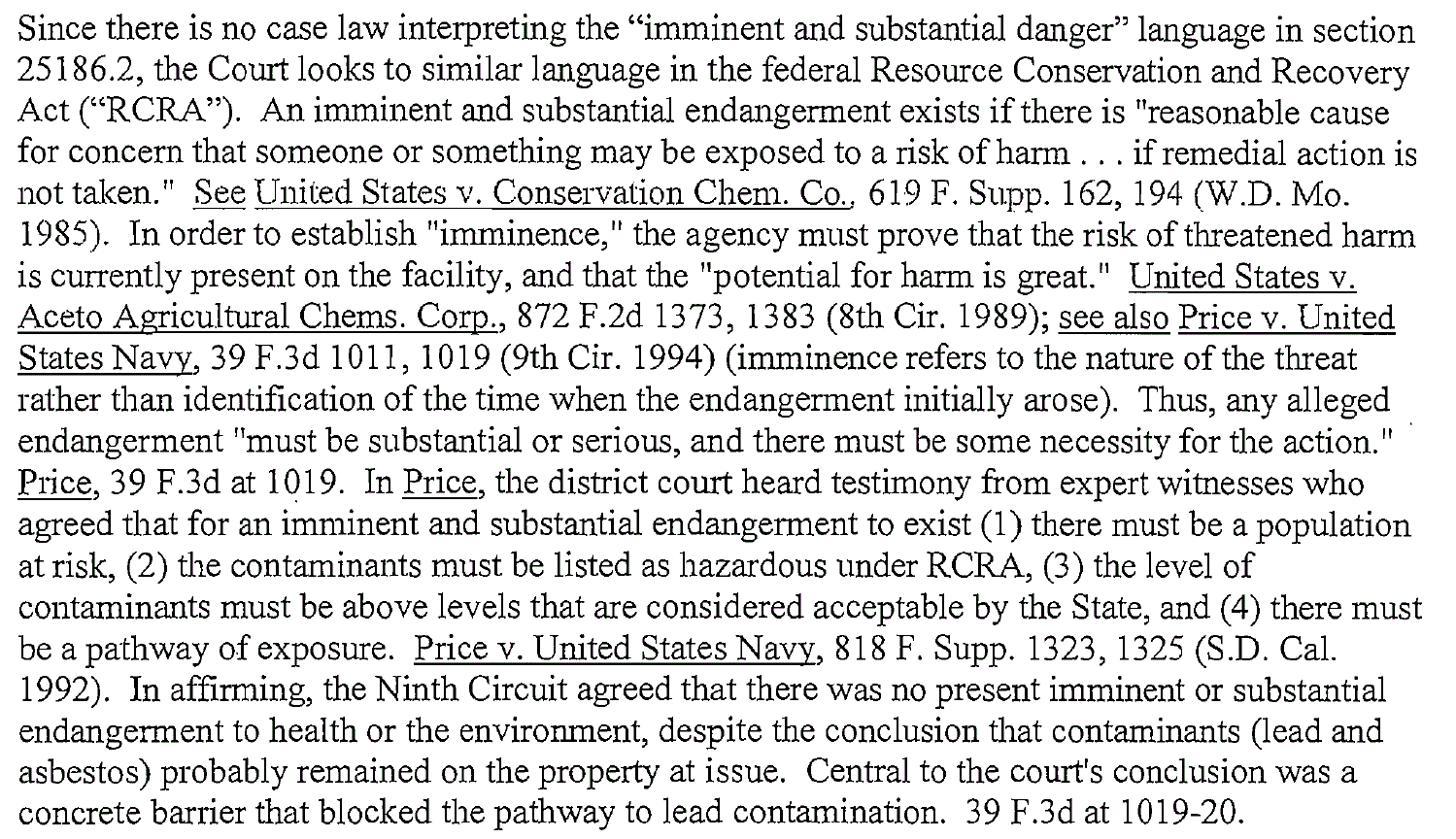
Apparently the Judge - who overturned DTSC's cease order - thought so as well:

Source
If you recall in my fifth post on Exide, I took issue with DTSC using a one in 1,000,000 (10-6) threshold while Proposition 65 allows for a deminimis of one in 100,000 (10-5).  The Judge took issue with that threshold too:

Source
In 2006 the DTSC had given the green light for Exide to finally get their Part B RCRA Permit (not that it would change anything mind you, but that's how it's supposed to work - Interim to Full).  What happened from that point to the consultant the DTSC hired to "review the existing permitting program and develop a recommended standardized process with clear decision criteria and corresponding standards of performance" recommending that to the DTSC that:
The facility serves as an example of when a permit should be revoked; it is on an interim status permit and has numerous air quality, solid waste and hazardous waste issues.
What took place from 2006 to 2013?

The LA Times October 8, 2013 article regarding the consultant's report on DTSC's permit review process and the public hearing called on the same day it was submitted, concludes with the following:
The 115-page report also noted that representatives of many environmental groups believe that the department has "a strong bias toward industry at the expense of public health." Some in the hazardous-waste industry, meanwhile, told the authors that the Department of Toxic Substances Control allows "unreasonable opposition" from the public to stand in the way of permits even when objections are "not based on science or law."
I found it interesting that these consultants would be aware of this dynamic and still make the statement that the Exide facility should serve "as an example of when a permit should be revoked."

Why?

What's the "science or law" that supports that?  How is allowing Exide to continue to operate doing so "at the expense of public health?"  These consultants bring up a 2002 consent order, arsenic air emissions, and the stormwater issue as their reason for having DTSC deny the permit.  If the 2002 consent order was a problem it would have been addressed in the 2006 public notice giving the green light for the Part B RCRA Permit.

You have read my posts on the arsenic emissions so let's look at how the Judge saw the stormwater pipe issue:

Source
When Exide bypassed the old system it removed any harm the old system could have been causing.  In addition to that bypass, the Judge found:

Source
That removes the objection for the stormwater piping causing harm, let alone "imminent and substantial" harm.

What does the Judge say about the arsenic emissions?

Source
Okay, let's be upfront here.  These guys (Exide) are an industry that smelts lead form the recycling of lead-acid batteries.  They generate air, water, and waste emissions.  They make mistakes, have spills, have busted pipes, leaks, blips, blunders, and upsets.  The question becomes are these issues significant enough that they are causing harm to the public or environment?  Are their actions inherently more dangerous then any of the other operations in the area?  Would shutting them down remove the risk to a point where it is noticeable?

Let's look at where Exide is located:


The nearest sensitive receptor, an Elementary School, is 1.9 miles away.  In terms of risk to the public who live there, is the following concern valid?
Delores Mejia held a cardboard box of red-paint-splattered fake million-dollar bills, which she said represented blood money Exide has made at the expense of the largely working-class and minority community. (1)
If you remove that red dot from the map, what will change?  Here again is what the Judge thinks about Exide:

What aggravates me on all of this is that DTSC has now painted themselves into a corner.  They were wrong to claim imminent and substantial and the court told them so.  One thing that I know about government folks who control agencies is that the do not like to be told they are wrong.  If you think DTSC is going to back away now, I have a bridge that you might be interested in.  They are going to look, and look, and look until they find something. 

The DTSC, working with the SCAQMD will eventually shut Exide down.  Their Bankruptcy will exacerbate their resolve to fight it and both these two agencies will nickle and dime them with technicalities.  The DTSC especially.  It got its hand slapped pretty hard by this judge and they will not take too kindly to backing off.

The red dot will be removed and the people in the area will not be made more safe, more healthy, or the environment more protected.  


Next Post: If they only had a RCRA permit...Part 9 (End)

.

Tuesday, December 31, 2013

If they only had a RCRA permit...Part 4

As I left off in my last post:
Which brings us to the 2006 DTSC public notice regarding the Part B permit?  What happened between 2006 and present date?
Here is what the DTSC stated in their 2006 Fact Sheet about Exide:
DTSC conducted a detailed review of the Exide Technologies Part B Permit application and has determined that it complies with all applicable regulatory standards and requirements.
Okay...no administrative dottin' and crossn' stuff holding it up...
DTSC completed an environmental impact evaluation called a draft Environmental Impact Report (EIR).
Okay...
The proposed project was concluded to have a potentially significant adverse air quality impact because PM10 (very fine particulate matter, under 10 microns in size) and off-site NOx emissions (nitrogen oxides, primarily related to trucks) exceeded the South Coast Air Quality Management District’s significance threshold for new sources.
So we have some air issues for particulate matter and nitrous oxide...
Note, that the Facility is not a new source and that all other emissions were determined to be less than significant.
What that means is that the requirements to deal with the PM and NOx are not as robust as they could be if the facility was a new facility.  That's part of the grandfathering issues with the Clean Air Act.  However, the DTSC found that all other emissions - which would include lead - were less than significant.
The impacts of the facility on all other environmental resources were also determined to be less than significant.
So other than PM10 and NOx, the DTSC had no environmental issue with Exide in 2006.  What about human health issues?
The risk assessment evaluated potential cancer and non-cancer health effects that could be caused by the facility’s operations. The assessment took into account a variety of factors, including the types and maximum amounts of waste that would be stored and handled at the facility, and all the possible ways people could be exposed (through breathing the air emissions, coming into contact with the soil surrounding the facility, and similar activities).
Okay...
For cancer, the potential effects from the facility are well within health risk limits.
Good on the cancer impact...
For non-cancer health risks, the risk assessment evaluated chronic and acute health effects for both the nearby residents and facility workers. The assessment concluded that non-cancer health risks are also well within the state established limits. 
Good on the non-cancer health impacts.

So what's the problem with issuing Exide their Part B permit in 2006? I can't find anything from that time using Google.  What I do find is information on a public meeting two California lawmakers had with the head of the DTSC.

I'll quote from Jessica Garrison's Los Angeles Times October 8th, 2013 article, starting here:
"Are our children worth as much as any other child?"
Agency Director Debbie Raphael somberly told the crowd that she could not explain the failures of the past but that her agency has been vigorously working to bring the facility into compliance during her two-year tenure.
Interrupting Raphael at one point, Mejia picked up a megaphone and screamed: "Stop permitting serial polluters! That's what you can do!"
It's the next paragraph that brought me back to Google for a search:
The meeting came the same day that the Department of Toxic Substances Control issued a consultant's report saying that its permitting program is racked by "poor management practices" and that the department does not have a system for revoking or denying permits even when there is a significant threat to human health, according to a consultant's report released by the agency Tuesday.
I looked at that report.  And what caught my eye was this:

Page 51 of the report
Here was the head of the DTSC being asked about the "failures" of the department with a consultants report concluding that the Exide permit should be revoked.

In 2006 everything was fine and now in 2013 no permit is the recommendation of their consultants that were hired to:

Using CPS HR Consulting's questions, I set out to find out why they made this recommendation.  Here is what the consultants say about Exide in their report to the DTSC:
Exide. This is a battery recycling facility located in Los Angeles area (City of Vernon). Exide is one of the last “interim” permits (a disposal site in existence prior to the 1982 law that established DTSC and grandfathered pre‐existing operators.) It has been controversial both because the South Coast Air Quality district has recently found its air emissions to pose elevated cancer risk in the area, while the Department discovered that the facility was releasing hazardous waste into the soil due to a degraded pipeline. The Department believed Exide was not fully cooperative or responsive.
In 2006 everything was in order, so where did this new information come from?
April 24, 2013: DTSC issued the order after receiving reports regarding airborne emissions from Exide’s operations and ongoing subsurface releases from degraded underground pipes.
All of this was happening under the backdrop of the fight in Texas over the Exide facility in Frisco. So what new stuff came into existence?  Enter Exhibits 1, 2, 3, and 4.  Man you gotta really get into the weeds to figure out what is going on.
Exhibit 1- Order of Temporary Suspension: "I conclude that it is necessary to issue this Order for Temporary Suspension pending hearing to prevent or mitigate the substantial danger pursuant to Health and Safety Code Section 25186.2."
Substantial danger...go on...
Exhibit 2: On March 5, 2013, Exide submitted a Storm Sewer Inspection Report (Report) which indicates that the underground pipelines used to convey the lead contaminated storm water to a hazardous waste treatment tank system are in poor conditions. Exide proposes to replace and design the underground pipelines to meet with the tank ancillary equipment requirements ... 
Okay, so that's what the consultant means as "releasing hazardous waste into the soil due to a degraded pipeline."  What about the claim that the SCAQMD "recently found its air emissions to pose elevated cancer risk in the area?"  Was this for PM10 and NOx?
16.1 In a letter dated March 1,2013, the SCAQMD advised Exide that the HRA submitted by Exide in January, 2013 indicates the Facility poses a maximum individual cancer risk (MICR) of 156 in one million for an offsite worker receptor about 300 meters northeast of the Facility (primarily arsenic).
16.4 Also, according to the SCAQMD, the HRA indicates the Facility poses a maximum individual cancer risk (MICR) of 22 in one million to the nearest residential receptor.
Wait...arsenic?  Nooooo not arsenic, and cancer?  Nooooo.  But alas, I must now go back to my ol' faithful nemesis, Arsenic.  That's what the DTSC is using to claim that "emissions from the facility operations pose a significant risk to the surrounding community."

Good ol' Arsenic.  Good ol' cancer risk...now the fun begins.  Is the DTSC correct in the assertion that the Exide is emitting arsenic into the community that increases the risk to "pose a significant risk to the surrounding community?"  Here is what they say in Exhibit 2 about that:
DTSC accepts a cumulative risk that does not exceed a one in one million (10-6) for cancer risk. A risk level of 10-6 implies there is a likelihood that up to one person. out of one million equally exposed people, would contract cancer if exposed to the specific concentration continuously (24 hours per day) over 70 years (an assumed lifetime). This would be in addition to those cancer cases that would annually occur in an unexposed population of one million people.
Okay, so the pipes be leakin' and Exide is going to fix them.  The arsenic presents another hurdle to overcome.  What I want to know is how they calculated that 22 in one million to the nearest receptor risk.

Inquiring minds gotta know.


If they only had a RCRA permit...Part 5

.

If they only had a RCRA permit...Part 3

Okay, so let's be honest with one another here regarding the Exide facility in California.  The NIMBY folks and the environmental activists folks do not want it.  Period.  No matter what Exide does to reduce, control, or eliminate exposure, the fact that they have a smoke stack, operate a smelter, and work with lead - a chemical they know causes harm to children - makes this facility unwanted.

There is nothing, absolutely nothing, that will convince these loud and angry folks otherwise.

Nothing.

That's not how the DTSC is supposed to look at the situation.  They are supposed to make decisions on health impact based off of data that supports or contradicts the contention of "imminent and substantial danger to public health and the environment." (1)

The loud and angry folks that protest, yell, threaten, and show up at public meetings to discus things like Exide's Part B permit, are the ones who get the agency's attention.  No one at the DTSC has the guts to tell them to shush and look at the numbers and evidence to determine harm.
On Tuesday, critics of Exide and state regulators, including Assembly Speaker John A. Pérez and two state senators, complained bitterly about how the residents were being treated. According to the Los Angeles Times, lawmakers clapped along while the audience rhythmically chanted, “Shut it down” at a community meeting attended by DTSC Director Debbie Raphael and other regulators.  (2)
 The other issue at hand is an agency - and this is not inclusive of only DTSC - that does not fully understand the science and technicalities regarding the stuff they regulate.  Remember the quote from the DTSC's "top spokesman" as quoted in the LA Times article that started these blog posts?
Jim Marxen, the agency's top spokesman, said last week that regulators do not have a good explanation for the plant's continued operation without a full permit.  "I don't blame the activists who say we are slow to act," he said. "If that was in my neighborhood, I would say the same thing. ... Ten years ago, when they had hearings on this, there was frustration even then."
Maybe he does know there is no difference between an interim status facility and a full Part B facility, but he is perpetuating the belief that the "neighborhood" is being impacted without a Part B in place.

The other issue in play regarding the permit revolves around the question; Is a Part B permit actually required?  Here is what California says about the Exide facility in Vernon:
A RCRA Permit (42 U.S.C. Section 6901 et seq.), is required for the storage, treatment, and disposal of hazardous wastes, and corrective action for the releases of hazardous wastes / substances found at the facility. On August 1, 1992, DTSC received RCRA final authorization from the U.S. EPA to implement the State Hazardous Waste Management Program (HWMP) in lieu of the federal RCRA program. Therefore, a Permit issued by DTSC is considered a RCRA-equivalent Permit.
The issue of whether a Part B permit is actually required in California is beyond my expertise. What I do know about Part B permitting is from the Federal point of view.
Under 40 CFR 266.100(c), owners or operators of smelting, melting, and refining furnaces that process hazardous wastes solely for metals recovery are conditionally exempt from regulation, except for 40 CFR 266.101 and 266.112, provided they comply with limited requirements set forth in Section 266.100(c). Similarly, 40 CFR 266.100(f) provides that owners or operators of smelting, melting and refining furnaces that process hazardous wastes for the recovery of precious metals are conditionally exempt from regulation, except for 40 CFR 266.112, provided they comply with limited requirements specified in Section 266.100(f).
Here is where it gets nuanced.  Are lead-acid batteries hazardous waste?  In California they appear to be:
Processing lead-acid batteries for recycling by draining the electrolyte, crushing, smelting or other physical methods is a fully regulated hazardous waste activity that requires a hazardous waste treatment permit. (4)
From the federal perspective, they are not:
40 CFR 266.80: If you generate, collect, transport, store, or regenerate lead-acid batteries for reclamation purposes, you may be exempt from certain hazardous waste management requirements.  Alternatively, you may choose to manage your spent lead-acid batteries under the ‘‘Universal Waste’’ rule in 40 CFR part 273.
40 CFR 273.2: A used battery becomes a waste on the date it is discarded (e.g., when sent for reclamation).
Remember how I said hazardous waste regulations are nuanced?  Let's not get into the definition of "discarded" or "core charges."  At some point the used lead-acid battery will need to be reclaimed.  That's what Exide does.  They smelt the lead to make new batteries.  The act of smelting is reclamation.  The reclamation allows the lead to be used again in new batteries.  That's recycling.

EPA says that Universal Waste (lead-acid batteries) that will be sent for recycling, fall under 273.60
(b) The owner or operator of a destination facility that recycles a particular universal waste without storing that universal waste before it is recycled must comply with 40 CFR 261.6(c)(2).
Because Exide stores the batteries, they must do the following in (c)(1):
(c)(1) Owners and operators of facilities that store recyclable materials before they are recycled are regulated under all applicable provisions of subparts A though L, AA, BB, and CC of parts 264 and 265, and under parts 124, 266, 267, 268, and 270 of this chapter and the notification requirements under section 3010 of RCRA, except as provided in paragraph (a) of this section. (The recycling process itself is exempt from regulation except as provided in §261.6(d).)
Note the last sentence?  "The recycling process itself is exempt from regulation except as provided in §261.6(d)"  Because Exide will store the batteries prior to reclamation, they must meet those requirements in 264/265.  In a nutshell, here is what the EPA says:
Spent lead-acid battery reclamation regulations are found in Part 266, Subpart G. Generators, transporters and storers are not subject to regulation under 40 CFR Parts 262 through 266 or Parts 270 or 124 or Section 3010 of RCRA per 40 CFR 266.80(a). However, reclaimers who store batteries prior to reclamation are subject to most facility standards and permit requirements with regard to storage per 40 CFR 261.6(a) and 40 CFR 266.80(b). Generally, the reclamation process itself is exempt from regulation.
261.6(a) states the same thing as (c)(1) above.  266.80(b) is the requirement for lead-acid batteries and a facility like Exide that stores and reclaims "are subject to 40 CFR parts 261, §262.11, and applicable provisions under part 268 [land disposal requirements]."

This leaves the "recycling unit itself" - in this case the smelter - which for lead-acid battery smelting is exempt.
Under 40 CFR 266.100(c), owners or operators of smelting, melting, and refining furnaces that process hazardous wastes solely for metals recovery are conditionally exempt from regulation, except for 40 CFR 266.101 and 266.112, provided they comply with limited requirements set forth in Section 266.100(c)[sic]. (5) (Note: 266.100(c) should be 266.100(d))
266.101: Management prior to burning
266.112: Regulation of residues
266.100(d): owners or operators of lead recovery furnaces that are subject to regulation under the Secondary Lead Smelting NESHAP must comply with the requirements of paragraph (h) of this section.
266.100(h): Starting June 23, 1997, owners or operators of lead recovery furnaces that process hazardous waste for recovery of lead and that are subject to regulation under the Secondary Lead Smelting NESHAP, are conditionally exempt from regulation under this subpart, except for §266.101. To be exempt, an owner or operator must provide a one-time notice to the Director identifying each hazardous waste burned and specifying that the owner or operator claims an exemption under this paragraph. The notice also must state that the waste burned has a total concentration of non-metal compounds listed in part 261, appendix VIII, of this chapter of less than 500 ppm by weight, as fired and as provided in paragraph (d)(2)(i) of this section, or is listed in appendix XI to this part 266.
That's on the federal side of it.  California, a whole 'nother beast if thar ever be one, can ignore all that and be much more stringent.

Which brings us to the 2006 DTSC public notice regarding the Part B permit?  What happened between 2006 and present date?

If they only had a RCRA permit...Part 4

.

Monday, December 30, 2013

If they only had a RCRA permit...Part 2

According to the Los Angeles Times article:
Jim Marxen, the agency's top spokesman, said last week that regulators do not have a good explanation for the plant's continued operation without a full permit.
Mr. Marxen goes on to say:
"I don't blame the activists who say we are slow to act," he said. "If that was in my neighborhood, I would say the same thing. ... Ten years ago, when they had hearings on this, there was frustration even then."
In my previous post, I showed that an interim permit or a full permit really does not change anything.  To reiterate, there is very little difference between what an interim status facility does and what they will do when they receive their full Part B permit.

Interim status facilities, such as Exide, operate under the 40 CFR Part 265 standards:
PART 265—INTERIM STATUS STANDARDS FOR OWNERS AND OPERATORS OF HAZARDOUS WASTE TREATMENT, STORAGE, AND DISPOSAL FACILITIES.
This particular standard has a purpose:
(a) The purpose of this part is to establish minimum national standards that define the acceptable management of hazardous waste during the period of interim status and until certification of final closure or, if the facility is subject to post-closure requirements, until post-closure responsibilities are fulfilled.
Here is what the EPA has to say about this difference:
RCRA §3004 requires that EPA develop standards for both existing TSDFs that were immediately subject to regulation at the time the statute was enacted and for facilities that would be built after regulations were established. Congress also mandated that the standards for both types of facilities should only be different where absolutely necessary. To make allowances for existing facilities that would not be able to comply with the full regulatory program immediately, EPA promulgated interim status standards in Part 265.
Let's put this " For decades, the Department of Toxic Substances Control has allowed the plant to operate without the full permit required by federal law" to rest.  The LA Times and the DTSC spokesperson do not appear to understand that there is no difference.  Instead, lets look at why it is 2013 and the Part B Permit that Exide did apply for has still not been approved.
Here is a time line of permiting events for this facility:
The Facility has been used for a variety of metal fabrication and metal recovery operations since 1922. Previous owners have included Morris P. Kirk & Sons, Inc., NL Industries, Gould Inc. and GNB Inc.
Gould Inc. filed a RCRA Part A notification on November 19, 1980, as a treatment and storage facility. This Part A identified storage of spent lead-acid batteries and other lead-bearing material prior to treatment and recycling, and a wastewater treatment system.
Gould Inc. was issued an Interim Status Document (ISD) by the State of California Department of Health Services (DHS), DTSC’s predecessor agency, on December 18, 1981.
The U.S. EPA rescinded the Facility’s Treatment and Storage Facility classification by returning Gould Inc.’s original RCRA Part A application, after Gould eliminated its waste pile, claimed that the smelters do not require a permit, and requested reclassification to generator status.
The Interim Status Document was subsequently rescinded by DHS in 1982.
GNB, Inc. purchased the Facility and filed a revised Part A application on July 5, 1985.
On September 3, 1986, DHS determined that a permit was necessary.
GNB, Inc. submitted the first RCRA Part B application on November 8, 1988.
On August 1, 1992, DTSC received RCRA final authorization from the U.S. EPA to implement the State Hazardous Waste Management Program (HWMP) in lieu of the federal RCRA program. Therefore, a Permit issued by DTSC is considered a RCRA-equivalent Permit.
On December 13, 1999, DTSC approved a Class 2 Interim Status modification for Supplemental Environmental Projects (SEPs) as a result of an enforcement case settlement.
On June 30, 2000, DTSC approved a Class 2 Interim Status modification, for replacement of the Waste Water Treatment Plant and to provide secondary containment.
On January 5, 2001, DTSC approved a Class 1 Interim Status modification, for change of ownership and operational control to Exide Corporation.
On November 16, 2001, DTSC approved a Class 1 Interim Status modification, for a name change from Exide Corporation to Exide Technologies.
Revisions to the Part B Application were submitted over the ensuing years with the latest being on April 17, 2006 and supplemental information on May 2, 2006.
In June of 2006 the Draft Part B goes out for public comment. 
Here is the most current information I could find about the status from DTSC, dated 10/18/2013:
Exide operates under an interim status authorization, and DTSC is reviewing the company’s application for a permit. As part of that review, DTSC could impose additional requirements that would force Exide to spend more money on upgrading the facility. In addition, Exide was required to set aside $10.9 million in a special fund to pay for any costs associated with closing the facility should that happen.
So, Exide is in bankruptcy, which you can than the good folks in Frisco, Texas, for.  That does not explain why from 2006 to October of 2013 the Part B has not been issued.  Here is what the DTSC says on their website for Exide:
DTSC then public noticed a draft Hazardous Waste Facility Permit (Permit), a Health Risk Assessment (HRA) and an Environmental Impact Report (EIR) on July 7, 2006. DTSC received numerous comments on the draft Permit, HRA and EIR.
Based on significant public inquiry and new regulations, significant upgrades were initiated at Exide under the joint oversight of the South Coast Air Quality Management District (SCAQMD) and DTSC. Exide has submitted a new permit application to DTSC which is currently under review by DTSC. 
Disregarding the bankruptcy issues, the time delay appears to be based on no one wanting to bring this thing to closure.  The local community wants the facility shut down.  But the DTSC nor the SCAQMD can shut them down permanently as long as they comply with corrective orders.  Every time they bring something up, Exide sets out to fix it.  There is no reason to delay the Part B permit other than public outcry that will come forth because a permit was approved.

DTSC is in a very bad place with this.  The latest tactic appears to involve going after Exide because the facility poses "an imminent and substantial danger to public health and the environment."
The Stipulation and Order resolves the administrative suspension order that DTSC issued against Exide in April 2013 and resolves a legal action that Exide filed against DTSC in June 2013. The Stipulation and Order sets out conditions that Exide must meet and timelines for completing them. It requires Exide to set aside $7.7 million in a special fund for upgrading the storm water system, reducing arsenic emissions in the air, blood lead testing in the community and sampling dust and soil around the facility. It sets a sliding scale of fines up to $10,000 per day if the conditions are not met. It means that Exide is being closely monitored, and the facility will be made safe or DTSC will shut it down again should the facility pose an imminent and substantial danger to public health and the environment. The Stipulation and Order addresses concerns additional to those posed in the earlier suspension order. The Stipulation and Order is separate from Exide’s application for a permit, which will be decided on its own merits.
As long as Exide commits to fixing the problem, the less reason DTSC has to deny the permit. Once the permit is issued, nothing changes other than the public's understanding that Exide is going to continue operation.

There are two things going on here.  This is speculation on my part.
  1. The DTSC keeps them in perpetual interim status to promote the appearance that they could be shut down and to avoid the public's wrath for issuing a permit.
  2. Keeping Exide in perpetual interim status benefits both parties and prevents Exide from pursuing a legal challenge.
I suspect that Exide knows that it needs to do what it takes to meet the current requirements in terms of perceived risks.  If the levels of air contaminants are too high then they will put controls in place.  If the stormwater pipes are leaking they will fix them.  This seems to be what is taking place.

As long as the public does not want Exide there in Vernon, DTSC will drag their feet until Exide cries uncle, which is probably in the next year since they also had public problems with their smelter in Frisco, Texas.

I want to move from Exide as a company and look at RCRA permitting for a company that recycles lead acid batteries.

Next post: If they only had a RCRA permit...Part 3

.

Sunday, December 29, 2013

If they only had a RCRA permit...Part 1

Been busy at work and have ignored my blog...so with that...

The Los Angeles Times had an article pop on my Google News feed yesterday:
Toxic waste watchdog can be glacially slow
It includes a photo with the caption " Protesters rally in October outside Exide Technologies, which has been required to set aside $7.7 million to replace leaking wastewater pipes and further reduce its arsenic emissions."  
Three reporters are credited with writing this article;  Jessica Garrison, Kim Christensen, and Ben Poston.  I am not sure where these three obtained their information for this story, but if I had to guess it was not from the DTSC (Department of Toxic Substances Control ), Exide, or anyone else in the Environmental Business other than those with the designation of "activist."

Maybe the "if it bleeds it leads" model is also in play for writing news articles on environmental issues.  Every photo they use is of protesters, except for the last one which is a really cool photo of a firefighter's arm and shadow while holding a sample.


There is a lot to talk about in this article, but I want to focus on the last part dealing with Exide.  Environmental regulation is complex.  I tell my students to "check their logic at the door" when we begin teaching our three day hazardous waste management class.  Laws and regulations are specific to what they cover and do not cover.  When you get into the environmental arena, it becomes even more convoluted and illogical.


So, if you are going to write about an environmental issue (take note Jessica Garrison, Kim Christensen, and Ben Poston), you need to spend some time understanding the topic.  You need to find the expertise out there to help you write objectively, unless that's not what you were going for with this article.


Hazardous waste requirements are very nuanced, so on the surface things can appear to be wrong, or dangerous, or unlawful.  That is why you attend training classes and consult with those that understand it.  Heck, even we experts get it wrong, but had we been consulted for this story, we would have painted a different picture about what is going on at Exide.


Let's start with this statement:

For decades, the Department of Toxic Substances Control has allowed the plant to operate without the full permit required by federal law. Instead, it has run on "interim status," a temporary designation intended to give companies time to qualify for permits and meet legal standards for safe handling and disposal of toxic materials.
What would a regular ol' Joe reading the LA Times come away with after reading that?  Is it true that for all this time they have not been required to perform safe handling and disposal of toxic materials?

These three reporters seem to be parroting the folks who are out there protesting.  They do not understand that there is almost no difference between the interim status requirements in 40CFR 265 and the full permit requirements in 40CFR 264.  They do not understand that even without an interim or full permit, Exide would meet the definition of a large quantity generator and would be required to meet most of the requirements for an interim status facility.

I lost you with that didn't I?  Too complicated, too many words, no photos of people in masks or with signs.  Boring ol' regulations.  That's what I write about.  Boring stuff in order to paint an accurate picture about what is really going on.  So if you are still reading, let's continue.

The Resource Conservation and Recovery Act (RCRA) is a federal law.  All states had to comply when the EPA's regulations were finalized in 1980.  California, being California (I was born there, educated there, and worked the first part of my environmental career there) set out to run their own RCRA program, getting full authorization in 1992.

I know this because I Googled for information on Exide in California and found this PDF from the DTSC.  After reading it, I became convinced that the three LA Times reporters never bothered to look for information that might paint Exide in a light other than bad.

I found another DTSC PDF that also describes the Exide situation regarding interim status.  Unfortunately, neither of these PDFs explain the nuance.  So I'll try and show why its no big deal for the facility to operate "for decades" under interim status.  That seems to be the crux of the "look how slow DTSC is."

Okay, from this point on, check your logic at the door and go where the regulations take you.

For four years prior to 1980 industry had known that there would be regulations coming out for waste streams deemed to be "hazardous."  The then owners of the Exide facility had been recycling the lead from lead-acid batteries for years prior to these new RCRA regulations.  They knew that the lead in lead-acid batteries was going to make their waste and their operation fall under RCRA.

So in 1980 the company that is now called Exide applied for an interim status permit with the EPA to continue their operation of recycling batteries and smelting lead. 

Let's look at how this permitting  process works:
The Resource Conservation and Recovery Act (RCRA) requires anyone who owns or operates a facility where hazardous waste is treated, stored, or disposed to have a RCRA hazardous waste permit issued by the U.S. Environmental Protection Agency (EPA).
We will come back to this because that requirement gets convoluted when it involves recycling.  According to the EPA:
There are two parts to a RCRA hazardous waste permit application – Part A and Part B.
Part A of the RCRA hazardous waste permit application consists of EPA Form 8700-23 (includes both the RCRA Subtitle C Site Identification Form and the Hazardous Waste Permit Information Form), along with maps, drawings, and photographs
Part B of the RCRA hazardous waste permit application contains detailed, site-specific information. There is no form for the Part B Permit Application; rather, the Part B Permit Application must be submitted in narrative form and contain the information described in applicable sections of 40 CFR 270.14 through 270.27.
That's the permit process in a nutshell.

1980 we get RCRA Regulations and in 1980 the Exide facility (different owner at the time) applies for a permit.  Here is what the EPA says about the interim permit:
Existing hazardous waste management facilities are those hazardous waste treatment, storage, or disposal facilities which were in operation or for which construction had commenced on or before November 19, 1980, or which were in existence on the effective date of the statutory or regulatory amendments that render the facility subject to the requirement to obtain a RCRA permit. RCRA establishes a procedure for obtaining interim status that allows these existing facilities to continue operating until a final hazardous waste permit is issued.
When did the Exide facility submit their interim status application?  November 19, 1980.

Now you need to remember that these were brand spanking new regulations for an agency that had been in existence for a little more than 8 years. Interim status was designed to give the EPA time to work through this process while allowing facilities to keep operating.

What's important to understand here is this statement made by the EPA:
RCRA establishes a procedure for obtaining interim status that allows these existing facilities to continue operating until a final hazardous waste permit is issued.
Here is what the EPA says about interim status:
Facility owners or operators with interim status are treated as having been issued a permit until EPA reviews the RCRA Part B Permit Application and issues a RCRA hazardous waste permit.
With or without a Part B permit, this battery recycling/lead smelting facility was required to meet regulatory standards for the treatments, storage, and disposal of hazardous waste.  But that's not what the three LA Times reporters tell you:
In 1992, soon after the state agency was founded, environmental activists flew to Sacramento and appealed to top officials to make sure the battery plant and similar facilities obtained permits.  
One by one, other facilities did.
Not Exide.
"How is that possible?" asked Jane Williams, executive director of California Communities Against Toxics, a nonprofit her mother helped found in 1989. "It's not like it's some small mom-and-pop facility that we have somehow missed ... Their smokestack can be seen from downtown L.A."
Those three reporters paint a very different picture for the reader then what is really going on.  Let's look at what the DTSC says about the Exide facility in 2006 when the Part B permit was up for public comment:
As part of the environmental impact evaluation of the facility, a Health Risk Assessment was prepared. The risk assessment evaluated potential cancer and non-cancer health effects that could be caused by the facility’s operations. The assessment took into account a variety of factors, including the types and maximum amounts of waste that would be stored and handled at the facility, and all the possible ways people could be exposed (through breathing the air emissions, coming into contact with the soil surrounding the facility, and similar activities).
For cancer, the potential effects from the facility are well within health risk limits.
For non-cancer health risks, the risk assessment evaluated chronic and acute health effects for both the nearby residents and facility workers. The assessment concluded that non-cancer health risks are also well within the state established limits.
"Well within health risk limits" or "Their smokestack can be seen from downtown L.A."

All I ask of folks who write for major news organizations is to write a full and accurate account of what is going on.

Yeah, I can hear what you are thinking, here it is in 2013 and Exide still does not have a Part B permit.  Yeah, that's a bit strange, but I think I have an answer for that.


Next post: If they only had a RCRA permit...Part 2

.