Sunday, March 8, 2015

Bottle of Wine.... Gallo Glass vs. DTSC - Part 7

That Matlock guy sure did not help Gallo Glass.  Can't we find someone a little more 21st century?

How about this guy?

.

Sherlock Holmes: C’mon! Where is your case? Did you eat it?

DTSC: It's not recycling, therefore its surrogate disposal!

Sherlock Holmes: Yes, thank you for your input, but you are missing one, possibly two, additional ways Gallo Glass gets out of this unscathed.

DTSC: No they will not! There was no recycling.  Gallo Glass put the EP sludge in silos where it was illegally stored and then illegally treated it in furnaces by adding it to the glass batch ingredient mix from which their glass bottles were made.  It's all there in the compliant, number 35 if you care to take a look.

Sherlock Holmes: Dear God. What is it like in your funny little brains? It must be so boring.  That Matlock lawyer may have been something big in his time, but the reclamation route he went was pretty sophomoric.

DTSC: And you can do better?

Sherlock Holmes: Gallo Glass puts the EP sludge back into the production process, yet you claim that this is surrogate disposal.  If I recall correctly, surrogate disposal is when the recycling material does not contribute any significant element to the product.

DTSC: Yes, that's how the EPA looks at it.

Sherlock Holmes: Yes, its right there on page 487 of that PDF is it not?  This seems to be the crux of your argument.  It is either recycling or it is not.  Deciphering this - it’s the key to throwing your complaint out, or at least a large part of it.

DTSC: We have the law and our regulations that we go by.

Sherlock Holmes:  Yes, and so do I.  I'll give you the fact that reclamation is not taking place.  Mr. Matlock was not too bright to use that as a defense.  Are you familiar with the rest of 261.2?  The part after (d)?

DTSC: Yes.

Sherlock Holmes: And if I recall from the Matlock transcript, the EPA's definition for recycling is valid.  So we can agree that recycling that is not reclamation also takes place when the materials is "used" or "reused."

DTSC: Yes, 261.1(b)(7).  It is also a "recyclable material."under our California regulations in the HSC 25120.5 by which it is a hazardous waste that is capable of being recycled because the EP sludge is a residue produced from the EP process.

Sherlock Holmes: Slow down there sir.  Let's not confuse two definitions that sound very similar.  "Recycling" is a very different definition from "recyclable material."  I am still not convinced that Gallo Glass' EP sludge is a hazardous waste.  If it is not a hazardous waste, then your "recyclable material" definition would not apply as that definition is for a hazardous waste that is capable of being recycled.  You do see the difference don't you?

DTSC: Illegally stored, illegally treated.  Surrogate disposal.

Sherlock Holmes: Yes, I figured that ould be your fallback, so let's look at a little closer shall we.  Gallo Glass is using the EP sludge in their process to make glass bottles are they not?  The question is, can they do that?  I'm not so sure yet under your silly California way of looking at waste, but I do have a good handle on how EPA views it.

DTSC: Mr. Holmes, you flatter yourself.

Sherlock Holmes: Let's get back to 261.2 shall we, specifically (e).  Would you be so kind as to read that to me?

DTSC: "Materials are not solid wastes when they can be shown to be recycled..."

Sherlock Holmes: "...by being used or reused as ingredients in an industrial process to make a product, provided the materials are not being reclaimed."  Did I state that correctly?

DTSC: Yes...

Sherlock Holmes: We agreed that there was no reclamation did we not?  And didn't you write in your complaint that Gallo Glass was using the EP sludge as and ingredient?

DTSC: They told us they were using the EP sludge as a substitute for salt cake, a raw ingredient used in the making of glass bottles.

Sherlock Holmes: Yes, number 34 in your compliant.  And if you will continue reading 261.2(e)(1), roman numeral (ii)...

DTSC: "Used or reused as effective substitutes for commercial products."

Sherlock Holmes: So according to 261.2(e)(1)(ii) "materials are not solid wastes when they can be shown to be recycled by being...used or reused as effective substitutes for commercial products."

DTSC: Yes, but we have not been provided with the requested information necessary to confirm that claim.

Sherlock Holmes: Yes, I read that in number 34.  I also read that based on "information and belief" you contend that Gallo Glass "reaped a substantial economic benefit by failing to properly dispose of all EP sludge to an authorized disposal facility."

DTSC: Yes, we also contend that Gallo Glass "failed to demonstrate that its practices qualify as recycling under California law" and "that it also did not comply with requirements for legitimate recycling." 

Sherlock Holmes: Yes, so would you also contend that disposal in a landfill is a better management practice then recycling?

DTSC: No, as you can read in our press release, we state ”DTSC promotes and supports legitimate recycling."

Sherlock Holmes: So...if this EP sludge was being recycled is a legitimate recycling method, would you allow it?

DTSC: I can't really speak for all of DTSC on that matter...

Sherlock Holmes: I figured as such.  Well I will then have to speak my mind on this subject, after all, that's what I was brought in to do.  Your complaint rests on the premise that the recycling of the EP sludge is not recycling therefore making the process "surrogate disposal."  You claim that Gallo Glass failed to demonstrate to you that their practice of putting the EP sludge back into the process does not qualify as recycling under California law.

DTSC: That is correct.

Sherlock Holmes: Well, while you were confirming what I already know, I looked up your definition of "recycling."  According to your California HSC 25121.1, you define recycling as "using, reusing, or reclaiming a recyclable material."  That sounds just like EPA's definition, does it not?

DTSC: We also add that it "means the collecting, transporting, storing, transferring, handling, segregating, processing, using or reusing, or reclaiming of recyclable material to produce recycled material."

Sherlock Holmes: Precisely!  So Gallo Glass takes their EP sludge that is produced when they make glass bottles and puts it back into the process to make glass bottles.  By doing this, they contend, the "precipitate captured by our air emission controls is comprised of the same raw materials used to make glass so we use it instead of adding new raw materials."  Why are you having a difficult time seeing this as recycling?

DTSC: Err...well Gallo Glass claims they are using it as a substitute for salt cake.  You can't just be a substitute.  261.2(e)(1)(ii) states it must be an "effective" substitute.  Like we told you, Gallo Glass has not "provided us with the requested information necessary to confirm that claim."

Sherlock Holmes: Okay...and in your complaint you acknowledge that Gallo Glass took a "significant amount" of EP sludge and "added it to the glass batch ingredient mix" and placed it "in the furnace" from which "glass bottles are made."  So, if I have this correct, the EP sludge is produced from making glass bottles, it is then put back into the glass bottle making process as a substitute for salt cake, whereby new EP sludge is produced and the process repeats.

DTSC: Yes, but we have no proof that the EP sludge is an effective substitute for salt cake, therefore Gallo Glass "failed to demonstrate that its practices qualify as recycling under California law." 

Sherlock Holmes: Yes, I am well aware of that oft repeated claim.  Are you daft?  We can agree, can we not, that the EP sludge comes from the process of making glass bottles and it is put back into the process of making glass bottles.  Gallo Glass tells us that "the use of precipitate in glass making is recognized throughout the world as the environmentally-sustainable best practice."

DTSC: That's what we acknowledge has happened in our complaint, except that last part...that's what Gallo Glass states.

Sherlock Holmes: Would you read 261.2(e)(1)(iii) for me please?

DTSC:  "Returned to the original process from which they are generated, without first being reclaimed or land disposed."

Sherlock Holmes: Go on...there is more, isn't there?

DTSC: "The material must be returned as a substitute for feedstock materials."

Sherlock Holmes: Gallo claims that it is, you claim that it is not.  White/gold or blue/gold dress I heard it described as. So if less feedstock is required, less waste is generated, and the bottles do not, as you claim in your press release state that you have "no evidence that consuming wine stored in these bottles poses a health threat," then the caveats in 261.2(e)(2), you can read them...the glass bottles are not "inherently waste-like," "used in a manner constituting disposal or used to produce products that are applied to the land," "burned for energy recovery, used to produce a fuel, or contained in fuels," or "accumulated speculatively."  None of those issues were addressed in your complaint as it relates to the process of placing the EP sludge into the furnace to make glass bottles.  Is that correct?

DTSC: Yes, none of those caveats  are listed in the compliant.

Sherlock Holmes: I don't know...maybe I am missing something here, but how is this process of putting the EP sludge, that was generated from making bottles, back into the making of glass bottles not recycling?  Help me out here, because I am not seeing surrogate disposal.  This EP sludge, as I see it, meets either 261.2(e)(1)(ii) or 261.2(e)(1(iii).  What more proof do you need then this current method of returning EP sludge back into the glass bottle making process is "recognized throughout the world as the environmentally-sustainable best practice?"  It is elementary even to Matlock that what Gallo Glass is doing is recycling within the definition of 261.2 and therefore is not a solid waste which, therefore, makes the EP sludge not a hazardous waste.

Announcer: Has Sherlock Holmes found the smoking gun?  Has he deciphered this correctly?  What will the DTSC throw at him next? Tune in for the next post, Part 8.

Bottle of Wine.... Gallo Glass vs. DTSC - Part 6

What we know - kind of know - assume to know - based on the compliant and Gallo Glass' Word doc is that the EP sludge is being returned back into the process.

This is, and would be considered to be recycling if you see that dress as white/gold. According to the DTSC press release:
The complaint, filed in Alameda County Superior Court, alleges the company illegally introduced dust containing lead, arsenic, cadmium and selenium into the manufacture of its wine bottles.
 Gallo Glass states:
Precipitate captured by our air emission controls is comprised of the same raw materials used to make glass so we use it instead of adding new raw materials.  The use of precipitate in glass making is recognized throughout the world as the environmentally-sustainable best practice and its use in the glass making process eliminates the need to transport and dispose of it in landfills. 
The DTSC thinks the dress is blue/gold:


Here is where the lawyers are going to make their pay and the judge and/or jury is going to become cross-eyed.

If it is recycling, the DTSC has no case (okay, they can get them on the spilled material).  If it is not recycling they do.

The DTSC calls it "surrogate disposal" which, I believe, is most likely based on this:
An example the EPA gives is the use of certain heavy metal sludges in the production of concrete. Because the sludges do "not contribute any significant element to the concrete's properties," the EPA said it would not consider this legitimate recycling. An example the Agency gives of legitimate recycling is the use of spent pickle liquor as a phosphorous precipitant in wastewater treatment.
What is going to happen here is the splitting of hairs.  If this is how the EPA views recycling that is not recycling and is really "surrogate disposal" then the DTSC would most likely take that same approach.

If I have said it once, I'll say it again.  If you want to do anything other than ship a waste to a hazardous waste permitted facility on a hazardous waste manifest, the burden to prove that it is okay falls on the generator's shoulders.

"Know before you Throw" I Teach my students.

Let's get back to EPA's regulations.  Remember that "[261.2(b)(1)(B)] Recycled, as explained in paragraph (c) of this section..." I mentioned in my previous post?  Well that's where we need to start with Gallo Glass.  Here is what that says:
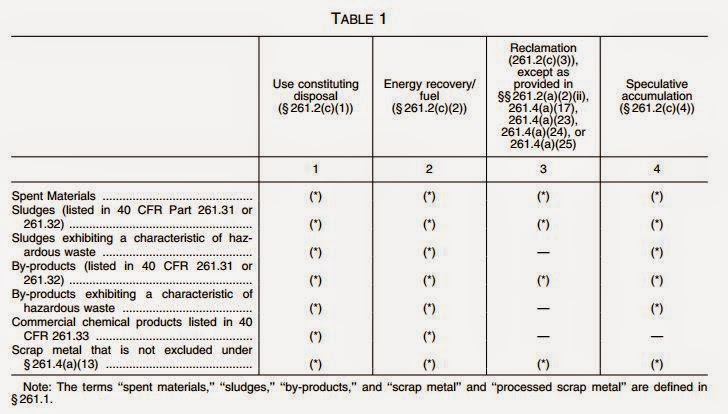
[261.2(c)(3)] Reclaimed. Materials noted with a ‘‘—’’ in column 3 of Table 1 are not solid wastes when reclaimed. Materials noted with an ‘‘*’’ in column 3 of Table 1 are solid wastes when reclaimed unless they meet the requirements of ...
Here is where it gets fun kids!  Let's look at Table 1:


Let's bring out Matlock to explain this:


Matlock: Do we all agree that Gallo Glass produces a sludge?  Do we also all agree that the sludge they produce exhibits the characteristic of hazardous waste, in this case, it exceeds the toxicity threshold in 261.24's Table 1 for arsenic, cadmium, lead, and selenium?

DTSC: Objection!

Judge: Overruled!

Matlock: Do you see, on the EPA's Table 1 which is in 40 CFR 261.2, an item in the first column that sounds a lot like Gallo Glass' EP waste?  I think the third item down "Sludges exhibiting a characteristic of hazardous waste" fits the bill pretty gosh darn close!

DTSC: Objection!

Judge: Overruled!

Matlock: So as I was a sayin' we have Gallo Glass's EP sludge clearly identified on Table I do we not?  Now my client takes that EP sludge and returns it back into the process.  This is an industry best practice used by most glass producers.  This, I think we can all agree, meets the definition of recycling does it not?

DTSC: Objection!

Judge: Define for us the term "recycling" Mr. Matlock.

Matlock.  Okay, if it please the court, the EPA defines in 40 CFR 261.1(b)(7) that a material is recycled if it is  "used, reused, or reclaimed."  Now, as I was saying, Gallo Glass recycles this EP sludge by putting it back into the process where it came from.  This is recycling in all senses of the word, and. I think we can all agree, meets the EPA definition.

DTSC: Objection!

Judge: Overruled!

Matlock: Now my eyes are not what they used to be when I was just a young sheriff in a small town, so I am going to need some help here.  DTSC can you tell me what symbol is noted in forth column over, the one titled "reclamation for the material in the first column that is three down?"

DTSC: Objection!

Judge: Answer the question DTSC!

DTSC:  There is a "—" in column 3 of Table 1.

Matlock:  And can you tell the judge what the "—" means?

DTSC: Objection!

Judge: Answer the question DTSC!

DTSC: That "—" in the reclamation column means that "sludges exhibiting a characteristic of hazardous waste" are not solid waste when they are reclaimed.

Matlock:  And you would agree, DTSC, that reclamation is recycling as per the EPA would you not?

DTSC: Yes, reclamation is recycling under EPA's definition.

Matlock:  And you would also agree, DTSC, that you cannot have a hazardous waste without first having a solid waste.  Isn't that the way y'all make a hazardous waste determination?  Solid waste first?

DTSC: Yes.  Solid waste is required to call something a hazardous waste.

Matlock:  And in that column there is a "—" symbol which means that Gallo Glass' EP sludge is not a solid waste and therefore is not a hazardous waste!  I'm a rational, reasonable man DTSC, and as plain as the nose on my face, Gallo Glass did not generate a hazardous waste!

DTSC: Objection!

Judge: What is your objection DTSC, Matlock's brilliant summary has convinced me.

DTSC:  Table 1 only excludes "sludges exhibiting a characteristic of hazardous waste" from being a solid waste if they are reclaimed.  Would your honor ask Mr. Matlock to define for him what the definition of reclamation is?

Matlock: Objection!

Judge: Answer the question Mr. Matlock.

Matlock: Er...ah...gosh...here it is...261.1(b)(4) "a material is "reclaimed" if it is processed to recover a usable product, or if it is regenerated."

DTSC:  And what does your client tell us they are doing with that EP sludge?  If you look at number 34 in the compliant you...

Matlock: Objection!

Judge: Answer the question Mr. Matlock.

Matlock: "Defendants claim EP sludge was being used as a substitute for salt cake, a raw ingredient used in the making of glass bottles..."

DTSC: Thank you Mr Matlock. Will your honor agree that what Gallo Glass is doing with the EP sludge is not reclamation and therefore their EP sludge is a solid waste?

Judge: Well...based on that information, I would have to agree with you...

Matlock: Doh!

Announcer: Has Ben Matlock finally met his match?  Does Gallo Glass generate an EP sludge that is a hazardous waste?  Can this EP sludge be recycled by putting it back into the process?  What will happen next is anyone's guess! Stay tuned for our next post: Part 7!

Saturday, March 7, 2015

Bottle of Wine.... Gallo Glass vs. DTSC - Part 5

There is RCRA the Law and RCRA the Regulation.

As generators of stuff, we pay attention to the regulations.  Now I know, California has their own take on this.  But when you call something a "RCRA hazardous waste" it means under the federal definitions 30 CFR 261.

Your state can be more stringent on what it wants done, but it cannot change this definition.  It belongs to RCRA and RCRA regulations for hazardous waste determination begin in 40 CFR Part 261.
[261.1] This part identifies those solid wastes which are subject to regulation as hazardous wastes under parts 262 through 265, 268, and parts 270, 271, and 124 of this chapter and which are subject to the notification requirements of section 3010 of RCRA. In this part:
(a)(1) Subpart A defines the terms ‘‘solid waste’’ and ‘‘hazardous waste’’, identifies those wastes which are excluded from regulation under parts 262 through 266, 268 and 270 and establishes special management requirements for hazardous waste produced by conditionally exempt small quantity generators and hazardous waste which is recycled.
This is how you make sausage, so bear with me...
(b)(1) The definition of solid waste contained in this part applies only to wastes that also are hazardous for purposes of the regulations implementing subtitle C of RCRA. For example, it does not apply to materials (such as non-hazardous scrap, paper, textiles, or rubber) that are not otherwise hazardous wastes and that are recycled. 
This is kind of important here.  If a material is not hazardous and it will be recycled, the EPA is telling us that that stuff is not the Droids they are looking for.

Because we know (assume to know) that the EP sludge is characteristic toxic for arsenic, cadmium, lead, and selenium, (b)(1) applies to Gallo Glass' EP sludge.

Help me 40 CFR 261.2(c)(3) you are my only hope!
This brings us to the definition of "solid waste" in 40 CFR 261.2.  Ya' can't have a hazardous waste unless you have a solid waste. Here is where we make the sausage good!
[261.2(a)(1)] A solid waste is any discarded material that is not excluded...
[261.2(b)(1)]  A discarded material is any material which is...
[261.2(b)(1)(B)] Recycled, as explained in paragraph (c) of this section...
Is Gallo recycling the EP sludge?  Here is what Gallo says in the March 2, 2015 press release:
Precipitate captured by our air emission controls is comprised of the same raw materials used to make glass so we use it instead of adding new raw materials.  The use of precipitate in glass making is recognized throughout the world as the environmentally-sustainable best practice 
The DTSC, in number 33 states:
EP sludge is also a "recyclable material"...
It's going to get, in my opinion, a little wacky on Gallo Glass' part here.  I'll go down what I consider to be the most logical path, in terms of meeting the regulatory definition.  As a reminder, I am looking first at EPA's regulations.  I'll then look at California's to see if that changes anything.

Where are we at this point?

Gallo Glass has a sludge
The sludge has four specifically identified heavy metals in Table 1 and would meet the definition of a hazardous waste under 40 CFR 261.24
The EP sludge is being recycled according to Gallo Glass

Does that sound like a reasonable synopsis of what we know at this point?  To me it does, so let's move on.

Next post: Part 6

Bottle of Wine.... Gallo Glass vs. DTSC - Part 4

Let's look at the facts...as we know them from the compliant.

Show the good people what we have Detective Friday:


The DTSC contends that:

Okay...nothing wrong with that.  That's how you recycle glass to make new glass.


This is where, in my opinion, the white/gold or blue/gold color of the dress decision gets made,

There are four things in number 33 that are very critical to the compliant creating the domino effect for all these fines.
  1. "Sludge"
  2. RCRA hazardous waste
  3. Toxicity Characteristic Leaching Process (TCLP), and
  4. "recyclable material"
California is a weird state in terms of how it regulates waste.  Back in the 80's and early 90s when I managed waste there, we had no large, small, or conditionally exempt generator status.  Everyone was treated the same and everything was a "hazardous waste" in California because they had set the toxicity threshold to 5000 mg/kg LD50.

Number 33 of the complaint calls the EP sludge "a RCRA hazardous waste" because it exhibits the toxicity characteristics under TCLP for "lead, arsenic, cadmium, and selenium" above the regulatory threshold in 40 CFR 261.24 Table 1.

I can find no mention of the DTSC sampling this EP waste and confirming that these four metals were above the threshold.  The DTSC claims they are above the regulatory threshold, and, in number 35, the complaint states:
The EP sludge that did not make it into the silo or furnace was...disposed of as a hazardous waste to an authorized landfill.
What I assume now to be true is that the EP sludge must contain these four metals above the toxicity threshold making the waste D008, D004, D006, and D010 characteristic hazardous waste under RCRA.

This means that the process of making glass bottles produces a waste, called "sludge" that meets the definition of a hazardous waste.  This, as you have seen me write about before - and here is where it gets wacky - is only true if the EP sludge meets the definition first of being called a "solid waste."

Under RCRA, because of how Congress wrote the hazardous waste definition, only a "solid waste" can become a "hazardous waste."

Source
If you are unfamiliar with hazardous waste, well, once again, here is where it becomes wacky.  You see the term "solid waste" does not mean solid.  It has its own definition:

Source
Remember the term "sludge" that the DTSC used for the EP stuff?  It meets the RCRA definition of "sludge" because it came for an "air pollution control facility" - the EP Unit.

Now that we have a "sludge" from an air pollution control facility, we have a "solid waste."  Once you have a "solid waste" you must make a hazardous waste determination.  Based on the compliant, this sludge is a hazardous waste because it exhibits the characteristics for toxicity for D004, D006, D008, and D010.

Case closed!  Let's go home!

But...but what about 40 CFR 261.2?

Yeah, about that...

Next post: Part 5


Bottle of Wine.... Gallo Glass vs. DTSC - Part 3

First let's start with this from WineIndustryInsight.com.
First of all, the lawsuit as filed does not — as so many mainstream media headlines screamed — allege a consumer health issue regarding toxic wine bottles containing lead, arsenic, and other heavy metals.
I have read - okay I am still reading and re-reading - the compliant and so far, that statement above appears to be true.  There is no where in the compliant where the DTSC contends the public has been put at risk or the wine within those bottle is unsafe to drink.

No public health or environmental impact, we can stop right here.  Move along folks!  Nothing to see here!

We are making sausage here, so we need to get into the kitchen to see what the big deal is.  Gallo claims:
Gallo Glass is one of the largest glass recyclers in California diverting thousands of tons of post consumer glass each year from landfills back into the glass making process.
California's DTSC (Department of Toxic Substance Control) claims:
The complaint...alleges the company illegally introduced dust containing lead, arsenic, cadmium and selenium into the manufacture of its wine bottles. 
And the DTSC states:
DTSC has no evidence that consuming wine stored in these bottles poses a health threat.
So we appear to have one truth in play here.  There is no public health threat contended.

Now if you follow the premise that the whole reason for having a DTSC and a hazardous waste law and its regulations is to protect public health and the environment, and there is no impact on public health or the environment, then there is no reason for a fine other than regulations were not followed.

If a tree falls in the forest....

Here is where the wacky part starts to come in.  The reason for the reg is to protect public health and the environment.  If public health and the environment is protected, then is the reg applicable?

DTSC contends that it is, apparently because, you know, its the reg.

Am I showing my bias already?  If you read my blog posts you should know where I stand.  I no longer put any value in following rules just because it is a rule.  I  have to do that, I have to recommend to do that. I have to teach people to do that.  But...I don't have to agree with that contention.

If it does not benefit public health or the environment or if it does not impact public health or the environment, forgetaboutit!

But Bowman, you say, that's like promoting anarchy!  Everyone can choose to ignore the rules!  Ignore it at your peril good sir!  If it impacts public health or the environment, well you get no sympathy from me.

But I digress.  On to making sausage!

First we need to see if the DTSC is correct, that the EP sludge Gallo Glass put back into the process is indeed a hazardous waste.  If it is not, then the dominoes stand.

Next post: Part 4


Bottle of Wine.... Gallo Glass vs. DTSC - Part 2

What you do with stuff at your facility is completely dependent on how that stuff is defined by the law and regulations in the state you are in.

The problem is, and always will be, how one party "sees" the definition.

Let's look at it this way.  Let's say that we have rule that if a dress is white and gold you get to drive a limousine directly to the prom.  If the dress is blue and gold, you must do 25 chores before you can go to the prom, and if you do not do those chores I am going to take money out of your bank account to punish you.

White and gold dress - easy trip to the prom.  Blue and gold dress, lots of chores ahead of you and possible fines if you don't do them.

So, what color is this dress?


Reddit had a whole bunch of posts on this issue.  I see blue and gold.  My wife sees white and gold.

The point here is how one "sees" the definition as either meeting, or not meeting, the stuff they have at their site.

If you get the definition wrong, that is, you see a white and gold dress and go directly to the prom,but the same dress is seen as blue and gold by some authority, well you went to the prom without doing those chores.  It starts the domino effect whereby the initial determination creates the large fines that get imposed.

You can see the same type of domino effect in play in my series of posts on Air Product's claim that the sulfuric acid they produced was a product and not a waste.  Get it wrong and all those things you were supposed to do for a hazardous waste were never done, because you said it was not a hazardous waste.

What a wacky world we find ourselves in.

So on to the boring stuff of definitions and regulations.  This is how the sausage is made.  If you can't stomach that part, well, stop reading here and enjoy this picture of a cat.


Next post: Part 3

Bottle of Wine.... Gallo Glass vs. DTSC - Part 1

Work keeps me too busy to write consistently.  But this Google news feed has piqued my interest.

I started this blog - and named it so - because the hazardous waste law and regulations I built my career around are often, well, wacky.

What I would like to focus on with this series of posts is the actual compliant the state of California has brought against Gallo Glass.


What follows in this 28 page complaint is a domino effect of $25,000 for each violation that rides on two determinations being true.

The first one is this:


And the second one is this:


Now what you are seeing is that state's contention.  What is actually true is unknown at this time.  All we have to by is the compliant and comments from Gallo Glass.
For decades, our plant has been regularly inspected by a variety of agencies and not one agency has ever suggested that our sustainable use of precipitate in the glassmaking process or our wastewater recycling system violated any law until the State started this enforcement action. Furthermore, both our air and water treatment plants are operating in accordance with the permits issued by other governmental agencies. 
Since all this broke loose on the 5th, my blog posts are going to be written in real time.  What I think is true today might be found to be untrue at the end.  It's complicated.  It's wacky.

Next Post: Part 2