Sunday, September 23, 2012

Arsenic in Rice: Part 3 - Why is 5 ppb the "safe" threshold for arsenic?

According to Consumer Reports:
No federal limit exists for arsenic in most foods, but the standard for drinking water is 10 parts per billion (ppb). Keep in mind: That level is twice the 5 ppb that the EPA originally proposed and that New Jersey actually established. Using the 5-ppb standard in our study, we found that a single serving of some rices could give an average adult almost one and a half times the inorganic arsenic he or she would get from a whole day’s consumption of water, about 1 liter. (CR)
In their earlier report on arsenic and apple juice they write:
The Environmental Protection Agency periodically revises its assessment of the toxicity of various chemicals to offer guidance on drinking-water standards. Based on such a review, the agency changed the water standard for arsenic to 10 ppb, effective in 2006, from the 50-ppb limit it set in 1975. The EPA had proposed a 5-ppb limit in 2000, so the current limit is a compromise that came only after years of haggling over the costs of removing arsenic. Since 2006, New Jersey has had a 5-ppb threshold, advising residents that water with arsenic levels above that shouldn't be used for drinking or cooking. (CR)
According to Consumer Reports, the New Jersey "5-ppb threshold" is the standard to which arsenic concentrations in the items we consume should be compared to.  This assumes that we are all on board with the idea of a threshold concentration below which we would consider the foodstuff to be "safe."

Why 5 ppb?  What does New Jersey know about the risk of arsenic in drinking water that the EPA does not know?  The EPA has a enforceable limit, a threshold, they call the maximum contaminant level (MCL) and has set the concentration at 10 ppb.

As Consumer Reports reminds its readers to "Keep in mind: That level is twice the 5 ppb that the EPA originally proposed and that New Jersey actually established" one must assume that 5 ppb is therefore "safe" and 10 ppb is, well, err..."troubling", "worrisome," or "potentially harmful?"

Where did that number "5-ppb" come from?  How did they end up with 5 and not 6, or 3, or 10?  One of the cool things about the government is that before it makes a regulation it has to put it out there for public comment.  The other cool thing is the internet and Google!

Here is what New Jersey says is their justification for a threshold of 5 ppb and not 10 ppb like the EPA uses for its MCL.
The NJSDWA differs from the Federal SDWA regarding the process for establishing MCLs.  For carcinogens, the NJSDWA mandates a cancer risk level of one-in-one-million additional cancer cases over a lifetime of exposure. (NJ)
What does the New Jersey say about arsenic as a carcinogen?
Arsenic is one of a relatively small number of chemicals that has been classified by the USEPA as a known human carcinogen, based on human epidemiological studies. Exposure to high concentrations of arsenic through drinking water has been linked to several types of cancer, including skin, lung, and bladder cancer.  (NJ)
So New Jersey sees arsenic as a carcinogen therefore they mandate "a cancer risk level of one-in-one-million additional cancer cases over a lifetime of exposure."

Which means that 5 ppb must be the maximum level of arsenic in a liter of water that will meet the threshold of "one-in-one-million additional cancer cases over a lifetime of exposure."  That's correct isn't it?  5 ppb is the threshold for the mandated cancer risk level of "one-in-one-million additional cancer cases over a lifetime of exposure?"

Yeah, I'm beating to hell that dead horse but this is important and it gets to the heart of the matter when looking at concentrations above a threshold.  If New Jersey law mandates a one in a million cancer risk, then 5 ppb must be the maximum concentration so that at or below we would see no more than "one-in-one-million additional cancer cases over a lifetime [70 years] of exposure."

That 5 ppb is what Consumer Reports uses as the threshold for rice.  And when their analysis showed levels above that, they printed them in red and used terms such as "troubling", "worrisome," "cause for concern." or "potentially harmful."


If the arsenic threshold is set by New Jersey at the concentration that will bring a cancer risk level of one-in-one-million additional cancer cases over a lifetime of exposure, is 5ppb, then any concentration above 5 ppb will increase that risk to more than one.  How much above one would we consider too much risk?

Now New Jersey had to do some toxicology and risk calculations to get to this number.  And good ol' government transparency makes that information public knowledge.  Since they were "mandated" to derive a cancer risk level of one-in-one-million additional cancer cases over a lifetime of exposure, they did the calculation and found:
Based on the current National Academy of Sciences (NAS) analysis, the New Jersey Drinking Water Quality Institute (Institute) determined that the drinking water concentration that results in a one-in-one-million excess lifetime risk of lung and bladder cancer for United States populations was an estimated 0.003 μg/l (or three nanograms per liter or three parts per trillion). (NJ)
Wait...does that say 3 parts per TRILLION?  Huh?  The threshold New Jersey uses to say the water is "safe" - and the threshold that Consumer Reports uses to claim rice that exceeds that threshold to be "troubling", "worrisome," "cause for concern." or "potentially harmful" - is 1666 times higher than the concentration that "results in a one-in-one-million excess lifetime risk of lung and bladder cancer."

Lucy!  You got some 'splainen to do!

According to New Jersey:
Therefore, in view of its concerns regarding reliable removal technology, the Department determined to promulgate the arsenic MCL at 5 μg/l [ppb]. This determination comports with the NJSDWA mandate to establish the MCL at the most protective level within the constraints of medical, scientific and technological feasibility. (NJ)
So it is 5 ppb instead of 0.003 ppb because arsenic in water cannot currently be treated to a level below 5 ppb.  Well then why is the EPA at 10, if 5 ppb is "most protective?"  Well you see...
USEPA conducts a cost-benefit analysis that considers the implementation costs of an MCL for water systems and their customers, which in some cases results in adjusting the MCL to a different level than might be the case if such costs were not considered. Because the MCL-setting process under the NJSDWA does not include a costbenefit analysis, the State MCLs for certain contaminants, such as arsenic, are more stringent than the Federal MCLs. (NJ)
Well now, isn't that nice, reality and costs come into play when trying to figure out a threshold.  So if 0.003 ppb is what we really need to be protective, how much more lung and bladder cancer above one-in-one-million additional cancer cases over a lifetime of exposure are we expected to see?

And, based on those numbers of additional cancer, how many more would we see at 10 ppb?  And then, in looking at those numbers, if we assume, as New Jersey does, that 5 ppb is the "most protective level within the constraints of medical, scientific and technological feasibility," how much less protective would 10 ppb of arsenic in the drinking water be.  If 0.003 ppb spits out a number of one-in-one-million, 5 ppb and 10 ppb will spit out a number as well.

So, once we know the x-in-one-million number for 5 ppb, we can compare the y-in-one-million number for 10 ppb to see if that number, y - x, is so high that we would consider it to be "troubling", "worrisome," "cause for concern." or "potentially harmful."

Remember, the number we will get for 5 ppb is considered "most protective" so how much above that x-in-one-million number can be considered "troubling", "worrisome," "cause for concern." or "potentially harmful?"

Cool, we get to use the slope factor.


Next post: Arsenic in Rice:  Part 4 - Slope Factor...one more time!

.

Saturday, September 22, 2012

Arsenic in Rice: Part 2 - Let's Agree to This...

In my presentation on "Arsenic, Apple Juice, and Risk" at the Anchorage, Alaska AHMP conference last week, I started out with this slide:

My presentation was not directed at the EPA, although the EPA played a big part in it.  It was geared toward the concept of how we look at risk from exposure to a chemical.  Basically, I have come to accept a few tenants with regard to toxicity.  The first being that there is a dose-response which brings about an acceptance that there is, therefore, a level that is safe.

If that is true, and it must be if we are to come up with a safe level, for example, the "safe" level of arsenic in apple juice or rice, we must accept this philosophy as truth.  I do, and I was trying to get my audience to accept it as well.  With that in mind, I put up this slide:


I thought the "line in the sand" was a good way to illustrate this concept.  With that line, I could visually show what was meant by a threshold and how that threshold signifies the idea of "safe."


The problem is, once we establish a threshold, what does it mean when we fall on the other side of the "safe" line?  What does being on that side mean?


This, in my opinion, is the $64,000.00 question.  We have painted ourselves in a corner that is becoming increasingly difficult to get out of.  Simply put, if it is "safe" over here, what is it over there?  C'mon...you know what it is, and so does the general public.  If it is "safe" over here it is "unsafe" over there.  And unsafe requires actions to get us to the safe area.  

But that's not risk of chemical exposure works.  The "safe" area - the threshold - means:
"daily exposure to the human population (including sensitive subgroups) [to that dose is] likely to be without an appreciable risk of deleterious effects during a lifetime [70 years]. (EPA)
If the cornerstone of the science of toxicology is based on the individual threshold hypothesis that:
"a range of exposures from zero to some finite value can be tolerated by the organism with essentially no chance of expression of the toxic effect.” (EPA)
Then we must agree that there is an amount of arsenic in apple juice and rice that is "likely to be without an appreciable risk of deleterious effects during a [70 year] lifetime.  Most importantly, we must move away from the philosophy that there is no safe level of exposure, as Dr. Honeycutt with the Texas Commission on Environmental Quality (TCEQ) is accusing the EPA of adapting

If we cannot agree that there is a "safe" level, then you might as well stop reading at this second post.  If you can accept that, then we can move on.

So what is the "safe" amount of arsenic that can be in rice so that it is likely to be without an appreciable risk of deleterious effects during a [70 year] lifetime?

Consumer Reports indicates that the "safe" level is less than 5 µg/L or 5 ppb:
No federal limit exists for arsenic in most foods, but the standard for drinking water is 10 parts per billion (ppb). Keep in mind: That level is twice the 5 ppb that the EPA originally proposed and that New Jersey actually established. Using the 5-ppb standard in our study, we found that a single serving of some rices could give an average adult almost one and a half times the inorganic arsenic he or she would get from a whole day’s consumption of water, about 1 liter. (CR)
The EPA established a threshold of 10 ppb as "safe", New Jersy established a threshold of 5 ppb as "safe."

Does this mean that 5 ppb is "safe" and  6 ppb is "unsafe"?  How can it be "unsafe" if the EPA says 10 ppb is "safe."  And why did Consumer Reports choose the New Jersey threshold to compare the concentration of arsenic found in a serving of rice?  Why 5 ppb?  Is 5 ppb "safe" because it is lower than 10 ppb or is it actually - really - safe?

This is what Consumer Reports is telling their readers:


The question I'm asking - and as I write this, I don't know the answer - is 5 ppb safe making anything above that concentration "troubling", "worrisome", or "potentially harmful?"

Why 5 ppb?  Why not zero?
For known human carcinogens such as inorganic arsenic, the EPA assumes there's actually no "safe" level of exposure. (CR)
If there is "no safe level" why is 5 ppb the threshold that indicates "safe."  Why 5 ppb, and, if that number is acceptable, why not 10 ppb?  If zero is the actual safe threshold, then 5 must pose some risk, correct?  Why is that risk okay, but the risk above 5 ppb "troubling", worrisome, or potentially harmful?

Next post: Arsenic in Rice:  Part 3 - Why is 5 ppb the "safe" threshold for arsenic?

.

Friday, September 21, 2012

Arsenic in Rice: Part 1 - We Meet Again

Bam!  Bam!  Bam!  Bam! Bam!  That's me banging my head on my desk after one of my fellow CHMMs sent me a link to this:
"Elevated Levels of Arsenic Found in rice Products."  Sept 19: "A new study from Consumer Reports found an increased amount of arsenic in some of the most popular brands of rice products.  TODAY's national investigative correspondent Jeff Rossen reports." (MSNBC)
Bam!  Bam!  Bam!  Bam! Bam! That's me beating this dead horse one more time.


Do you know what I did last week?  I presented my paper "Apple Juice, Arsenic, and Risk" at the 2012 AHMP Conference in Anchorage Alaska.  My paper was on Dr. Oz and Consumer Reports findings regarding arsenic detected in apple juice.  I wrote kind of extensively - ad nauseum some might argue - on this topic in bunch of previous posts.

So what new insight can I add to this new enlightenment coming from Consumer Reports?  At this point in time, I have not dived into it too deeply.  I do know that they have determined the range of inorganic arsenic in rice and published that range indicating, in red, where the concentration of arsenic exceeded the New Jersey standard for arsenic in drinking water.

Bam!  Bam!  Bam!  Bam! Bam!  If I have said it once, I will say it a million more times (see photo of Lego storm troopers beating a dead horse above to illustrate my point).  Do not - I repeat - DO NOT compare a value found in one thing with a regulatory limit set for another thing.  To pardon the pun, compare apple juice with apple juice, not apple juice with drinking water (read my previous posts if you want to know why).

Dear Consumer Reports; Stop.  Please stop reporting on what you find without having a full and complete understanding of what the numbers mean.  The experts you are consulting, with their highfalutin degrees and university connections are not giving you the full monty.  I am unsure as to what makes highly educated scientists lose sight of how their numbers stack up against reality.  You see, in assigning risk to an exposure, we are only as good as the data we can gather and the certainty we have in how accurate that data reflects our reality.  If the glove don't fit, you must acquit!

Which brings us to this:  Does the amount of arsenic that Consumer Reports found in the rice that they found reflect a risk of a health harm, in this case cancer, for those that consume it?

At this point in time, I don't know.  I remain skeptical of the findings because of how Consumer Reports looked at apple juice.  I am also skeptical because they lowered the threshold to the number New Jersey uses for arsenic in drinking water instead of the MCL that they compared apple juice to.  Why?  I suspect it was to get more red numbers in their table (red means it exceeded the threshold).  But that's speculation on my part.  Consumer Reports would not stoop that low, would they?

Next Post: Arsenic in Rice:  Part 2 - Let's Agree to This...


.

Saturday, July 28, 2012

RfD and Consensus...Part 2

Not to beat a dead horse...my gosh, I say that a lot...but it's so applicable here.

If the foundation behind what we consider "safe" is a risk calculation that produces a number expressed in ppm or ppb, how confident are we in the variables used the calculation?  Let's look at the calculation used to derive the Maximum Contaminant Level Goal (MCLG) for drinking water.

The MCL is based on the concept that drinking water should contribute no more than 20% of the contaminant entering into the receptor.  The Drinking Water Equivalent (DWEL) is a calculation that is based on the maximum amount of the contaminant being consumed through drinking water only.

So, if we assume that the human receptor will receive a dose of arsenic from other sources, what would the "safe" level of arsenic need to be for drinking water?

If arsenic comes from no other source other than drinking water, the DWEL calculates the "safe" level as:
  • 0.01 mg/L
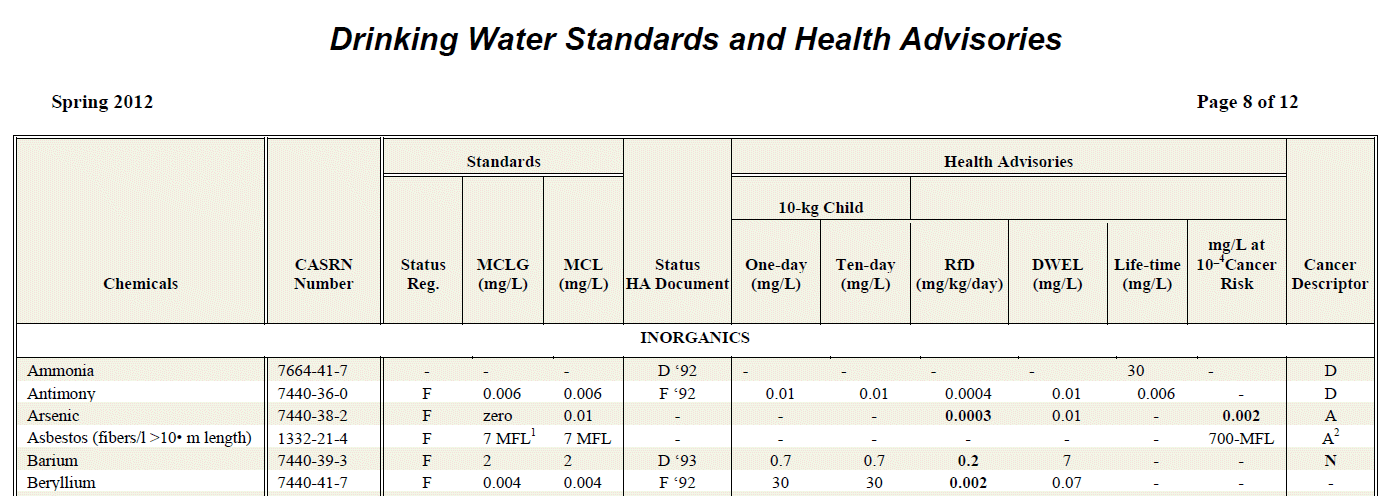
Not to complicate this, bu arsenic is a carcinogen so when we look at the risk of arsenic in drinking water, it is based on non-cancer DWEL (0.01 mg/L) and 1 in 10,000 cancer risk (0.002 mg/L) as follows:

Source

Since these posts are about the reference dose (RfD), I am going to ignore the cancer risk for now.

The formula for the DWEL is:

Source
For arsenic, this would be calculated as follows:
  • (0.0003 x 70)/2 = 0.0105 mg/L or 0.01 ppm or 10 ppb

The MCLG is therefore 20% of that amount, or 0.20 x 0.01 = 0.0021 mg/L.  However (there is always a however) because arsenic is a carcinogen, the MCLG is set at "zero."  The MCL is set at 0.01 which the EPA believes is a reasonable concentration that a water system can treat down to based on current technology and be considered "safe"  Notice how the MCL is set at the DWEL.

For arsenic, we want to see zero but that's not feasible for all drink water suppliers, so an acceptable level of arsenic is deemed to be 0.01 ppm.

So back to the original dead horse statement/question:
If the foundation behind what we consider "safe" is a risk calculation that produces a number expressed in ppm or ppb, how confident are we in the variables used the calculation? 
 For a non-carcinogen, to accept the MCLG one must accept the DWEL.  To accept the DWEL, one must accept the parameters and the values used.  There is little controversy regarding the weight of an adult/child nor on the amount of water consumed, they are averages based on what we have found to be true in the population.  So the only parameter in question, the only value that is paramount is the RfD.

If the "safe" level is to be derived then the RfD must be as bullet proof as possible.  This, is where the fun begins.  The RfD is:
An EPA estimate, with uncertainty or safety factors built in, of the daily lifetime dose of a substance that is unlikely to cause harm in humans. (1)
Let's look at perchlorates for example:
Perchlorate was discovered by the [EPA] in private drinking water wells in a portion of the Deep Creek area of western Spokane County in early 2006. Since that discovery, EPA has sampled additional wells and continues to find perchlorate at low levels across the study area. The perchlorate levels range from non-detected to 3.2 micrograms per liter (ug/l). These levels are not considered an immediate health risk.
For the EPA to make that claim, it had to be based on something...
There are no federal or Washington State drinking water standards for perchlorate. However, EPA uses a 24.5 ug/l perchlorate drinking water equivalent level (DWEL)1 as a preliminary remediation goal (PRG).
You can see why I beat this dead horse.  If the clean up goal is based on the DWEL and the DWEL is based on an "EPA estimate, with uncertainty or safety factors built in, of the daily lifetime dose of a substance that is unlikely to cause harm in humans." that "estimate" better be solid.

For perchlorates, is it solid?
EPA completed its draft toxicological review of perchlorate in 2002, and proposed a reference dose (RfD) of 0.00003 milligrams per kilogram per day (mg/kg/day) based primarily on studies that identified neurodevelopmental deficits in rat pups. 
So 0.00003 mg/kg-day was derived based on a "maternal exposure to perchlorate" that saw "neurodevelopmental deficits in rat pups" The EPA then finds:

Subsequently, NAS [National Academy of Science] reviewed the health implications of perchlorate, and in 2005 proposed an alternative reference dose of 0.0007 mg/kg/day based primarily on the Greer et al, 2002 study. 

Why the increase in what was deemed an acceptable dose (0.00003 to 0.0007)?  Instead of rat pups, we now had data on humans. 

During that study, 37 human subjects were split into four exposure groups and exposed. Significant decreases in iodide uptake were found in the three highest exposure groups. Iodide uptake was not significantly reduced in the lowest exposed group, but four of the seven subjects in this group experienced inhibited iodide uptake. The RfD proposed by NAS [0.0007 mg/kg-day] was accepted by EPA and added to its integrated risk information system (IRIS) in 2005.
So based on one study [Greer] involving 37 human subjects, the RfD is calculated at 0.0007 mg/kg-day based on Iodine uptake.

Is that enough to mandate a cleanup level for a site contaminated with perchlorates?  Well, whatcha got that's better?  You see, that's all we have to go on.  Small studies, most of the time based only on animals.  How confident are we that 10 ppb of arsenic is safe?  That 5 ppb of perchlorates is safe?  If you factor in just how low the dose is that caused the adverse health effect, and then take in the fact that the dose is made even less due to uncertainty, the level we deem is safe is very protective of public health.

That's how it works.  That's how we beat that dead horse,  The question now becomes, how certain are we of the certainty of the RFD.

Next post: RfD and Consensus...Part 3


.

Sunday, July 15, 2012

RfD and Consensus...Part 1

I recently added a section called "consensus" to the Wikipedia page on "Reference Dose."

Yeah, that's what I do for fun.

I was looking for some supporting information to help me put my AHMP presentation together and came across an EPA memo titled:
WASHINGTON STATE DEPARTMENT OF HEALTH’S EVALUATION OF EPA’S PERCHLORATE DRINKING WATER PRELIMINARY REMEDIATION GOAL (PRG).
Back to the question of "safe" is it?  Here is what the memo says about perchlorates found in the Deep Creek area in the state of Washington:
There are no federal or Washington State drinking water standards for perchlorate. However, EPA uses a 24.5 ug/l perchlorate drinking water equivalent level (DWEL) as a preliminary remediation goal (PRG). 
In looking at how perchlorates enter into the human receptor, EPA has decided that the predominate way would be through drinking Deep Creek water which has perchlorate contamination.

Though there is no MCL - "maximum contaminant level" - for perchlorates, the EPA uses the DWEL - "drinking water equivalent level" to establish a "safe level" of perchlorates in the water that may be consumed.

The DWEL is the basis for establishing the MCL, so this is a reasonable approach   The DWEL is calculated for non-carcinogens and uses the reference dose (RfD).

The DWEL, therefore, is defined by EPA as:

"a drinking water lifetime exposure level, assuming 100% exposure from that medium, at which adverse, noncarcinogenic health effects would not be expected to occur."
When the EPA establishes the "safe" level of a contaminant in drinking water it bases it on the "lifetime health advisory" derived as follows:

The Lifetime HA for the drinking water contaminant is calculated from its associated Drinking Water Equivalent Level (DWEL), obtained from its RfD, and incorporates a drinking water Relative Source Contribution (RSC) factor of contaminant-specific data or a default of 20% of total exposure from all sources. 
As you can see, the RfD is the foundation upon which all these "safe" levels are derived.

Where we have confusion is when we compare a concentration in one media - such as apple juice - with the regulatory level established for drinking water.  Without an understanding of the RfD for non-carcinogens and risk factors for carcinogens, comparing what is found in the apple juice to what is acceptable in drinking water will make the apple juice appear to be tainted.

Case in point.  From the Dr. Oz Website: 

In 2006, the Environmental Protection Agency (EPA) enacted a stringent health standard with respect to arsenic levels in drinking water, stating concentrations should not exceed 10 parts per billion (ppb). Interestingly, the actual goal for arsenic exposure from drinking water, what is termed the maximum contaminant level goal (MCLG), is zero ppb. That bears repeating – the goal is no arsenic in our drinking water. The 10 ppb level is simply as close as we can reasonably get considering our natural exposure to arsenic in the environment and other limitations. At that level, almost all experts agree our drinking water is quite safe.
So if our drinking water is "quite safe" why say this right after?

Shouldn't the same goal or, at the very least, similar science-based exposure guidelines, be in place for the juices we commonly give to our children?
It is, in my opinion, due to a disconnect in how a "safe" level is derived, a disconnect on how the the RfD is calculated, and a disconnect in how a "goal" and "risk" are different.

Let's look at benzene, for example. 

Source
Now benzene is kind of an odd bird, which makes it a good example on how this works.
Because benzene is considered a human carcinogen, there may be some degree of carcinogenic risk even below the MCL. Based upon EPA calculations, the EHP estimates that drinking water containing 5 ppb benzene would be associated with an increased lifetime risk of cancer in the range of between two and eight in one million (2 to 8 excess cancer cases in 1,000,000 people exposed). This estimate is based on a daily intake of two liters of water per day for 70 years. (1)
For this reason - carcinogenicity - benzene is given an MCLG of "0":
MCLG: Maximum Contaminant Level Goal. A non-enforceable health benchmark goal which is set at a level at which no known or anticipated adverse effect on the health of persons is expected to occur and which allows an adequate margin of safety. (2)
The EPA has also developed a toxicity value (Reference Dose or RfD) for non-cancer effects based on a human study.

A decrease in cells which are vital to immune system function (lymphocytes) was the most sensitive effect of several measured blood parameters. The adult drinking water equivalent level (DWEL) for this RfD is a benzene concentration in water of 140 ppb - 0.14 mg/L - ppm.
The benzene DWEL, which is the "lifetime exposure level assuming 100% exposure from that medium," is 0.1 mg/L.  This is based on the following formula:

Source

Plugging the RfD into the formula, we get:
DWEL (mg/L) = (0.001 x 70) / 2 = 0.14 mg/L = 0.1 mg/L or "ppm"
Because we know that there is a risk of cancer, the MCLG is set at zero.  Because we know that zero is unattainable, and we know that there is also a non-cancer risk, we can set the legally enforceable MCL for benzene at 0.005 mg/L or 5 ppb.

When Dr. Oz posts:
Interestingly, the actual goal for arsenic exposure from drinking water, what is termed the maximum contaminant level goal (MCLG), is zero ppb. That bears repeating – the goal is no arsenic in our drinking water. The 10 ppb level is simply as close as we can reasonably get considering our natural exposure to arsenic in the environment and other limitations. At that level, almost all experts agree our drinking water is quite safe.
He is acknowledging that the current standard for arsenic is safe even though the goal is zero.  This is the same with benzene and all the other carcinogens.  We want zero, it is safe at the MCL.  Why is it safe?  Because the MCL and MCLG is set lower than the DWEL:
The MCLG is then derived by considering other known or potential sources of exposure, using the relative source contribution (RSC) factor.
  • MCLG (mg/L) = DWEL x RSC
    The RSC from drinking water is based on actual exposure data, or, if data are not available, a value of 20% is assumed for effects based on lifetime exposure. This allows 80% of the total exposure to come from sources other than drinking water, such as exposure from food, inhalation, or dermal contact. For the few MCLGs based on adverse effects related to exposure in children, an RSC of 100% was usually applied because the source of exposure for the critical study was drinking water. However, in more recent assessments, even when actual data from other sources are available, EPA uses a maximum RSC value of 80% to allow for potential unidentified sources. (3)
    In other words, for a chemical such as benzene, a non-cancer RfD is established that generates a DWEL of 0.14 mg/L.  That DWEL is then multiplied by about 0.8 (80%) to compensate for all the other ways the chemical gets into the receptor.  For benzene, however, the MCLG is set at zero and the MCL - the value set as close to the MCLG as feasible using the best available analytical and treatment technologies and taking cost into consideration - is set at 0.005 mg/L.
    • We consider the DWEL safe because it is based on the RfD.
    • We consider the RfD acceptable because it is based on "an estimate (with uncertainty spanning perhaps an order of magnitude) of a daily oral exposure to the human population (including sensitive subgroups) that is likely to be without an appreciable risk of deleterious effects during a lifetime." (3)
    • The MCL is less than the DWEL
    • The MCLG can be less than the MCL and is set at "zero" for carcinogens.
    How low can you go (/queue music)

    All the way to zero.

    Which brings me back to my original question of the RfD.  If the RfD is the foundation, how confident are we in the number we are using?  As the EPA writes:
    A change in the RfD could lead to a change in the MCLG and thus possibly also in the MCL. (3)
    A good read on all of this can be found here.

    Next post: RfD and Consensus...Part 2


    .

    Sunday, July 8, 2012

    Reference Dose: The foundation of Risk

    I am getting ready to prepare my presentation "Apples, Arsenic, and Risk" for the upcoming 2012 AHMP conference in Alaska September 9 -13 in Anchorage. I wrote a lot on this topic in previous posts and need to pare it down (pun intended).

    One of the most difficult parts of preparing a presentation is finding the starting point from which to tell your story. I can't just stand up there and whine about Dr. Oz and Chuck Norris. Nor can I present a bunch of facts and figures to prove my case. Boring. I get one shot at this, and I need to make it work.

    So, where to start and what to build is where I am in July. I know the story's end, I know the moral, how do I tell it for Environmental Health Safety Professionals who depend on the very information I am going to present but know little about how it works without being condescending, preachy, or uninteresting.

    Sure they understand risk, and regulatory compliance concentrations, and clean up levels, but do they understand why other than that is what they are told - or - what some formula spits out?  Why do we set the limit at 10µg/L for arsenic in our drinking water, 5 mg/L for the level of arsenic in our waste, 0.018 µg/L for ambient water quality criteria, 0.3 mg/L for arsenic in storm water, and 23 µg/L for arsenic in our fruit juice?

    We are dealing with the same chemical, yet depending on where we find it, the values assigning the risk change.  As well it should. It is deemed "safe" if it is below the threshold depending on where we find it and what receptor (animal/plant/human) will be exposed to the arsenic, how much (dose), and length of time exposed (acute/chronic).

    We draw a line in the sand and say "safe" or "presents a risk."  That line in the sand is drawn from a formula that looks at the length of time exposed as well as how the chemical will enter into the receptor. Since I am interested in protecting human health, the receptor will be based on that.

    That formula - for humans - is based on the concept that there is a daily level at which we do not expect harm to take place over a lifetime.  This is what we call the "reference dose" or "RfD."
    RfD: An EPA estimate, with uncertainty or safety factors built in, of the daily lifetime dose of a substance that is unlikely to cause harm in humans.
    The foundation for risk for all chemicals that are suspected to cause harm to human health are based on this concept.  You must accept that concept - that there is an amount that we can consume every day for a lifetime - of a risk that is unlikely to cause harm in humans.

    I've discussed this concept a number of times in previous posts.  This is how we do it in the United States. We set thresholds based on a formula of what we think might take place using a value that we have determined is a "safe" level if there is uptake into the receptor.

    When the FDA says that 23 µg/L for arsenic is the maximum "safe" level in our fruit juice it is basing that level on the amount of juice to be consumed that would be put into the human receptor.  Therefore, if consuming juice - normally - over a lifetime, it would be “unlikely” to cause harm from arsenic.

    When folks like Dr. Oz, Consumer Reports, and Chuck Norris compare the amount of arsenic found in apple juice to the amount of arsenic deemed safe for drinking water - the MCL - they are forgetting that the MCL and FDA concentration deemed "safe" are based on the same foundation; the RfD.  What is different in these two values is what is considered to be "normal" uptake. We drink more water than apple juice therefore we can consume more arsenic in the apple juice and remain safe.

    Why are the two values different?

    Because the RfD states that there is "daily lifetime dose of a substance that is unlikely to cause harm in humans."  Consume less than the RfD and there will "unlikely" be harm.  It is all about the RfD and the dose that delivers that RfD, and the length of time you will be exposed to that dose.

    Chemical Exposure is similar to wealth, only the inverse.  If it takes $2.00 to buy a cup of coffee and you have no money or $1.99, you are in the same predicament - you will have no coffee.  Same goes with chemicals.  If the RfD concept is to be our foundation, then we have to move away from "less is better" and move toward a threshold based on uptake into the receptor.  Below that concentration in the matrix we are exposed to, we are fine.

    Which brings us to another question.  If the foundation is the RfD, then how confident are we in the RfDs we have established?


    Next Post: RfD and Consensus


    .

    Sunday, June 10, 2012

    Typical...just typical. No, but really...typical

    For those of you who don't spend their time as a full-time instructor/trainer, let me tell you about a typical day.  A typical day, just like I had today.

    I teach 8-hour classes.  Last week I did a full week of 8 hour classes, so about 40 hours of training, plus travel and prep to set up the class.  We got back late Friday so I was unable to get my next class - which starts at 0800 Monday, set up during "normal" business hours.

    When you walk into a training class, there is often a bunch of prep work that went into it.  Some classes are easy, show up a half hour early and setup and go.  But this weeks class, one I do to prep folks to sit for the REM or CHMM exam, takes a bit of work to get ready.

    Those who are attending this class are usually a little nervous because of the exam they will often take on Friday.  So having everything laid out and up and running so it starts well sets the tone for the rest of the week.

    So I get to the training room, which has been moved to a different building and will involve carting my stuff from one location about a quarter mile away.  Got it, was prepared for that opening the door.  But the training gods were in a particular feisty mood today and decided I needed a bit of extra effort on my Sunday.

    First, the room had been arranged for a party, so the tables and chairs had to be moved and rearranged.

    Next, the computer says "windows has been updated, you must restart your computer."  OK.

    Computer comes back on, "Adobe Flash has been updated, you must restart your computer."  Really...OK, one more time.

    With the computer updated, I try to access my files, which requires me to log in.  Only it will not take my username or password.  My power point files, which are on the main comp, are not available for the class that starts Monday at 0800, which, as a state agency, is before our computer nerds get in and man the help desk.  Off to get my backup computer which is arranged so that the fixed cords which are all nice and neat and bundled together will not reach the slots on my comp.

    I'll get the coffee ready to go, no coffee.

    Books have a few pages that need to be replaced with current info.  Go to print and they have the copy machine locked up in a room.  Aha!  I know a workaround.  I can sneak through the registration office door and into the admin room where a copy machine is.  Two can play this game!  What, the door is locked, when did they start locking that door?

    No big deal, I can send the print order to the printer in the building I normally train in.  ...and print!.  Drive to that building, unlock the door, go to copy machine, and "Tray D is out of paper".  Load paper.  Done.  Look for three-hole punch, no where to be found.  Place a few single sheet handouts on the copier, press copy, and 30 sheets of barely readable stuff comes out.  No biggie, I can print them Monday at break.  Typical.

    Drive back to the classroom and look for a three-hole punch.  There are two.  One is old and the other looks like it was made when Texas A&M was started in the 1870s.  I'll try the "newer" one.  Funny thing about three-hole punches, they often don't like to let the paper slide under the punch.  Bang on the handle - slide the paper under, adjust the margins, press the lever down...  Funny thing about three-hole punches, they often don't like to let go of the paper once the hole is punched.  Bang it on the desk, one, two, three times the charm.  Paper comes out, and there are only two holes, not three.  Off to get the antique one.

    The prehistoric three-hole punch seems to work without a problem,  Place the paper in, push the lever down, and presto!  Three holes.  Only the holes are too small in diameter for the notebooks I am using.

    OK, we will push that task off for Monday while I go looking for a real three-hole punch.  I know we have one, because I bought a real one - that works for my program a number of years back.  Only thing is, I recently decided not to horde it and thought it would be better to share it.  Someone has my three-hole punch.  Don't make me go all Milton on you my fellow workmates!

    Argg.  Typical...just typical

    Well, at least the air conditioning was working today.  Then again, there is always tomorrow.