Showing posts with label Mobil Chemical. Show all posts

Monday, December 24, 2012

The Village of DePue: "A" is for Arsenic - Part 7

T'was the day before Christmas...
And I'm looking at sample data.

Last post I looked at all the 125 samples collected in OU-4.  These samples I surmised, represented the potential exposure for the people who live in DePue.


Yellow = Chemicals of Concern for public health.  Red indicates the highest concentration found that exceeds the soil screening level for residence chronic health.  If the highest value is not in red, there were no samples that exceeded the SSL and those sites do not pose a human health risk for that chemical at that concentration.

I found that seven of the contaminants exceeded the screening level threshold.  That being the case, I need to look to see how many samples exceeded it and if that exceedance elevates my concern for a risk to public health.

The one that caught my eye was arsenic.  If you are going to make a statement of "way-above-normal concentrations" that one might fit the bill.  What's important here is to see how many of the 125 soil samples from OU-4 exceed the Soil Screening Level (SSL).

So I go back to the Excel file, sort on arsenic, and...they all do!

Well that can't be right.  No where have I read that arsenic was a chemical of concern for this site.  Yet all 125 samples are above the screening level establish for inorganic arsenic!

In 1992 - before any cleanup had begun, the Illinois EPA said this about the site:
All residential soil samples showed elevated levels of cadmium when compared to samples taken in Tiskilwa. All but two samples showed elevated levels of zinc. Thirteen samples showed elevated levels of barium. Other samples showed elevated levels of arsenic, lead, copper, mercury, and selenium.
Okay, so arsenic is identified there.  But they go on to say:
Many of the contaminants are naturally occurring in soil at lower concentrations. Based on this first round of sampling, cadmium appears to be the main contaminant of concern.
Wait...cadmium is the main CoC, not arsenic?  Okay...so if cadmium is elevated and it is being dispersed in dust, then one would expect the other metals to follow along with it.  But we have only 26 that are elevated for cadmium, with the average concentration at 91 mg/kg - which is very close to the cadmium SSL of 70 mg/kg.

Something isn't right here.  I would think the Illinois EPA would be making much more of a concern over arsenic and chromium since the SSL is exceed considerably for both those compounds.  Why focus on cadmium?

Oh..."many of the contaminants are naturally occurring in soil."

What are the screening levels for arsenic and chromium based on?  Cancer (ca).

Oh yeah...carcinogens are calculated differently.  If you will recall from previous posts, cancer risk is based on the number of excess cancers we are willing to accept.  In the case of soil screening levels, the cancer risk plugged into the formula that spits out that number uses a value of one additional cancer in one million cancers (1.0E-6).

Source

This creates a problem for us.  Our formula that calculates a SSL does so based on the parameters and values we assign.  If we tell it to spit out a SSL for a contaminant we classify as a carcinogen, it will use the slope factor and the target cancer risk of 0.000001.  Here is what those calculations look like:

Source

Aren't you glad the computer does those calculations for you?  Trust me on that one.  I had to do these by Excel which is way easier than the poor chaps who had to do them with a paper and a calculator.

Don't get bogged down on those formulas.  What I want you to see is that these calculations use the cancer slope factor (CFO) and the target cancer risk (TR) of one in one million in their calculation of the soil screening level.  If you want to know more about the cancer slope factor see my previous posts.

So...based on these two parameters, CFO and TR, we get SSLs that are very...very...very low for suspected carcinogens.  They are that low because our margin of safety is less than one additional cancer in one million over a 70 year lifetime - based on a theoretical dose from the cancer slope factor.

The point is, our SSL for aresenic is lower than what our background exposure to that compound will be.  Arsenic and chromium are natural elements (yes, I know chrome VI is not, I used the most toxic form and assume that all of the chromium they detected is chrome VI).  In other words, what we theoretically want to see is not the reality of the world we live in.  In this case, we can ignore the calculated SSL and set the SSL to background.

That's what California does:

Source

And that's how the Illinois EPA does it as well:
IL EPA Soil Background Level: The standards used to compare soil samples are the Illinois EPA's background concentrations of inorganic chemicals in counties outside metropolitan statistical areas, as published in Section 742 Appendix A, Table G of Title 35 of the Illinois Administrative Code (starting on page 89 of this document). The standard states that "For each parameter whose sampling results demonstrate concentrations above those in Appendix A, Table G, the [responsible party] shall develop appropriate soil remediation objectives in accordance with this Part." The Illinois EPA considers these background standards an appropriate measure by which to compare soil samples.
That came from the Cleanup DePue's website.  Table G looks like this:

Source
...and with that table, as well a MCLs, we get a whole bunch of confusion as to what level is "safe."  The Cleanup DePue webpage writes:
The standard states that "For each parameter whose sampling results demonstrate concentrations above those in Appendix A, Table G, the [responsible party] shall develop appropriate soil remediation objectives in accordance with this Part." The Illinois EPA considers these background standards an appropriate measure by which to compare soil samples.
I'll need to look into that statement.  If that is what it states, then it is looking at risk incorrectly when requiring a cleanup plan be developed.  And since this is a Superfund site, there's this thing we call ARARs that are taken into consideration.  Oh goody.  Looks like I will be posting into the double digits before I get through with this series.


Next post: The Village of DePue:  Mmm....TACOs  - Part 8


Sunday, December 23, 2012

The Village of DePue: Looking at red dots - Part 6

In the Chicago Tribune news article that started this series of posts, my eyes sent a signal to my brain when I read this:
But many say the involvement of Northwestern University's Environmental Advocacy Center — which is providing DePue with free legal representation — has given them some much-needed clout and could help the town finally realize its goal of eliminating or containing the contamination.
My brain told me that something must be happening there in DePue if Northwester University's Environmental Advocacy Center has gotten involved.

Now I know nothing about Northwestern University or their advocacy center.  My interest was piqued because they - a university - had gotten involved, and, that involvement was with a center that had the term "environment" in its name.

"University" plus "environment" equals "you got my interest."

So when I then read this:
"All the complaining we've done, we've learned that there's good reason for us to be worried about the type of cleanup we get here."
...I'm wondering what the heck is going on in DePue?

I work in the environmental field and I have worked for a plethora of private companies and governmental organization that deal with remediation and site cleanup.  I also have worked for hundreds of companies that are guilty of past behavior - the ones who get tagged as Potentially Responsible Parties (PRPs).  I know how my industry - including the regulators - behave in this type of situation where contamination from previous activities - legacy property - has initiated a cleanup order.

I know how it works.  I know the sampling that must be done.  I know the qualifications of the guys who collect and analyze and interpret the results.  They are not perfect, and they get it wrong, but the overall methodology does not leave too many stones unturned.  There is tons of data from these sites and everything is made available for public feedback.

So with that in mind, my curiosity piqued, and reading "we've learned that there's good reason for us to be worried about the type of cleanup we get here,"  I set out to see for myself.

I don't see anything to be worried about...yet.

According to the Press Release that appears on the Cleanup DePue organizations website, these folks contend:
The slag and waste left behind continue to leach heavy metals and carcinogens into ground water that runs off into Lake DePue, which flows directly into the Illinois River. Contaminated debris blows onto public and private property throughout the village and surrounding natural areas, exposing residents -- more than a quarter of whom are children under the age of 16 -- and local wildlife to arsenic and heavy metals such as lead, mercury and cadmium. Visit www.CleanUpDePue.org to see an interactive map that details the way-above-normal concentrations of pollutants at hundreds of contaminated sites.
I went looking for these "way-above-normal concentrations of pollutants at hundreds of contaminated sites."

I am giving the Cleanup DePue folks the benefit of the doubt by not dismissing their claims.  I don't automatically think their  "just a bunch of hicks out here crying about our town being contaminated."  With Northwest University involved, and being told in the Press Release:
The map shows the location for 1,976 samples taken by the companies over the past several years, exactly which contaminants were found in each sample, and the health risks of residents’ prolonged exposure to these contaminants. The website and map were built under grants from the Initiative for Sustainability and Energy at Northwestern (ISEN) and the Environmental Chemical Sciences Program of the  National Science Foundation's Division of Chemistry, Northwestern University Chemistry student interns worked over six month to analyze, interpret, and enter the data that you see on the map." 
...I'm thinking I hit the goldmine in being able to use viable data to support a claim of risk.

The Press Release tells me there is an  "interactive map that details the way-above-normal concentrations of pollutants at hundreds of contaminated sites," and that map was put together with funds provided by the University and the National Science Foundation, and "Northwestern University Chemistry student interns worked over six month to analyze, interpret, and enter the data that you see on the map," I'm looking a good, sound, peer reviewed, scientifically valid information.

I started writing Post Number 1 because of what I know about the industry - my industry - and the claim that "we've learned that there's good reason for us to be worried about the type of cleanup we get here."

What did they learn?  What are they being told?  Does that data Northwestern University "worked over six month to analyze, interpret, and enter" into the interactive map detail "the way-above-normal concentrations of pollutants at hundreds of contaminated sites."

My last two posts dealt with Mr. Garcia, a science teacher at DePue High School "who had his class sample soil and water to document unsafe concentrations of pollutants."  I looked at this data.  Nothing that even comes close to "way-above-normal concentrations."

Now it's time to look at the rest of the data.  I have looked at a few of the red dots on the map already:


 Now I would love to spend my two days before Christmas looking at all those red dots.  Even I'm not that nerdy to do that.  Instead, I'm going to bias my chance of finding a "way-above-normal concentration" somewhere close to where the contaminated sites are.

Once again.  I do not care about what is on the contaminated site.  I only care about what comes off that site and the exposure level the folks in DePue are forced to live with.  If you tell me that there is "way-above-normal concentrations" present then I expect to see them.  "Way-above-normal concentrations" would be an indication of exposure and we could estimate the risk of a health affect from the contaminants these folks are exposed to.

That's how we do it.  We are looking to estimate the dose that is being received by the people who live in DePue.  "Way-above-normal concentrations" would indicate a dose that could be "jeopardizing the health and well-being of the children, families and wildlife in DePue.”

So where should I start looking...

Here is what we know about where the contaminated property is located and its proximity to where people live.:

Source
OU-1: South Ditch Contaminated Sediments
OU-2: Phosphogypsum Stack
OU-3: Former Plant Site Area (FPSA)
OU-4: Off-site Soils
OU-5: DePue Lake Sediments and the Flood Plain

From the map above, it looks like samples from OU-4 represent the concentrations for contaminants that DePue folks would be exposed to.  What I find there - where people live, work, and play - would support the claim:
"Contaminated debris blows onto public and private property throughout the village and surrounding natural areas, exposing residents -- more than a quarter of whom are children under the age of 16 -- and local wildlife to arsenic and heavy metals such as lead, mercury and cadmium."
Mr. Garcia's samples did not support that claim.  So what did they find in the soil samples collected where people live?  I expect the contamination in OU-2 and OU-3 to be "way-above-normal concentrations."  I need the concentrations to be below soil screening levels in the areas where people live.

Wait a minute!  The website allows me to download an Excel file that has all the soil sampling data that has been collected!  I can look at it all.  Less bias on my part, less randomness, less leaving something out.  Cool!

I can then look at all the samples for OS-4 and find out which samples have the highest concentrations of the 12 contaminants Mr. Garcia looked at.  I don't care about potassium, sodium, manganese, pH, or anything else.  I want to look at the metals we normally consider toxic - the RCRA 8 and copper, nickel, and zinc, but I'll list the others simply because they are there.

I am also going to assume that the values entered into this spreadsheet are in mg/kg - ppm concentrations.  Looking at OU-4 data, I have 125 individual sample results.

So here is what I found:


Yellow = Chemicals of Concern for public health.  Red indicates the highest concentration found that exceeds the soil screening level for residence chronic health.  If the highest value is not in red, there were no samples that exceeded the SSL and those sites do not pose a human health risk for that chemical at that concentration.

So...life would have been a heck of a lot easier for me if they were all less than the screening level.  I could have ended this series of posts with a brief statement of no concern.  But some of the OU-4 samples did come show a concentration above the screening level.  How much higher will determine my concern.

Source
Before we get into this, a little reminder about the generic soil screening levels I am using:
The generic SSLs [are] calculated from the same equations used in the simple site-specific methodology, but are based on a number of default assumptions chosen to be protective of human health for most site conditions.  Generic SSLs can be used in place of site-specific screening levels; however, they are expected to be generally more conservative than site-specific levels. (Page 3)
Because I am doing this research in real time, I am writing about what I see and what I find out.  It would be easy for me to ignore things, such as the Thallium, but I want my work to stand scrutiny.  If it cannot be explained then more work will need to be done.  I am trying to provide information as well as support the claim that there are "way-above-normal concentrations of pollutants at hundreds of contaminated sites."

So far we have levels for some chemicals of concern (in red) that exceed the generic SSL.  I need to pause here and change my initial assumption that there is nothing to worry about based on Mr. Garcia's samples.  There are sample sites where the townsfolk of DePue have access to that appear to exceed the level that is accepted to be protective of public health.

The question I need to ask now is; "do any of the seven chemicals in red that exceed the SSL pose a health risk at that concentration?"  If yes, how many locations are at an unsafe level and where are they located?

Dang...two day to Christmas and I am going to be looking at an Excel file.  Maybe there is something there that they see...maybe...


Next post: The Village of DePue: "A" is for Arsenic - Part 7

.

Friday, December 21, 2012

The Village of DePue: I'll take information for $200, Alex - Part 4

According to the "Contamination Map" on the "Clean Up DePue" web page, the two samples collected at the baseball field show:
Contaminants above MCL for drinking water : Iron, Manganese, Sulfate, pH
Clicking on the little red question mark tells the reader that an MCL stands for Maximum Contaminant Level and is the EPA's "level of a contaminant in drinking water below which there is no known or expected risk to health."  The reader is then told that "EPA standards for human health risk in soil are relatively close to those set for drinking water."

No...no they are not.  Why they state that is...well..perplexing, because at the end of the paragraph they write:
Please note: There are no known soil "standards" on a state or federal level; there are only objectives or screening criteria and those vary with the source. EPA drinking water MCLs exist, however they may not be compared directly to the soil concentrations listed on this website.
So what is the reason for posting the data in the first place?  What is the information that the reader - particularly a DePue resident - supposed to think when they read:
  • "Contaminants above MCL for drinking water : Iron, Manganese, Sulfate, pH"
  • "EPA standards for human health risk in soil are relatively close to those set for drinking water.
C'mon, they - Northwestern University's Environmental Advocacy Center - know exactly what message they want the reader - particularly a DePue resident - to come away with.  And if they - Northwestern University's Environmental Advocacy Center - do not understand how data can be misinterpreted then perhaps they should not be the ones to be relied on for their expertise on evaluating the remediation plan.

I know, I know, "they put a note there at the bottom," you might be thinking.  That's the giveaway for me.  They do understand that the secondary MCL has nothing to do with evaluating the risk at the baseball park.  They needed to show something above a threshold, so they choose Iron, Manganese, Sulfate, and pH

And therein lies the problem, it distorts the thinking of the folks who live in DePue:
ExxonMobil and CBS are continuing to minimize the risks to human health and the environment and to set the groundwork for leaving the contaminated waste where it is,” said Nancy Loeb, director of the Environmental Advocacy Clinic at Northwestern University School of Law’s Bluhm Legal Clinic and pro-bono counsel for the Village of DePue. 
With Northwestern University School of Law’s Bluhm Legal Clinic telling the the village of 1,800 residents that the actual risk has been minimized, you can see how easy it is for those citizens to tell the Chicago Tribune:
"All the complaining we've done, we've learned that there's good reason for us to be worried about the type of cleanup we get here."
..and be quoted in the Press Release stating:
“The consent order required the responsible parties to come up with the plan, supervised by the Illinois EPA. I don’t know how to respond to that plan. It’s not even close to what’s needed.” 
What they are being told may - or may not - be a factual/sound representation of risk.  So how can we go about evaluating that risk with the information we do have?  If all we have is groundwater samples and we are told that "EPA drinking water MCLs exist, however they may not be compared directly to the soil concentrations listed on this website," what can we look at to give us an idea if, as per the Press Release:
Contaminated debris blows onto public and private property throughout the village and surrounding natural areas, exposing residents -- more than a quarter of whom are children under the age of 16 -- and local wildlife to arsenic and heavy metals such as lead, mercury and cadmium. 
Let's focus on that concern.  That the contaminants are blowing onto public and private property.  If that statement is true, then we would expect to see these contaminants outside of the fence line.  And, if they are outside of the fence line, they must be in a concentration high enough to cause a health effect.

We can assume that any amount outside of the fence line that falls below a health/environmental threshold is not a concern.  This is how the EPA looks at contaminated property.  This graphic comes from the EPA from the data that the Cleanup DePue website cites:

Source
So you see from the graphic that somewhere between "zero" concentration and this thing called a "screening level" no further study is necessary.  In other words, below the screening level for that contaminant we will consider the site to not present a health concern for the activity that will commence on it.  For the citizens of DePue we will consider the activity to be "residential" use.

So what the heck is a "screening level" and can it be used to determine if the conditions found today are "jeopardizing the health and well-being of the children, families and wildlife in DePue?”

when the reader is incorrectly told by Cleanup DePue that  "EPA standards for human health risk in soil are relatively close to those set for drinking water," that statement is attributed to a document cited as "[2, PDF]."  That EPA publication is called the "Soil Screening Guidance: Technical Background Document."  Now where in that EPA document - I checked - does it imply or state that risk in soil are relatively close to an MCL.

What it does say, in relationship to an MCL, is this:
SSLs are backcalculated for migration to ground water pathways using ground water concentration limits [nonzero maximum contaminant level goals (MCLGs), maximum contaminant levels (MCLs), or health-based limits (HBLs) (10-6 cancer risk or a HQ of 1) where MCLs are not available]. (Page 5)
What that means is the contribution to groundwater contamination through leaching - which is the primary health concern if the groundwater is used for drinking - is considered when establish the Soil Screening Level (SSL).  Even if little Sally will not come in contact with that soil through contact and/or ingestion, the impact on the drinking water that little Sally will drink is considered in setting that SSL.

So once more, what the heck is a soil "screening level?"
SSLs are risk-based concentrations derived from standardized equations combining exposure information assumptions with EPA toxicity data. (1)
So...there is an equation that is used to make this determination of risk.  Cool.  And I know that Mr. "Keith Garcia, a science teacher at DePue High School [had] his class sample soil and water to document unsafe concentrations of pollutants."  And those soil sample results are available on the Cleanup DePue website:

Source

Now that I know the contaminants of concern, I can look to see what the Soil Screening Levels are for those compounds that have been calculated based on residential use of the property.

You know what really cool about being a researcher in the 21st century.  The internet, google and the availability of mathematical formulas to calculate just about anything.  you provide the data and they provide the calculation.  How cool is that!

The EPA just so happens to have a really cool calculator for doing this.  This is based on the methodology put forth in the "Soil Screening Guidance: Technical Background Document" the Cleanup DePue's website cites.

Source

So...I asked it to calculate the Soil Screening Levels (SSLs) for the 12 metals that Mr. Garcia, a science teacher at DePue High School had his class sample for at the baseball field.  Here is what the calculations look like:


Wow, that's a lot of numbers.  A lot of scientifically looking stuff.  A lot of data.  Yeppers, that's what we have here.  A lot of data and no information.  So if you are still reading this...let's get to understanding what it all means.

First, if you recall the definition of a SSL:
SSLs are risk-based concentrations derived from standardized equations combining exposure information assumptions with EPA toxicity data. (1)
...then we need to accept those calculations as sound.  If you have a better way of calculating the concentration that is of concern, then you need to support that method and tell me why it is better than this one.  I am going to assume - warts and all - that the value and parameters used in these calculations is conservative enough to be an indicator of the risk if those levels are exceeded.

That's how we do it.  We public health scientists have agreed to these formulas and parameters.  So the number it spits out; "Screening Level (mg/kg)," is how we will make a determination of potential risk to a resident at this site.  And yes, they take into account exposure of children in these calculations.

With that in place, if the quantity of any of these 12 compounds Mr. Garcia' class sampled at the baseball field exceed the Screening Level, we can assume that a value below that is protective of human health.

At this point - I am writing this as I do the research - I do not know if the 12 compounds at the baseball field exceed the SSLs establish for a resident.  Lets put this data in a more user friendly format to find out:


In looking at the Screening Levels that were calculated for chronic exposure to these 12 contaminants, none of the concentrations found by Mr. Garcia's class in the soil at the baseball field are exceeded.  That's just as I suspected when I looked at them on the website.

This means, that based on one sample collected, assuming that it is representative of the baseball field where children play, the level of contaminants found are low enough to be protective of public health.  Magnesium and Manganese are not public health concerns in soil which is why they are not calculated.

This soil sample, along with the two groundwater samples that were collected, does not support the conclusion of the press release:
Contaminated debris blows onto public and private property throughout the village and surrounding natural areas, exposing residents -- more than a quarter of whom are children under the age of 16 -- and local wildlife to arsenic and heavy metals such as lead, mercury and cadmium. Visit www.CleanUpDePue.org to see an interactive map that details the way-above-normal concentrations of pollutants at hundreds of contaminated sites.
...at least for the baseball field.  I guess we need to look at Mr. Garcia's samples for the other stops on the virtual tour.  If the baseball field does not have concentrations "way-above-normal", maybe somewhere else does.

Next Post: The Village of DePue: Where are they way-above-normal? - Part 5

.

Thursday, December 20, 2012

The Village of DePue: Batter up! - Part 3

At some point a decision must be made.  When it involves a determination of risk, that line we draw in the sand, that line that says "safe," is not always easy to see and even less easy to understand.

I wasn't always this way in my thinking.  In fact, up until about 2008, I would have sided with the folks in DePue.  I would have sided with them because I had not made the jump from making a decision based on the perception of risk to one based on the understanding of risk.

It was not until I entered into the Master's program at Texas A&M's School of Rural Public Health's Environmental and Occupational Health program that the light bulb clicked on.  I have been dealing with hazardous waste and remediation of contaminated sites since 1984 and I did not understand the basic concept of risk for adverse health effects - which is the driver for cleanup levels and remediation plans.

Perhaps it was because in 1984 we were just learning about how chemical contamination effects a population and without a lot of data we assumed that the presence of chemical A equaled the health concern seen when exposure to chemical A took place.  For the bulk of my career, if chemical A was present the assumption was that there was risk.  So for the longest time the remediation method was to remove it.

No chemical A, no risk from chemical A.

But that ignores the basic concept of toxicology, the dose.  In other words, just because chemical A is present, if the dose is not high enough there will not be any adverse health effects.

For years my understanding was this: If chemical A can cause health effect B, then chemical A presents a health risk. In other words, my thinking had been skewed to automatically think that the mere presence of the chemical in the area automatically implies risk.

Enter the Donnelly Risk Paradigm (see this post):


I had been automatically programmed to think chemical = health effect, completely ignoring all the steps necessary to bring about that health effect.  Once I understood this, my focus shifted from perception of harm to trying to actually quantify harm.

So when I say" It does not matter if it is there, what matters is the dose (uptake)" hopefully you will see where I am coming from.  This is the same concept the EPA uses with the toxicity characteristics for hazardous waste.  We do not care how much of the toxic chemical is in the waste.  What we care about is what will come out (release).

That's what the RCRA TCLP is all about.  We assume a material is a hazardous waste if it will release a chemical above a threshold.  We assume that the mere ability to release the chemical presents a risk.  However, in reality, there are three more steps necessary to associate that release with a health effect; transport, exposure, and uptake.  And even if there is uptake, that uptake must be at a high enough dose (unit of chemical to unit of body weight) to manifest the health effect.

Same concept is in play in DePue.  We have a bunch of contaminated sites where a bunch of chemicals know to cause various health effects are present.  Here is the thinking of those behind the "Clean Up DePue" web page:
The slag and waste left behind continue to leach heavy metals and carcinogens into ground water that runs off into Lake DePue, which flows directly into the Illinois River. Contaminated debris blows onto public and private property throughout the village and surrounding natural areas, exposing residents -- more than a quarter of whom are children under the age of 16 -- and local wildlife to arsenic and heavy metals such as lead, mercury and cadmium.
The reason this has become a news story is that a plan has been adopted that these folks at "Clean Up DePue" find unacceptable:
“The companies spent millions of dollars on consultants in an attempt to show that this SuperFund site poses no significant risks, and they delivered a superficial plan that barely touches many of the contaminated areas, leaves the slag pile and other waste in place, does nothing to stop contamination from seeping into the groundwater, and leaves backyards, playgrounds and Lake DePue without real remediation.” 
All of this boils down to this:
“The consent order required the responsible parties to come up with the plan, supervised by the Illinois EPA. I don’t know how to respond to that plan. It’s not even close to what’s needed.” 
So I will ask:  What is needed?

Well according to Mr. Garcia, the science teacher at DePue High School, ExxonMobil and CBS is:
"jeopardizing the health and well-being of the children, families and wildlife in DePue,”
Okay, so now we have a baseline to start with.  At this present time, folks like Mr. Garcia, believe that the current conditions are "jeopardizing" public health.  Therefore, a remediation plan that does not remove the contaminant will continue to jeopardize the health and well-being of the children, families and wildlife in DePue.

So my question is, are the children, families and wildlife in DePue coming in contact with contaminants from the contaminated site that will jeopardize their health?

Enter the data...

In my last post I randomly chose one of the 1,976 samples that were taken that just so happen to also be at the baseball field where Mr. Garcia's science class took a soil sample.  With that data I can make a general statement about the risk for that particular area.

First, we must agree on a few things:
  1. We are going to accept the samples as representative of the area as a whole.
  2. We are going to accept that there is a level of contaminant - a threshold - that "can be tolerated by the organism with essentially no chance of expression of the toxic effect.” (EPA)
We are going to draw a line in the sand...


You must agree to those two concepts before we move on.  If you have a different concept, then let me know.

I am doing this in real time, so I do not know what the data is going to lead me to conclude.  What I do know is that what works for the baseball field is what will apply to all areas where the children, families and wildlife in DePue live, work, and play.

So lets look at the data we have...

Mr. Garcia's science class found:

Source
The "Contamination Map" on the "Clean Up DePue" web page shows two samples that were collected:
"The map shows the location for 1,976 samples taken by the companies over the past several years, exactly which contaminants were found in each sample, and the health risks of residents’ prolonged exposure to these contaminants."
Here is what is shown for location "6" on that map:


Expanding Sample GYP-MW-15LS we see:

Source
Wow...that's a lot of numbers.  Numbers = data.  Data = good.

Okay, that's what we have.  This makes sense to me, but is there anywhere on the "Clean Up DePue" website or the Chicago Tribune article where these numbers are explained?  Oh sure, it states "Contaminants above MCL for drinking water." but it does not explain how that concentration is  "jeopardizing the health and well-being of the children, families and wildlife in DePue,”

If you have read any of my previous posts you should know by now that I hate, HATE, hate it when a threshold is used without explanation or relevance to the situation in play.  I can make sense out of this data and relate it to risk.  But look at it from the standpoint of a non-scientist.  How would a normal person interpret "Contaminants above MCL for drinking water?"  What's that mean to them?  What's their thinking when they click on that little red question mark and read:
MCL: MCL stands for Maximum Contaminant Level and is the US Environmental Protection Agency's "level of a contaminant in drinking water below which there is no known or expected risk to health." EPA standards for human health risk in soil are relatively close to those set for drinking water.  On this website, secondary MCLs (those related to aesthetics such as water taste or smell) which are exceeded are marked in yellow, whereas primary MCLs (those related to health) which are exceeded are marked in red. 
As my wife would say "too many words" or as they say on the website Reddit "Too long, Didn't Read - TL;DR."  What they see, if they look at this data is "Contaminants above MCL for drinking water."  What do you think enters into their thinking when a value exceeds something called a "Maximum Contaminant Level?"

Are the folks who put this web page together being purposely disingenuous or are they just plain ignorant to what those values mean?  I am not using ignorant in a derogatory way here.  I just get a bit annoyed when statements such as  "Contaminants above MCL for drinking water" are used without context or proper explanation.  I do not expect the townsfolk of DePue to understand this, so when I read that they have assistance from Northwestern University's Environmental Advocacy Center, I expect someone at the University level to understand the context and present the information correctly.

And if no one at Northwestern University's Environmental Advocacy Center understands the difference between a health based MCL (Primary) and and Ascetic level (Secondary) then they need to quit advocating for the environment because they are misleading people in believing there is a problem when there most likely is none.

First, it is putting stress into the lives of the people who live in DePue.  Stress is a public health concern.  Second, it is taking money that could be spent actually helping the citizens of DePue and spending it on things that do not and will not benefit the the health and well-being of the children, families and wildlife in DePue,”

But I digress...

Back to the question of risk at the baseball field.  Do those mg/kg and mg/L numbers for all those chemicals mean that the health and well-being of the children, families and wildlife in DePue are being jeopardized?


Next post: The Village of DePue: I'll take information for $200, Alex - Part 4


.

Wednesday, December 19, 2012

The Village of DePue: Data and Context - Part 2

Now I am an outsider looking in.  Y'all know if you have read my previous postings, that I am skeptical of claims of harm.  Show me the data.  Show me the numbers that support your claim of harm or risk.  If you make a claim that "heavy metal pollution continues to affect the ecosystem of DePue," then show me how this affect was quantified.  If you claim that "prolonged chronic exposure to heavy metals may lead to severe health hazards including neurological disorders and a wide incidence of cancer," then show me the exposure levels the citizens are coming in contact with.  I need numbers people, otherwise its nothing more than anecdotal, speculation, and ignorance driving this train.

Show me the data and I can support your claim that nothing is being done "to stop contamination from seeping into the groundwater, and leaves backyards, playgrounds and Lake DePue without real remediation.”  Show me what you have and I will be on your side.  I promise.  I want to protect human health and the environment but I have to have something to protect it against.

Right now - and as you are reading this you know as much as I do - all I know about this situation is that there is "a pile of contaminated slag weighing at least 570,000 tons that looms over the main road into town, left behind by a zinc smelter." (1)

Source
What I know is that, but what I am hearing is this:
"It's not like we're just a bunch of hicks out here crying about our town being contaminated," Bryant said. "All the complaining we've done, we've learned that there's good reason for us to be worried about the type of cleanup we get here."
What have you learned and what are those good reasons to be worried?  Whatcha got?  Show me the data!

Mr. Bryant claims that his town is being contaminated.  The "Cleanup DePue" website has issued a Press Release detailing what their issues are.  Here is what it says:
The residents of DePue waited 17 years for the companies responsible for the toxic waste in their village to produce a clean-up plan under a court order they signed. Recently, ExxonMobil and CBS (formerly Viacom) finally divulged their plan -- and their “solution” would turn the central Illinois River town into a permanent toxic waste dump.
Okay, so now a picture is starting to appear.  Some folks in the town of DePue do not like the proposed clean-up plan.  No surprise there.  But will that plan "turn the central Illinois River town into a permanent toxic waste dump?"

And here is where the problem begins.  Remember, I just learned about this on Tuesday, December 18th, 2002.  I have no connection to this site or the parties involved.  How do I "know" what that problem is?  I can read it in their Press Release.  I "know" because it is the same basic problem that crops up over and over in these situations.

Item A contains contaminant B.  Contaminant B may lead to severe health hazards including neurological disorders and a wide incidence of cancer.  Item A therefore presents a risk and must be removed.

Can't argue with that logic now can you?  That's the problem for DePue.  They know there is toxic contaminants in that "pile of contaminated slag weighing at least 570,000 tons that looms over the main road into town, left behind by a zinc smelter."  And they know that the pile of slag was put there by a company owned by ExxonMobil and CBS.  Therefore, and you can see the logic here, ExxonMobil and CBS need to clean up their dang mess!

Simple.

Well not really, because you now have to look at the risk if that 570,000 tons is excavated and moved.

That's where guys like me come in to the equation.  I do not care what is in the pile.  I only care about what comes out of the pile.  And then, I only care about what the people living in and around that pile uptake into their bodies.  I also care about that pile causing environmental damage to the ecosystem, but I want to stick to just looking at public health here, since that's the concern of the press release.

Let me say it one more time:  I do not care what is in that pile - and neither should the citizens of DePue.

So what's the beef they have with the plan?

According to the Illinois EPA Fact Sheet:
In August 2006, the Village posted Notices to Abate Nuisance at the site. The notices ordered Exxon to remove the materials and clean the site of all contaminants to the satisfaction of the Village within ten days. If Exxon failed to comply within ten days, the notices required Exxon to pay a nuisance fine of $ 750 per day until the site cleanup was complete and the site was removed from the NPL. The notices did not define the terms "materials" or "contaminant". In 2007, the Village of DePue filed a complaint against Exxon in Illinois state court, asserting that Exxon had violated and continued to be in violation of the Village's nuisance ordinance. It sought three forms of relief: a judgment declaring that Exxon had violated the ordinance, daily fines of up to $ 750 for that alleged violation and injunctive relief requiring Exxon immediately to clean the site and have it removed from the NPL. Exxon moved the case to U.S. District Court and filed a motion to dismiss the complaint because the causes of action stated in the complaint were preempted by federal and state law. The district court agreed. In 2008, the Village of DePue appealed the District Court's decision to the U.S. Court of Appeals, 7th Circuit and the District Court's verdict was affirmed because the Village's claims are preempted by Illinois law.
The U.S. Court of Appeals found that the DePue's claims are preempted by Illinois law.  Well heck, that sucks.  So they make a move to get around that:
On September 8, 2008, the Village of DePue enacted a new ordinance against hazardous waste, and on November 4, 2008, the Village became a home-rule municipality under the Illinois constitution. The Village filed a new suit in Illinois circuit court, making claims against the PRPs based on the new ordinance. The PRPs moved the case to U.S. District Court, which dismissed the Village's claims because the new ordinance was an invalid exercise of home-rule authority under the Illinois constitution. The Court also dismissed the Village's common law trespass and nuisance claims. The Village filed an amended complaint on July 27, 2009, re-alleging its trespass and nuisance claims under Illinois law. The District Court dismissed this complaint on May 12, 2010. The Village is currently pursuing an appeal.
You can see why they might be a little upset about this. That's why in the article the paper writes:
The village's leaders and residents say they've felt abandoned for years, locked in a three-way struggle with the Illinois Environmental Protection Agency and the two companies responsible for the industrial sites as they seek to have the contamination cleaned up.
On one side you have laws that give you no standing or ability for redress.  On the other side you have guys like me telling them the best thing to do is leave it there.  You can see, or at least I can, how DePue might fell as if they are getting the short end of the stick on all of this.  They are not getting what the want.

Does that make them "just a bunch of hicks out here crying about our town being contaminated?"  Nope.

Are they being forced to accept a remediation plan that "does nothing to stop contamination from seeping into the groundwater, and leaves backyards, playgrounds and Lake DePue without real remediation.”  Not from what I can see - so far.

I am writing this blog in "real time."  That is, I am looking at what is being said and I am looking at the available data to see if it supports either sides contention. One side says it is "safe" and the other side says it is "unsafe."

It is somewhat easy to support "unsafe."  It is much harder to support the assertion of "safe."

So...show me the data that supports the claim that DePue is currently being affected by the materials that will be left in place?  Show me the data to support this statement in the press release:
The slag and waste left behind continue to leach heavy metals and carcinogens into ground water that runs off into Lake DePue, which flows directly into the Illinois River. Contaminated debris blows onto public and private property throughout the village and surrounding natural areas, exposing residents -- more than a quarter of whom are children under the age of 16 -- and local wildlife to arsenic and heavy metals such as lead, mercury and cadmium.
Show me the data...
Visit www.CleanUpDePue.org to see an interactive map that details the way-above-normal concentrations of pollutants at hundreds of contaminated sites.
Really...you got data?  Cool!  I can now see the "way-above-normal" concentrations that support your contention of harm and risk. Data good...data will help me make up my mind.  So...whatcha got?

Source
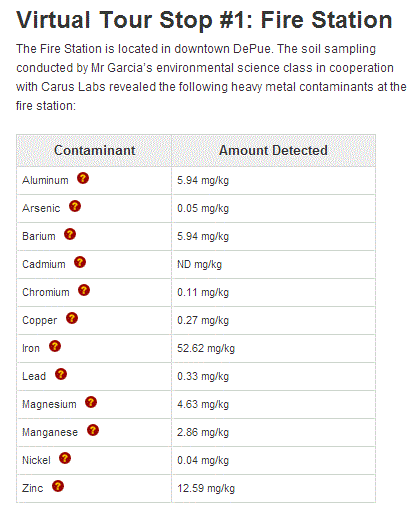
Okay...and what do those values mean in terms of risk?  Maybe that's what the little question mark symbol tells you.

Okay standard worst-case information on arsenic... is there anything written where they describe what was found at the Fire Station to the potential risk associated with that exposure concntration, you know, puts it in context?


That's it?  For each of the five stops where data was collected by Mr Garcia’s environmental science class no one explained what those values mean in terms of risk?  I have five sets of data from five locations presented with a quantity and a blurb about the health effects of each parameter, but there is nothing describing how that quantity relates to potential risk.  C'mon people, you need more than showing a mg/kg value when assigning risk  Am I missing something here?  According to the Press Release:
“We want everyone to know what ExxonMobil and CBS are doing,” said Adeline Gavina, a DePue High School student. Together with chemistry students from Northwestern University and Groundswell Educational Films, DePue students built a website with a virtual tour of their town and the interactive map. The map shows the location for 1,976 samples taken by the companies over the past several years, exactly which contaminants were found in each sample, and the health risks of residents’ prolonged exposure to these contaminants. The website and map were built under grants from the Initiative for Sustainability and Energy at Northwestern (ISEN) and the Environmental Chemical Sciences Program of the  National Science Foundation's Division of Chemistry, Northwestern University Chemistry student interns worked over six month to analyze, interpret, and enter the data that you see on the map."
Maybe that map shows data that I can use to support the DePue claim that thy are at risk.  Okay, so I randomly picked a number on the interactive map.  I chose "6" because it was outside of town.  Well sample location "6" just so happens to be the baseball field when the map zooms in.


According to the Press Release:
...and they delivered a superficial plan that barely touches many of the contaminated areas, leaves the slag pile and other waste in place, does nothing to stop contamination from seeping into the groundwater, and leaves backyards, playgrounds and Lake DePue without real remediation.” 
So I got lucky in choosing the baseball field.  I now have data from sampling performed by the Potentially Responsible Party (PRP) as well as data from Mr Garcia’s environmental science class, "Virtual Stop Number 3."  With that data I can support the finding of potential harm for DePue residence who play at the baseball field.

I can then do the same thing for all the areas outside of the fenced-in contaminated areas.  Remember, I do not care what is in the fence line.  I only care about what is coming out and the amount of contaminants that the DePue townsfolk are exposed to.  With that I can assign risk and support the claim that:
“In determining whether a person is exposed to potentially harmful levels of toxic pollutants, CBS and ExxonMobil are counting each exposure as if it were an isolated incident, and pretending that residents are exposed only to a single contaminant and only in one area of the town. The reality is that children are growing up here, eating from home gardens, playing in parks and ball fields, boating in the lake, and later working and living as adults in DePue. Any realistic assessment of health risks has to take these multiple, constant and long-term exposures into account.” 
That's a valid point they are making.  I wonder if I can do that from the data that is available   I am doing this research real-time at this moment.  I have no idea if the data is there or if I can make a valid risk statement. What I do think I can come up with is a bit of context that is missing from this website.

Just because Chemical A can cause Health Affect B does not mean it will.  It is all about dose.  So my next post will look at the dose anticipated from someone playing all day, everyday, at the baseball field.

We got data baby!


Next post:  The Village of DePue: Batter up! - Part 3